Division of Endocrinology, Department of Medicine, Keck School of Medicine, University of Southern California, Los Angeles, CA, United States.
Keck School of Medicine, Diabetes and Obesity Research Institute, University of Southern California, Los Angeles, CA, United States.
Front Endocrinol (Lausanne). 2021 Mar 31;12:638504. doi: 10.3389/fendo.2021.638504. eCollection 2021.
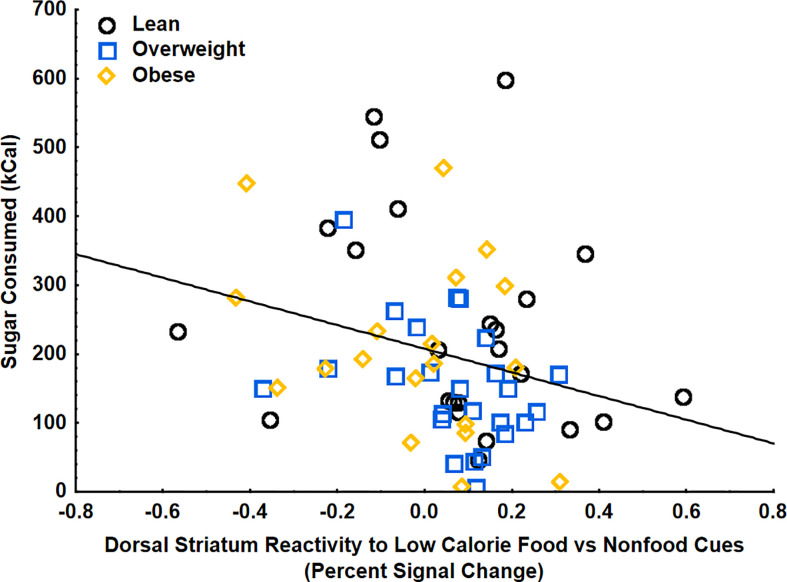
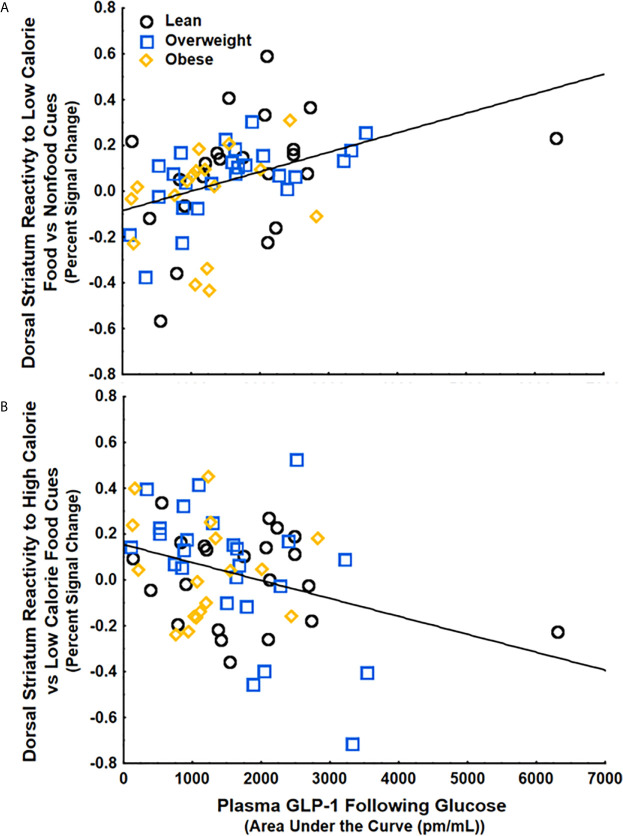
It has been hypothesized that the incretin hormone, glucagon-like peptide-1 (GLP-1), decreases overeating by influencing mesolimbic brain regions that process food-cues, including the dorsal striatum. We previously showed that habitual added sugar intake was associated with lower glucose-induced circulating GLP-1 and a greater striatal response to high calorie food cues in lean individuals. Less is known about how dietary added sugar and obesity may interact to affect postprandial GLP-1 and its relationship to striatal responses to food cues and feeding behavior. The current study aimed to expand upon previous research by assessing how circulating GLP-1 and striatal food cue reactivity are affected by acute glucose consumption in participants with varied BMIs and amounts of habitual consumption of added sugar. This analysis included 72 participants from the Brain Response to Sugar Study who completed two study visits where they consumed either plain water or 75g glucose dissolved in water (order randomized; both drinks were flavored with non-caloric cherry flavoring) and underwent repeated blood sampling, a functional magnetic resonance imaging (fMRI) based food-cue task, and an ad-libitum buffet meal. Correlations between circulating GLP-1 levels, striatal food-cue reactivity, and food intake were assessed, and interactions between obesity and added sugar on GLP-1 and striatal responses were examined. An interaction between BMI and dietary added sugar was associated with reduced post-glucose GLP-1 secretion. Participants who were obese and consumed high levels of added sugar had the smallest increase in plasma GLP-1 levels. Glucose-induced GLP-1 secretion was correlated with lower dorsal striatal reactivity to high-calorie versus low-calorie food-cues, driven by an increase in reactivity to low calorie food-cues. The increase in dorsal striatal reactivity to low calorie food-cues was negatively correlated with sugar consumed at the buffet. These findings suggest that an interaction between obesity and dietary added sugar intake is associated with additive reductions in postprandial GLP-1 secretion. Additionally, the results suggest that changes to dorsal striatal food cue reactivity through a combination of dietary added sugar and obesity may affect food consumption.
有人假设,肠促胰岛素激素胰高血糖素样肽-1(GLP-1)通过影响处理食物线索的中脑边缘脑区(包括背侧纹状体)来减少暴饮暴食。我们之前的研究表明,习惯性添加糖的摄入与瘦个体中葡萄糖诱导的循环 GLP-1 降低以及对高热量食物线索的纹状体反应增强有关。关于饮食中添加的糖和肥胖如何相互作用以影响餐后 GLP-1 及其与食物线索和进食行为的纹状体反应的关系,人们知之甚少。本研究旨在通过评估不同 BMI 的参与者在摄入急性葡萄糖后循环 GLP-1 和纹状体食物线索反应性如何受到影响,来扩展先前的研究。这项分析包括来自糖对大脑反应研究的 72 名参与者,他们完成了两次研究访问,在访问中他们分别饮用了普通水或 75 克溶解在水中的葡萄糖(顺序随机;两种饮料都用无热量的樱桃味调味),并进行了重复采血、功能磁共振成像(fMRI)基于食物线索的任务和自助餐。评估了循环 GLP-1 水平、纹状体食物线索反应性和食物摄入量之间的相关性,并研究了肥胖和添加糖对 GLP-1 和纹状体反应的相互作用。BMI 和饮食添加糖之间的相互作用与餐后 GLP-1 分泌减少有关。肥胖且摄入高水平添加糖的参与者血浆 GLP-1 水平升高幅度最小。葡萄糖诱导的 GLP-1 分泌与高热量与低热量食物线索相比背侧纹状体反应降低有关,这是由于对低热量食物线索的反应增加所致。背侧纹状体对低热量食物线索的反应增加与自助餐中摄入的糖呈负相关。这些发现表明,肥胖和饮食添加糖摄入量之间的相互作用与餐后 GLP-1 分泌的累加减少有关。此外,研究结果表明,通过饮食添加糖和肥胖的组合对背侧纹状体食物线索反应性的改变可能会影响食物的消耗。