Fournier Isabelle B, Lovejoy Connie, Vincent Warwick F
Département de Biologie and Institut de Biologie Intégrative et des Systèmes (IBIS), Université Laval, Quebec City, QC, Canada.
Centre for Northern Studies (CEN), Université Laval, Quebec City, QC, Canada.
Front Microbiol. 2021 Mar 31;12:660719. doi: 10.3389/fmicb.2021.660719. eCollection 2021.
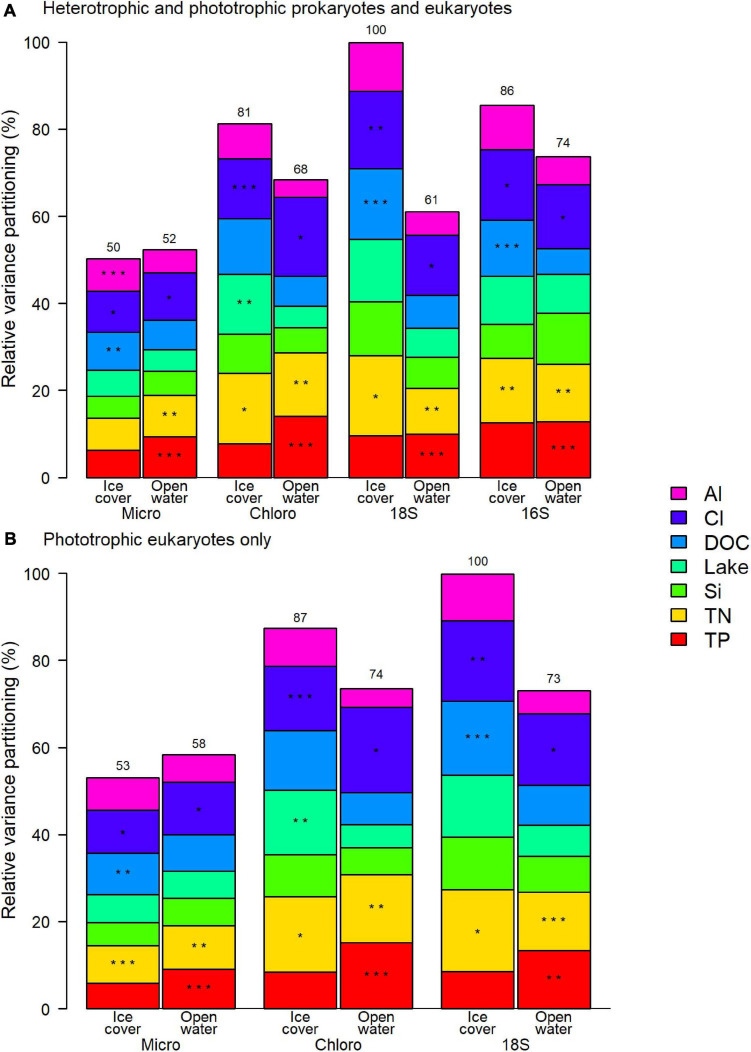
Salinization of freshwater is increasingly observed in regions where chloride de-icing salts are applied to the roads in winter, but little is known about the effects on microbial communities. In this study, we analyzed the planktonic microbiomes of four lakes that differed in degree of urbanization, eutrophication and salinization, from an oligotrophic reference lake with no surrounding roads, to a eutrophic, salinized lake receiving runoff from a highway. We tested the hypothesis that an influence of road salts would be superimposed on the effects of season and trophic status. We evaluated the microbial community structure by 16S rRNA sequencing for Bacteria, and by four methods for eukaryotes: 16S rRNA chloroplast analysis, 18S rRNA sequencing, photosynthetic pigment analysis and microscopy. Consistent with our hypothesis, chloride and total nitrogen concentrations were among the most important statistical factors explaining the differences in taxonomic composition. These factors were positively correlated with the abundance of cryptophytes, haptophytes, and cyanobacteria. Ice-cover was also a major structuring factor, with clear differences between the winter communities and those of the open-water period. Nitrifying and methane oxidizing bacteria were more abundant in winter, suggesting the importance of anaerobic sediment processes and release of reduced compounds into the ice-covered water columns. The four methods for eukaryotic analysis provided complementary information. The 18S rRNA observations were strongly influenced by the presence of ribosome-rich ciliates, but revealed a much higher degree of taxonomic richness and greater separation of lakes, seasonal changes and potential salinity effects than the other methods.
在冬季将氯化物除冰盐用于道路的地区,淡水盐渍化现象日益明显,但人们对其对微生物群落的影响知之甚少。在本研究中,我们分析了四个湖泊的浮游微生物群落,这四个湖泊在城市化程度、富营养化程度和盐渍化程度上存在差异,从一个没有周边道路的贫营养参考湖泊,到一个接收高速公路径流的富营养化、盐渍化湖泊。我们检验了一个假设,即道路盐分的影响将叠加在季节和营养状态的影响之上。我们通过对细菌进行16S rRNA测序,以及对真核生物采用四种方法来评估微生物群落结构:16S rRNA叶绿体分析、18S rRNA测序、光合色素分析和显微镜检查。与我们的假设一致,氯化物和总氮浓度是解释分类组成差异的最重要统计因素之一。这些因素与隐藻、定鞭藻和蓝细菌的丰度呈正相关。冰层覆盖也是一个主要的结构因素,冬季群落与敞水区群落之间存在明显差异。硝化细菌和甲烷氧化细菌在冬季更为丰富,这表明厌氧沉积物过程以及向冰封水柱中释放还原化合物的重要性。四种真核生物分析方法提供了互补信息。18S rRNA观察结果受到富含核糖体的纤毛虫存在的强烈影响,但与其他方法相比,它揭示了更高的分类丰富度以及湖泊、季节变化和潜在盐度效应之间更大的分离度。