Ziubryte Greta, Jarusevicius Gediminas
Department of Cardiology, Hospital of Lithuanian University of Health Sciences Kaunas Clinics, Institute of Cardiology, Lithuanian University of Health Sciences, Kaunas, Lithuania.
Postepy Kardiol Interwencyjnej. 2021 Mar;17(1):33-38. doi: 10.5114/aic.2021.104765. Epub 2021 Mar 27.
The development of interventional cardiology increases the number of invasive procedures which are inevitably associated with increased exposure to ionizing radiation and associated risks. A percutaneous coronary intervention (PCI) substantiated by evaluation of the coronary artery lesion's functional significance is recommended by both European and American cardiologists. Nevertheless, the prevalence of physiology-guided PCIs does not exceed 10% all over the globe.
To identify the physiology evaluation method which is associated with the lowest exposure to ionising radiation.
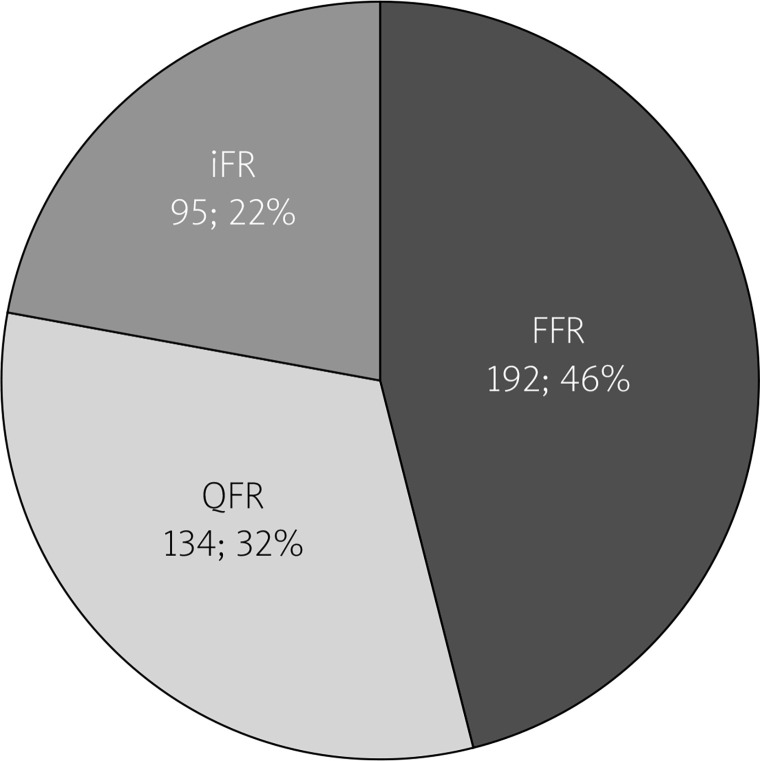
Anonymised data of 421 patients with stable angina pectoris for whom elective coronary artery angiography followed by physiological assessment of intermediate coronary artery stenosis was performed were prospectively included in this study. Only diagnostic-procedure-related data of dose of ionizing radiation were analysed. Physiological assessment of coronary artery lesions was performed by fractional flow reserve (FFR), quantitative flow ratio (QFR), or instantaneous wave-free ratio (iFR).
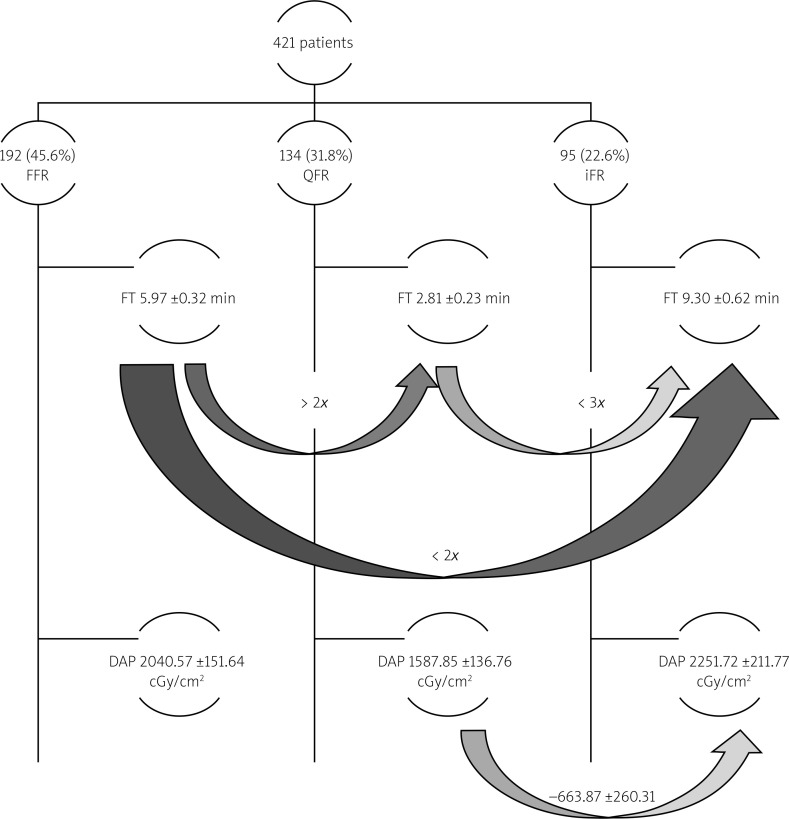
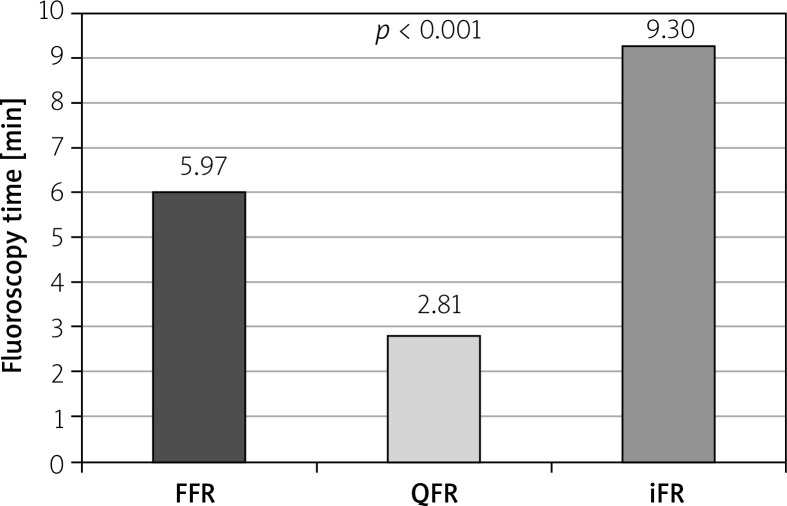
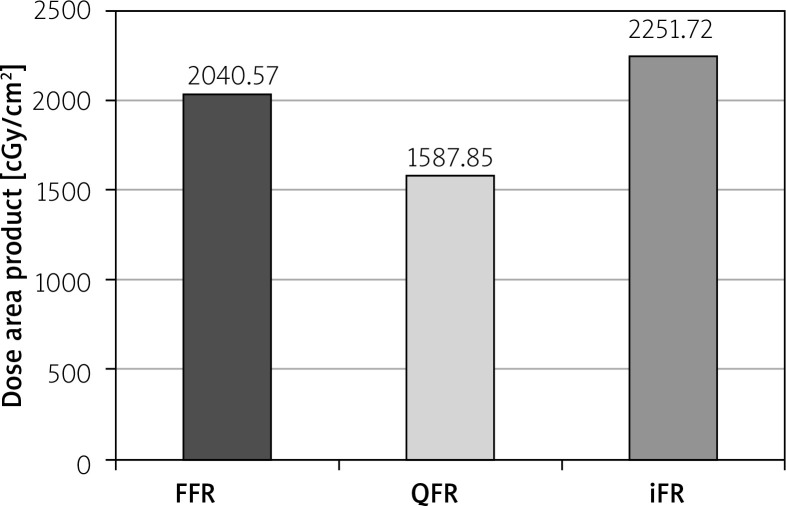
Compared to FFR as a reference, fluoroscopy time (FT) was almost half in QFR and almost double in iFR, < 0.001. QFR was associated with more than 3 times shorter FT compared to iFR. The dose area product was 663.87 ±260.51 cGy/cm ( = 0.03) lower in QFR compared to iFR.
QFR is associated with significantly reduced exposure to ionising radiation compared to both FFR and iFR. Therefore, wider QFR application in clinical practice could eliminate any additional exposure to ionising radiation and increase the prevalence of physiology-guided coronary artery revascularization.
介入心脏病学的发展增加了侵入性手术的数量,而这些手术不可避免地伴随着更多的电离辐射暴露及相关风险。欧美心脏病专家均推荐通过评估冠状动脉病变的功能意义来进行经皮冠状动脉介入治疗(PCI)。然而,全球范围内生理指标引导的PCI的普及率不超过10%。
确定与最低电离辐射暴露相关的生理评估方法。
本研究前瞻性纳入了421例稳定型心绞痛患者的匿名数据,这些患者接受了选择性冠状动脉造影,随后对中度冠状动脉狭窄进行了生理评估。仅分析与诊断程序相关的电离辐射剂量数据。通过血流储备分数(FFR)、定量血流比(QFR)或瞬时无波比(iFR)对冠状动脉病变进行生理评估。
与作为参照的FFR相比,QFR的透视时间(FT)几乎减半,而iFR的FT几乎翻倍,P<0.001。与iFR相比,QFR的FT缩短了3倍多。与iFR相比,QFR的剂量面积乘积低663.87±260.51 cGy/cm²(P=0.03)。
与FFR和iFR相比,QFR与显著降低的电离辐射暴露相关。因此,在临床实践中更广泛地应用QFR可以消除任何额外的电离辐射暴露,并提高生理指标引导的冠状动脉血运重建的普及率。