Hartman Sarah J, Bagby Stacey M, Yacob Betelehem W, Simmons Dennis M, MacBeth Morgan, Lieu Christopher H, Davis S Lindsey, Leal Alexis D, Tentler John J, Diamond Jennifer R, Eckhardt S Gail, Messersmith Wells A, Pitts Todd M
Division of Medical Oncology, Department of Medicine, University of Colorado Anschutz Medical Campus, Aurora, CO, United States.
Department of Oncology, Dell Medical School, The University of Texas Austin, Austin, TX, United States.
Front Oncol. 2021 Mar 25;11:642328. doi: 10.3389/fonc.2021.642328. eCollection 2021.
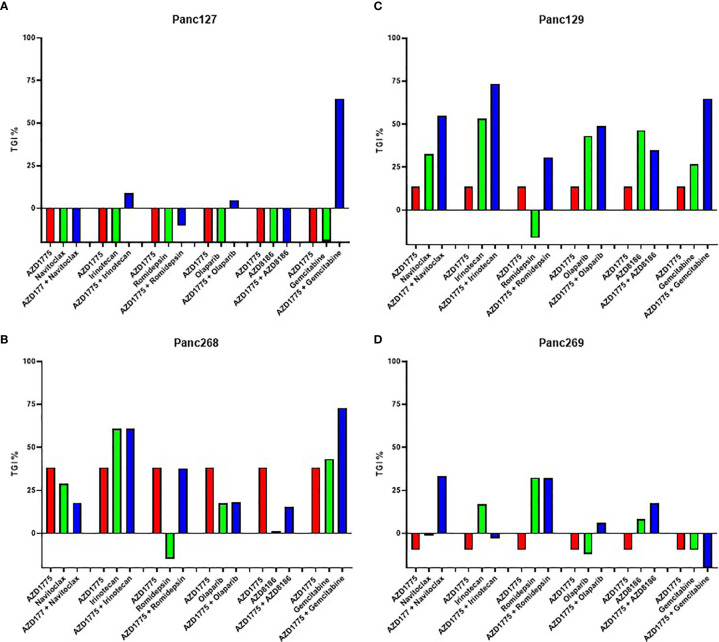
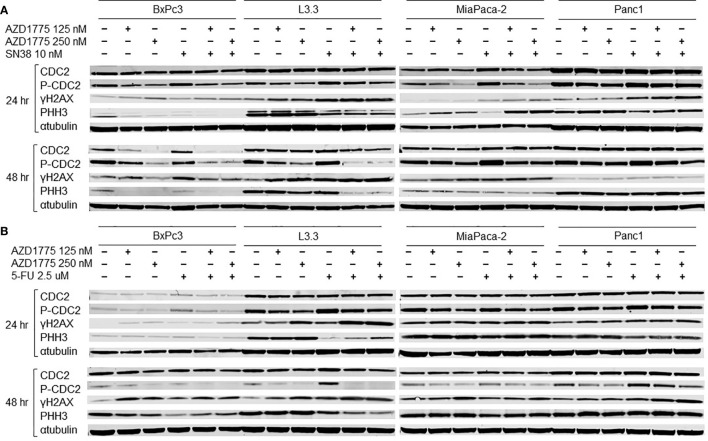
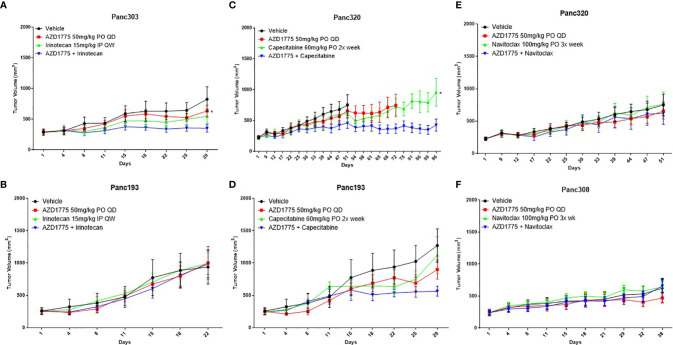
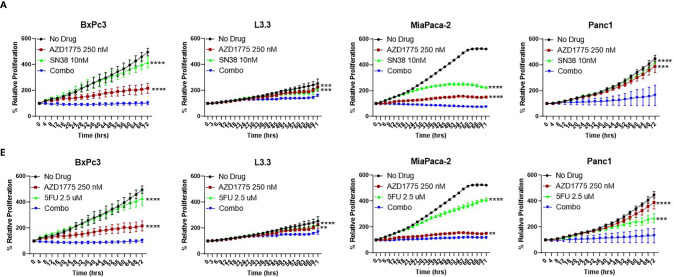
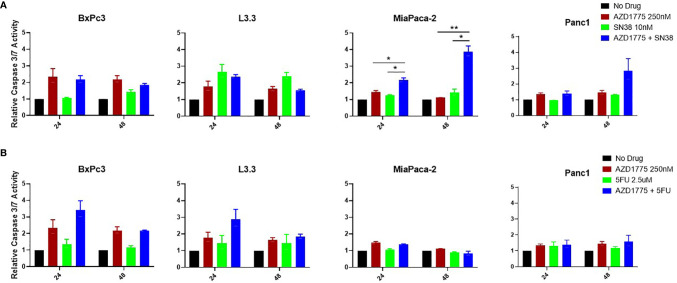
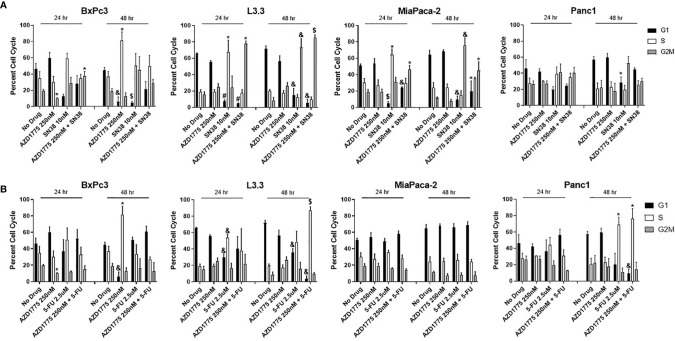
Pancreatic ductal adenocarcinoma (PDAC) is a highly lethal cancer with high incidences of p53 mutations. AZD1775 (adavosertib, previously MK-1775) is a small molecule WEE1 inhibitor that abrogates the G2M checkpoint and can potentially synergize with DNA damaging therapies commonly used in PDAC treatment. The purpose of this study was to identify combination partners for AZD1775, including standard chemotherapy or targeted agents, in PDAC preclinical models. Low powered preliminary screens demonstrated that two of the four PDX models responded better to the combinations of AZD1775 with irinotecan or capecitabine than to either single agent. Following the screens, two full powered PDAC PDX models of differing p53 status were tested with the combinations of AZD1775 and irinotecan or capecitabine. The combinations of AZD1775 and SN38 or 5-FU were also tested on PDAC cell lines. Cellular proliferation was measured using an IncuCyte Live Cell Imager and apoptosis was measured using a Caspase-Glo 3/7 assay. Flow cytometry was conducted to measure alterations in cell cycle distribution. Western blot analysis was used to determine the effects of the drug combinations on downstream effectors. In PDX models with mutated p53 status, there was significant tumor growth inhibition from the combination of AZD1775 with irinotecan or capecitabine ( ≤ 0.03), while PDX models with wild type p53 did not show anti-tumor synergy from the same combinations ( ≥ 0.08). The combination of AZD1775 with SN38 or 5-FU significantly decreased proliferation in all PDAC cell lines, and enhanced apoptosis in multiple cell lines. Cell cycle distribution was disrupted from the combination of AZD1775 with SN38 or 5-FU which was recorded as G2M arrest and decreased G1 phase. AZD1775 inhibited phospho-CDC2 and increased the expression of H2AX that was either maintained or enhanced after combination with SN38 or 5-FU. The combination of AZD1775 with irinotecan/SN38 or capecitabine/5-FU showed anti-tumor effects and in PDAC models. These results support further investigation for these combination strategies to enhance outcomes for PDAC patients.
胰腺导管腺癌(PDAC)是一种具有高致死率且p53突变发生率高的癌症。AZD1775(adavosertib,先前称为MK - 1775)是一种小分子WEE1抑制剂,可消除G2M检查点,并可能与PDAC治疗中常用的DNA损伤疗法产生协同作用。本研究的目的是在PDAC临床前模型中确定AZD1775的联合用药伙伴,包括标准化疗或靶向药物。低效能的初步筛选表明,在四个PDX模型中,有两个对AZD1775与伊立替康或卡培他滨的联合用药反应比对单一药物更好。筛选后,对两个p53状态不同的全效能PDAC PDX模型进行了AZD1775与伊立替康或卡培他滨联合用药的测试。AZD1775与SN38或5 - FU的联合用药也在PDAC细胞系上进行了测试。使用IncuCyte活细胞成像仪测量细胞增殖,使用Caspase - Glo 3/7检测法测量细胞凋亡。进行流式细胞术以测量细胞周期分布的变化。蛋白质免疫印迹分析用于确定药物联合对下游效应分子的影响。在p53突变状态的PDX模型中,AZD1775与伊立替康或卡培他滨联合用药有显著的肿瘤生长抑制作用(P≤0.03),而p53野生型的PDX模型对相同联合用药未显示出抗肿瘤协同作用(P≥0.08)。AZD1775与SN38或5 - FU联合用药显著降低了所有PDAC细胞系的增殖,并增强了多个细胞系的凋亡。AZD1775与SN38或5 - FU联合用药使细胞周期分布受到干扰,表现为G2M期阻滞和G1期减少。AZD1775抑制磷酸化的CDC2,并增加H2AX的表达,与SN38或5 - FU联合用药后该表达维持或增强。AZD1775与伊立替康/SN38或卡培他滨/5 - FU联合用药在PDAC模型中显示出抗肿瘤作用。这些结果支持对这些联合治疗策略进行进一步研究,以改善PDAC患者的治疗效果。