Mahajan Supriya D, Ordain Nigel Smith, Kutscher Hilliard, Karki Shanta, Reynolds Jessica L
Department of Medicine, Jacobs School of Medicine and Biomedical Sciences, University at Buffalo, Buffalo, NY, United States.
Institute for Laser, Photonics and Biophotonics, University at Buffalo, The State University of New York, Buffalo, NY, United States.
Front Cell Dev Biol. 2021 Apr 1;9:637192. doi: 10.3389/fcell.2021.637192. eCollection 2021.
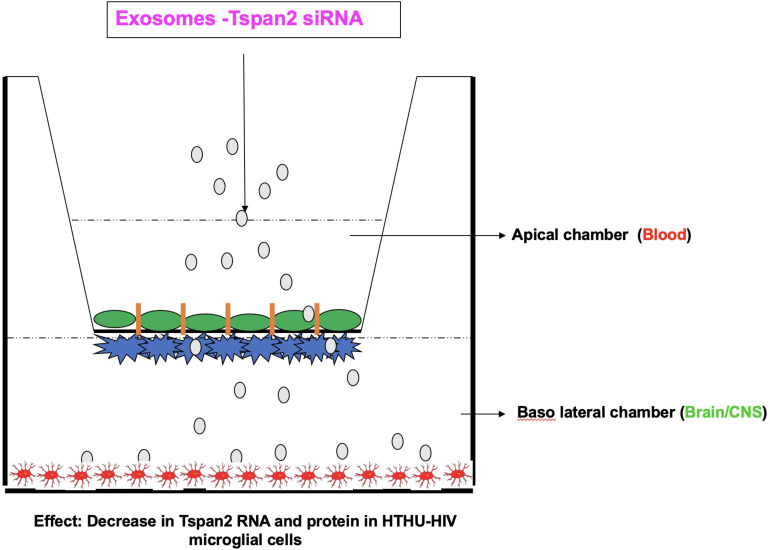
Fifty to sixty percent of HIV-1 positive patients experience HIV-1 associated neurocognitive disorders (HAND) likely due to persistent inflammation and blood-brain barrier (BBB) dysfunction. The role that microglia and astrocytes play in HAND pathogenesis has been well delineated; however, the role of exosomes in HIV neuroinflammation and neuropathogenesis is unclear. Exosomes are 50-150 nm phospholipid bilayer membrane vesicles that are responsible for cell-to-cell communication, cellular signal transduction, and cellular transport. Due to their diverse intracellular content, exosomes, are well poised to provide insight into HIV neuroinflammation as well as provide for diagnostic and predictive information that will greatly enhance the development of new therapeutic interventions for neuroinflammation. Exosomes are also uniquely positioned to be vehicles to delivery therapeutics across the BBB to modulate HIV neuroinflammation. This mini-review will briefly discuss what is known about exosome signaling in the context of HIV in the central nervous system (CNS), their potential for biomarkers as well as their potential for vehicles to deliver various therapeutics to treat HIV neuroinflammation.
50%至60%的HIV-1阳性患者会出现与HIV-1相关的神经认知障碍(HAND),这可能是由于持续炎症和血脑屏障(BBB)功能障碍所致。小胶质细胞和星形胶质细胞在HAND发病机制中的作用已得到明确阐述;然而,外泌体在HIV神经炎症和神经发病机制中的作用尚不清楚。外泌体是50-150纳米的磷脂双分子层膜囊泡,负责细胞间通讯、细胞信号转导和细胞运输。由于其多样的细胞内成分,外泌体有能力深入了解HIV神经炎症,并提供诊断和预测信息,这将极大地促进神经炎症新治疗干预措施的开发。外泌体还具有独特的地位,可作为载体跨越血脑屏障递送治疗药物,以调节HIV神经炎症。本综述将简要讨论在中枢神经系统(CNS)中HIV背景下外泌体信号传导的已知情况、它们作为生物标志物的潜力以及它们作为递送各种治疗药物以治疗HIV神经炎症的载体的潜力。