Watanabe Koichiro, Yoshihisa Akiomi, Sato Yu, Hotsuki Yu, Anzai Fumiya, Ichijo Yasuhiro, Kimishima Yusuke, Yokokawa Tetsuro, Misaka Tomofumi, Sato Takamasa, Kaneshiro Takashi, Oikawa Masayoshi, Kobayashi Atsushi, Takeishi Yasuchika
Department of Cardiovascular Medicine, Fukushima Medical University, Fukushima, Japan.
Department of Advanced Cardiac Therapeutics, Fukushima Medical University, Fukushima, Japan.
Front Cardiovasc Med. 2021 Mar 29;8:631807. doi: 10.3389/fcvm.2021.631807. eCollection 2021.
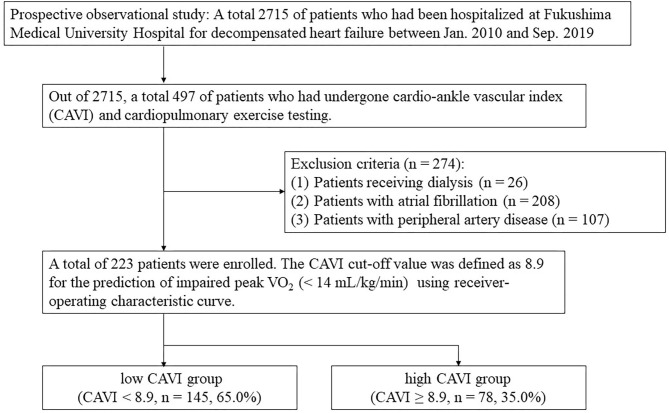
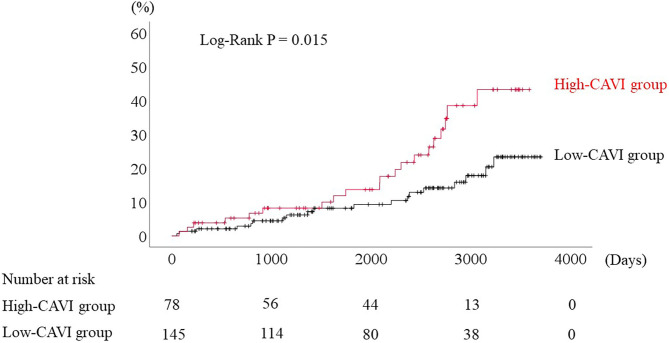
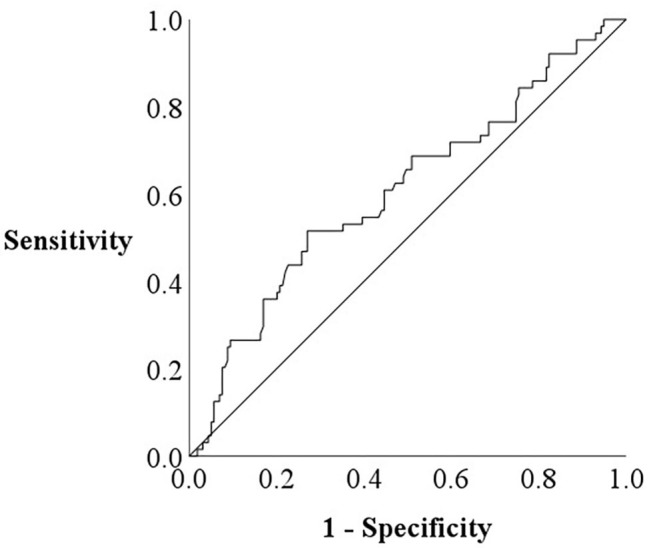
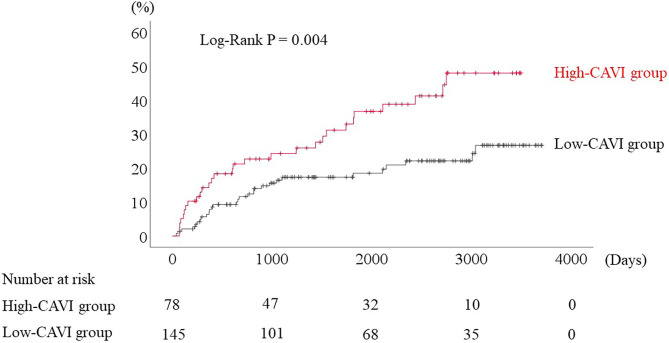
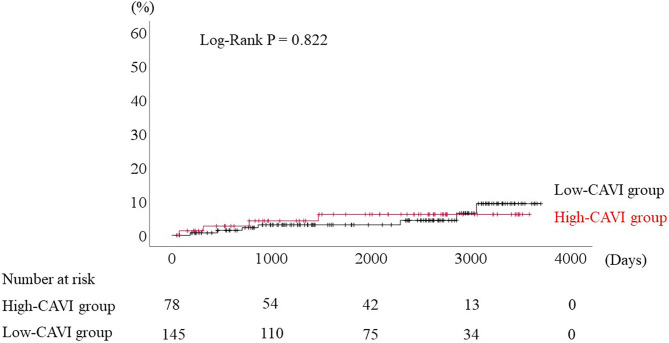
We aimed to assess the associations of CAVI with exercise capacity in heart failure (HF) patients. In addition, we further examined their prognosis. We collected the clinical data of 223 patients who had been hospitalized for decompensated HF and had undergone both CAVI and cardiopulmonary exercise testing. For the prediction of an impaired peak oxygen uptake (VO) of < 14 mL/kg/min, receiver-operating characteristic curve demonstrated that the cutoff value of CAVI was 8.9. In the multivariate logistic regression analysis for predicting impaired peak VO, high CAVI was found to be an independent factor (odds ratio 2.343, = 0.045). We divided these patients based on CAVI: the low-CAVI group (CAVI < 8.9, = 145) and the high-CAVI group (CAVI ≥ 8.9, = 78). Patient characteristics and post-discharge cardiac events were compared between the two groups. The high-CAVI group was older (69.0 vs. 58.0 years old, < 0.001) and had lower body mass index (23.0 vs. 24.1 kg/m, = 0.013). During the post-discharge follow-up period of median 1,623 days, 58 cardiac events occurred. The Kaplan-Meier analysis demonstrated that the cardiac event rate was higher in the high-CAVI group than in the low-CAVI group (log-rank = 0.004). The multivariate Cox proportional hazard analysis revealed that high CAVI was an independent predictor of cardiac events (hazard ratio 1.845, = 0.035). High CAVI is independently associated with impaired exercise capacity and a high cardiac event rate in HF patients.
我们旨在评估心脏衰竭(HF)患者中颈股动脉脉搏波速度(CAVI)与运动能力之间的关联。此外,我们进一步研究了它们的预后情况。我们收集了223例因失代偿性HF住院且接受了CAVI和心肺运动测试的患者的临床数据。对于预测峰值摄氧量(VO)<14 mL/kg/min受损情况,受试者操作特征曲线显示CAVI的截断值为8.9。在预测峰值VO受损的多因素逻辑回归分析中,高CAVI被发现是一个独立因素(比值比2.343,P = 0.045)。我们根据CAVI将这些患者分为两组:低CAVI组(CAVI < 8.9,n = 145)和高CAVI组(CAVI≥8.9,n = 78)。比较了两组患者的特征和出院后心脏事件。高CAVI组年龄更大(69.0岁对58.0岁,P < 0.001)且体重指数更低(23.0对24.1 kg/m²,P = 0.013)。在出院后中位1623天的随访期内,发生了58次心脏事件。Kaplan-Meier分析表明,高CAVI组的心脏事件发生率高于低CAVI组(对数秩检验P = 0.004)。多因素Cox比例风险分析显示,高CAVI是心脏事件的独立预测因素(风险比1.845,P = 0.035)。高CAVI与HF患者运动能力受损和高心脏事件发生率独立相关。