Wang Jr-Yi, Liaw Chen-Kun, Huang Chi-Chang, Liou Tsan-Hon, Lin Hui-Wen, Huang Shih-Wei
Department of Orthopedic Surgery, Shuang Ho Hospital, Taipei Medical University, New Taipei City.
Department of Orthopedics, School of Medicine, College of Medicine, Taipei Medical University, Taipei.
Orthop J Sports Med. 2021 Apr 5;9(4):2325967120986808. doi: 10.1177/2325967120986808. eCollection 2021 Apr.
Patients with adhesive capsulitis are evaluated for pain and progressive contracture of the glenohumeral joint. Whether endocrine, immune, or inflammatory processes are involved in its definite pathogenesis is still under debate. Some cross-sectional studies with a small sample size have noted that hyperlipidemia is a possible risk factor for frozen shoulders.
PURPOSE/HYPOTHESIS: The purpose was to conduct a longitudinal population-based study to investigate the risk of adhesive capsulitis among patients with hyperlipidemia. It was hypothesized that patients with hyperlipidemia would have a higher risk of adhesive capsulitis and that the use of statin drugs could reduce the rate.
Cohort study; Level of evidence, 3.
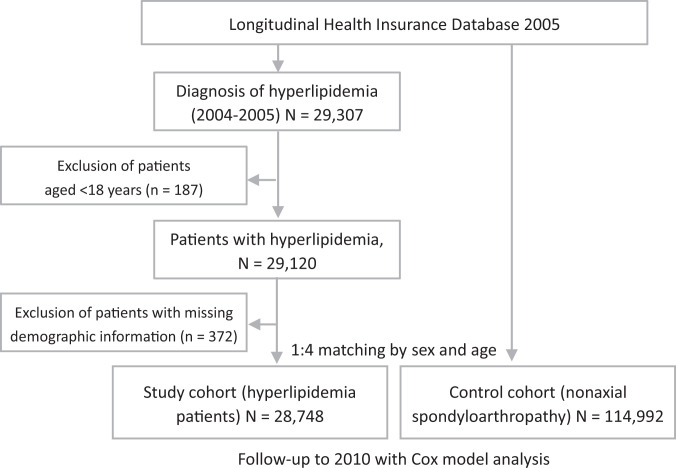
Using data from the National Health Insurance Research Database (NHIRD) of Taiwan, the authors obtained the records of patients with hyperlipidemia who received a diagnosis between 2004 and 2005 and were followed up until the end of 2010. The control cohort comprised age- and sex-matched patients without hyperlipidemia. Propensity score matching was performed for the other comorbidities. A Cox multivariate proportional hazards model was applied to analyze the risk factors of adhesive capsulitis. The hazard ratio (HR) and adjusted HR were estimated between the study and control cohorts after adjustment for confounders. The effects of statin use on adhesive capsulitis risk were also analyzed.
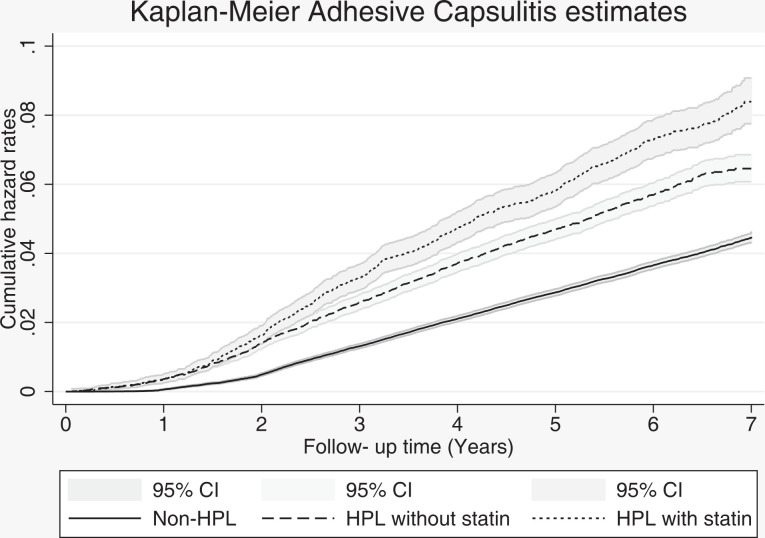
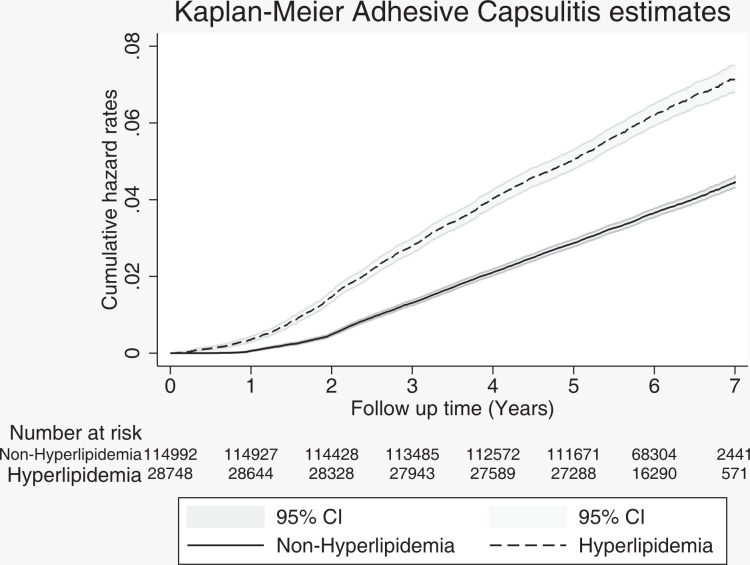
The NHIRD records of 28,748 patients and 114,992 propensity score-matched controls were evaluated. A higher incidence rate of adhesive capsulitis was revealed in the hyperlipidemia cohort, with a crude HR of 1.70 (95% CI, 1.61-1.79; < .001) and adjusted HR of 1.50 (95% CI, 1.41-1.59; < .001). Patients with hyperlipidemia who used a statin still had higher crude and adjusted HRs compared with controls. Statin use did not exert protective effects on patients with hyperlipidemia.
Patients with hyperlipidemia had a 1.5-fold higher risk of adhesive capsulitis than did healthy controls. Statin use did not provide protection against adhesive capsulitis in patients with hyperlipidemia.
对粘连性关节囊炎患者进行评估,以了解其疼痛情况及盂肱关节的进行性挛缩。内分泌、免疫或炎症过程是否参与其确切发病机制仍存在争议。一些小样本的横断面研究指出,高脂血症是肩周炎的一个可能危险因素。
目的/假设:目的是进行一项基于人群的纵向研究,以调查高脂血症患者发生粘连性关节囊炎的风险。假设高脂血症患者发生粘连性关节囊炎的风险更高,且使用他汀类药物可降低该发生率。
队列研究;证据等级,3级。
利用台湾国民健康保险研究数据库(NHIRD)的数据,作者获取了2004年至2005年间被诊断为高脂血症并随访至2010年底的患者记录。对照队列包括年龄和性别匹配的无高脂血症患者。对其他合并症进行倾向评分匹配。应用Cox多变量比例风险模型分析粘连性关节囊炎的危险因素。在对混杂因素进行调整后,估计研究队列与对照队列之间的风险比(HR)和调整后的HR。还分析了他汀类药物的使用对粘连性关节囊炎风险的影响。
对28748例患者的NHIRD记录和114992例倾向评分匹配的对照进行了评估。高脂血症队列中粘连性关节囊炎的发病率更高,粗HR为1.70(95%CI,1.61 - 1.79;P <.001),调整后的HR为1.50(95%CI,1.41 - 1.59;P <.001)。与对照组相比,使用他汀类药物的高脂血症患者的粗HR和调整后的HR仍然更高。他汀类药物的使用对高脂血症患者没有保护作用。
高脂血症患者发生粘连性关节囊炎的风险比健康对照高1.5倍。他汀类药物的使用对高脂血症患者预防粘连性关节囊炎没有保护作用。