Morse Janice M, Kent-Marvick Jacqueline, Barry Lisa A, Harvey Jennifer, Okang Esther Narkie, Rudd Elizabeth A, Wang Ching-Yu, Williams Marcia R
University of Utah, Salt Lake City, USA.
University of Alberta.
Glob Qual Nurs Res. 2021 Mar 31;8:23333936211005475. doi: 10.1177/23333936211005475. eCollection 2021 Jan-Dec.
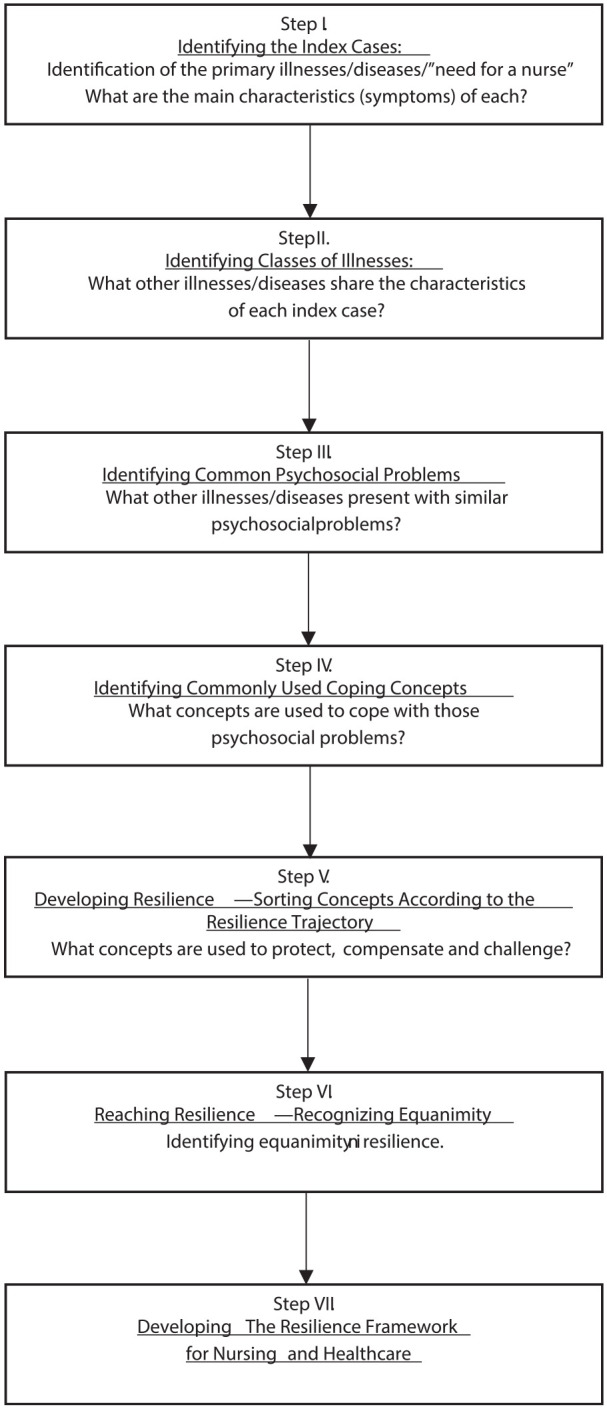
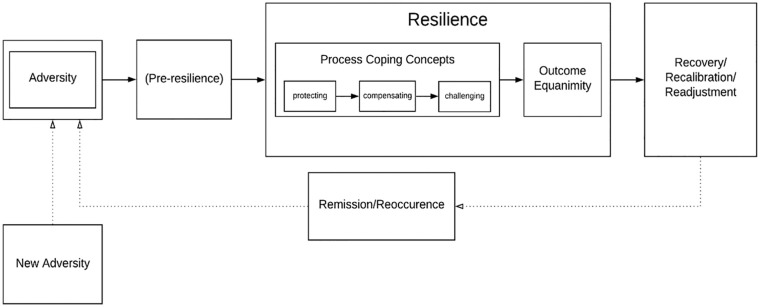
Despite four decades of resilience research, resilience remains a poor fit for practice as a scientific construct. Using the literature, we explored the concepts attributed to the development of resilience, identifying those that mitigate symptoms of distress caused by adversity and facilitate coping in seven classes of illness: transplants, cancer, mental illness, episodic illness, chronic and painful illness, unexpected events, and illness within a dyadic relationship. We identified protective, compensatory, and challenge-related coping-concept strategies that healthcare workers and patients use during the adversity experience. Healthcare-worker assessment and selection of appropriate coping concepts enable the individual to control their distress, resulting in attainment of equanimity and the state of resilience, permitting the resilient individual to work toward recovery, recalibration, and readjustment. We inductively developed and linked these conceptual components into a dynamic framework, , making it widely applicable for healthcare across a variety of patients.
尽管韧性研究已有四十年,但作为一种科学概念,韧性在实践中的适用性仍然较差。通过查阅文献,我们探讨了与韧性发展相关的概念,确定了那些能减轻逆境所致痛苦症状并促进七类疾病应对的概念:移植、癌症、精神疾病、偶发性疾病、慢性疼痛性疾病、意外事件以及二元关系中的疾病。我们确定了医护人员和患者在逆境经历中使用的保护性、补偿性和与挑战相关的应对概念策略。医护人员对适当应对概念的评估和选择使个体能够控制自己的痛苦,从而实现平静和韧性状态,使有韧性的个体能够朝着康复、重新校准和重新调整努力。我们归纳性地开发了这些概念组件,并将它们链接成一个动态框架,使其广泛适用于各类患者的医疗保健。