Zhang Dongmei, Li Xiaoping, Zhang Ming, Huang Anle, Yang Liu, Wang Congzhi, Yuan Ting, Lei Yunxiao, Liu Haiyang, Hua Ying, Zhang Lin, Zhang Jing
School of Nursing, Wannan Medical College, Wuhu, Anhui, China.
School of Innovation and Entrepreneurship, Wannan Medical College, Wuhu, Anhui, China.
Front Psychiatry. 2024 Feb 13;15:1328226. doi: 10.3389/fpsyt.2024.1328226. eCollection 2024.
Insomnia in healthcare workers has become a topic of concern in the health system. The high infectivity and longevity of the COVID-19 pandemic have resulted in great pressure and a high incidence of insomnia among healthcare workers. Insomnia among healthcare workers has a negative impact on high-quality healthcare services in addition to their health. Thus, it's necessary to explore insomnia's underlying mechanisms.
The present research's aims were threefold: explored the association between social support, resilience, COVID-19 anxiety, and insomnia among healthcare workers during the pandemic, elucidated the underlying mechanism of insomnia, and offered recommendations for improving the health of these workers.
A cross-sectional design was adopted. From May 20 to 30, 2022, 1038 healthcare workers were selected to fill out the Oslo 3-item Social Support Scale, the eight-item Athens Insomnia Scale, the Coronavirus Anxiety Scale, and the Brief Resilience Scale. Descriptive statistics and correlations were analyzed by SPSS 25.0. Mediation analysis was conducted by Mplus 8.3 using 5000 bootstrap samples.
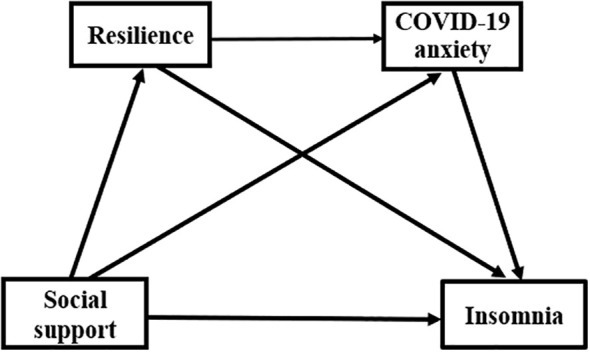
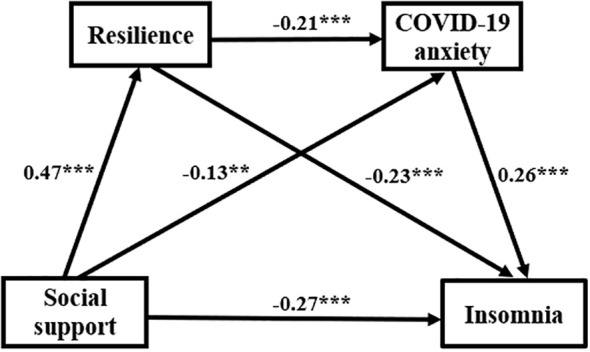
Of the participating 1038 healthcare workers, the prevalence of insomnia was 41.62% (432/1038). Significant associations were found involving insomnia, resilience, COVID-19 anxiety, and social support. Insomnia was directly affected by social support. Moreover, three indirect pathways explain how social support affected insomnia: resilience's mediating role, COVID-19 anxiety's mediating role, and the chain-mediation role of resilience and COVID-19 anxiety.
The results validated our hypotheses and supported the opinion of Spielman et al. 's three-factor model of insomnia. Social support of healthcare workers has an indirect impact on insomnia in addition to its direct one via independent and chain-mediation effects of resilience and COVID-19 anxiety.
医护人员的失眠问题已成为卫生系统中备受关注的话题。新冠疫情的高传染性和长期性给医护人员带来了巨大压力,导致他们失眠的发生率很高。医护人员的失眠不仅会影响自身健康,还会对高质量的医疗服务产生负面影响。因此,有必要探究失眠的潜在机制。
本研究旨在实现三个目标:探讨疫情期间医护人员的社会支持、心理韧性、新冠焦虑与失眠之间的关联,阐明失眠的潜在机制,并为改善这些医护人员的健康状况提供建议。
采用横断面设计。2022年5月20日至30日,选取1038名医护人员填写奥斯陆3项社会支持量表、8项雅典失眠量表、冠状病毒焦虑量表和简易心理韧性量表。使用SPSS 25.0进行描述性统计和相关性分析。使用Mplus 8.3进行中介分析,共5000个自抽样样本。
在参与研究的1038名医护人员中,失眠的患病率为41.62%(432/1038)。研究发现失眠、心理韧性、新冠焦虑和社会支持之间存在显著关联。社会支持直接影响失眠。此外,社会支持影响失眠的途径有三条间接路径:心理韧性的中介作用、新冠焦虑的中介作用以及心理韧性和新冠焦虑的链式中介作用。
研究结果验证了我们的假设,并支持了斯皮尔曼等人的失眠三因素模型的观点。医护人员的社会支持除了通过心理韧性和新冠焦虑的独立及链式中介效应直接影响失眠外,还存在间接影响。