Kamer Angela R, Pushalkar Smruti, Gulivindala Deepthi, Butler Tracy, Li Yi, Annam Kumar Raghava Chowdary, Glodzik Lidia, Ballman Karla V, Corby Patricia M, Blennow Kaj, Zetterberg Henrik, Saxena Deepak, de Leon Mony J
Department of Periodontology and Implant Dentistry College of Dentistry New York University New York USA.
Department of Molecular Pathobiology College of Dentistry New York University New York USA.
Alzheimers Dement (Amst). 2021 Apr 12;13(1):e12172. doi: 10.1002/dad2.12172. eCollection 2021.
Periodontal disease is a chronic, inflammatory bacterial dysbiosis that is associated with both Alzheimer's disease (AD) and Down syndrome.
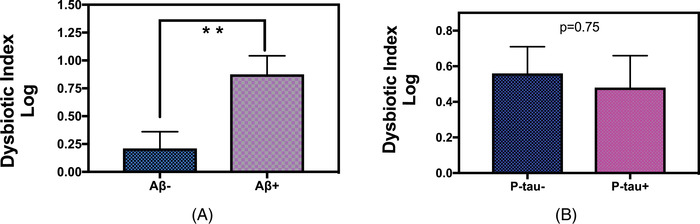
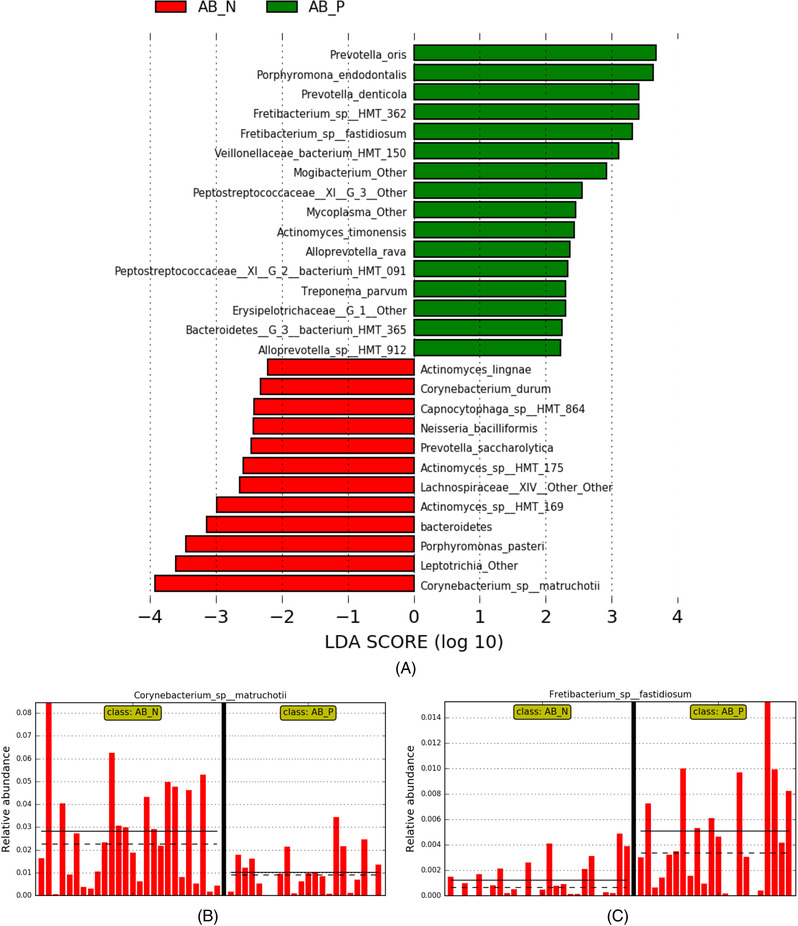
A total of 48 elderly cognitively normal subjects were evaluated for differences in subgingival periodontal bacteria (assayed by 16S rRNA sequencing) between cerebrospinal fluid (CSF) biomarker groups of amyloid and neurofibrillary pathology. A dysbiotic index (DI) was defined at the genus level as the abundance ratio of known periodontal bacteria to healthy bacteria. Analysis of variance/analysis of covariance (ANOVA/ANCOVA), linear discriminant effect-size analyses (LEfSe) were used to determine the bacterial genera and species differences between the CSF biomarker groups.
At genera and species levels, higher subgingival periodontal dysbiosis was associated with reduced CSF amyloid beta (Aβ)42 ( = 0.02 and 0.01) but not with P-tau.
We show a selective relationship between periodontal disease bacterial dysbiosis and CSF biomarkers of amyloidosis, but not for tau. Further modeling is needed to establish the direct link between oral bacteria and Aβ.
牙周病是一种慢性炎症性细菌生态失调疾病,与阿尔茨海默病(AD)和唐氏综合征均有关联。
共有48名认知功能正常的老年人接受评估,以检测淀粉样蛋白和神经纤维病理的脑脊液(CSF)生物标志物组之间龈下牙周细菌的差异(通过16S rRNA测序分析)。在属水平上定义了一个生态失调指数(DI),即已知牙周细菌与健康细菌的丰度比。采用方差分析/协方差分析(ANOVA/ANCOVA)、线性判别效应大小分析(LEfSe)来确定CSF生物标志物组之间的细菌属和种的差异。
在属和种水平上,较高的龈下牙周生态失调与脑脊液淀粉样β蛋白(Aβ)42降低相关(P = 0.02和0.01),但与磷酸化tau蛋白无关。
我们发现牙周病细菌生态失调与淀粉样变性的脑脊液生物标志物之间存在选择性关系,但与tau蛋白无关。需要进一步建模以建立口腔细菌与Aβ之间的直接联系。