Desai Madhav, Anderson Joseph C, Kaminski Michael, Thoguluva Chandrasekar Viveksandeep, Fathallah Jihan, Hassan Cesare, Lieberman David, Sharma Prateek
Department of Gastroenterology, Kansas City VA Medical Center, Kansas City, Missouri, United States.
Department of Veterans Affairs Medical Center, White River Junction, Vermont, United States.
Endosc Int Open. 2021 Apr;9(4):E610-E620. doi: 10.1055/a-1352-4095. Epub 2021 Apr 13.
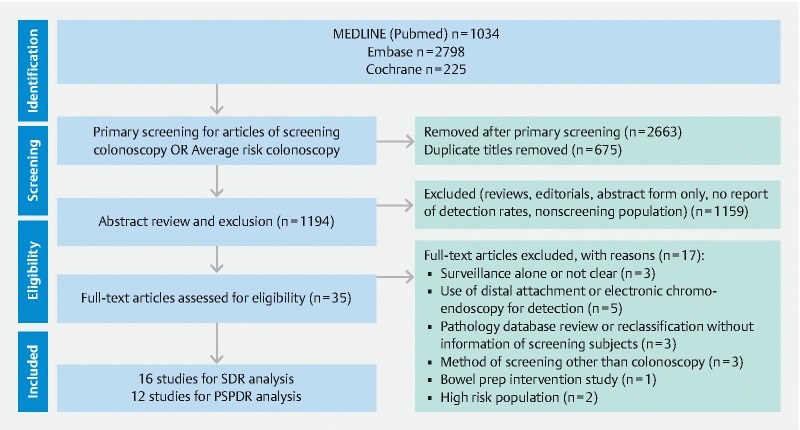
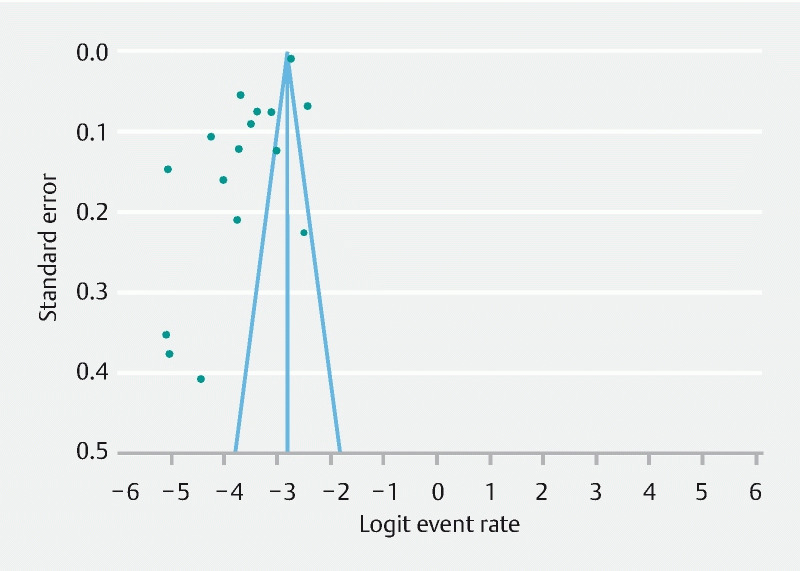
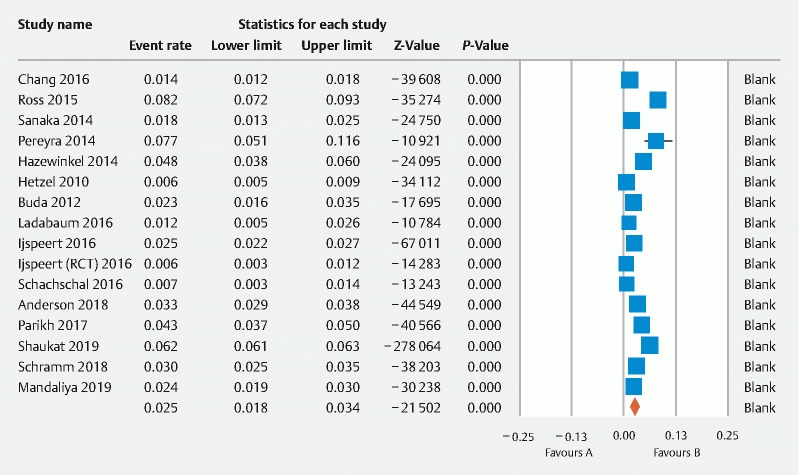
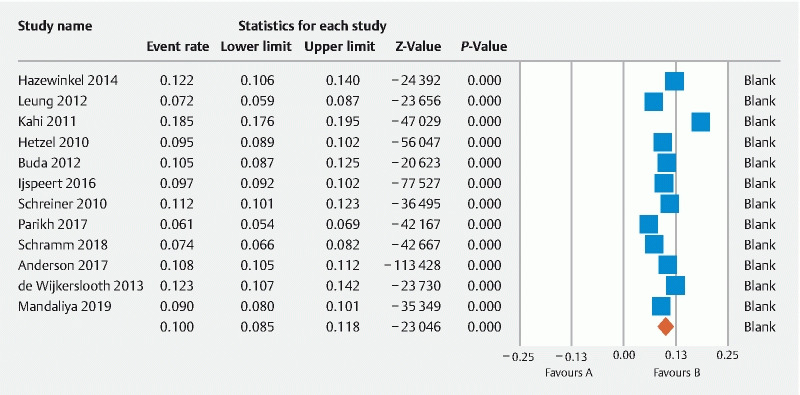
Sessile serrated lesion (SSL) detection rate has been variably reported and unlike adenoma detection rate (ADR) is not currently a quality indicator for screening colonoscopy. Composite detection rates of SSL in patients undergoing average risk screening colonoscopy are not available. Electronic database search (Medline, Embase and Cochrane) was conducted for studies reporting detection rates of serrated polyps (SSL, Hyperplastic polyp, traditional serrated adenoma) among average risk subjects undergoing screening colonoscopy. Primary outcomes were pooled SDR (SSL detection rate) and proximal serrated polyp detection rate (PSPDR). Pooled proportion rates were calculated with 95 %CI with assessment of heterogeneity (I ). Publication bias, regression test and 95 %prediction interval were calculated. A total of 280,370 screening colonoscopies among average risk subjects that were eligible with 48.9 % males and an average age of 58.7 years (± 3.2). The pooled SDR was available from 16 studies: 2.5 % (1.8 %-3.4 %) with significant heterogeneity (I = 98.66 %) and the 95 % prediction interval ranging from 0.6 % to 9.89 %. When analysis was restricted to large (n > 1000) and prospective studies (n = 4), SDR was 2 % (1.1 %-3.3 %). Pooled PSPDR was 10 % (8.5 %-11.8 %; 12 studies). There was evidence of publication bias ( < 0.01). Definitions of SSL have been varying over years and there exists significant heterogeneity in prevalence reporting of serrated polyps during screening colonoscopy. Prevalence rate of 2 % for SSL and 10 % for proximal serrated polyps could serve as targets while robust high-quality data is awaited to find a future benchmark showing reduction in colorectal cancer arising from serrated pathway.
无蒂锯齿状病变(SSL)的检出率报道不一,与腺瘤检出率(ADR)不同,目前它并非筛查结肠镜检查的质量指标。平均风险筛查结肠镜检查患者中SSL的综合检出率尚无可用数据。通过电子数据库检索(Medline、Embase和Cochrane),查找报告平均风险筛查结肠镜检查受检者中锯齿状息肉(SSL、增生性息肉、传统锯齿状腺瘤)检出率的研究。主要结局指标为汇总的锯齿状病变检出率(SDR,即SSL检出率)和近端锯齿状息肉检出率(PSPDR)。采用95%置信区间计算汇总比例率,并评估异质性(I²)。计算发表偏倚、回归检验和95%预测区间。共有280370例平均风险受检者接受了筛查结肠镜检查,其中男性占48.9%,平均年龄58.7岁(±3.2岁)。16项研究提供了汇总的SDR:2.5%(1.8% - 3.4%),异质性显著(I² = 98.66%),95%预测区间为0.6%至9.89%。当分析限于大型研究(n>1000)和前瞻性研究(n = 4)时,SDR为2%(1.1% - 3.3%)。汇总的PSPDR为10%(8.5% - 11.8%;12项研究)。有证据表明存在发表偏倚(P<0.01)。多年来SSL的定义一直在变化,筛查结肠镜检查期间锯齿状息肉患病率报告存在显著异质性。在等待可靠的高质量数据以确定未来显示锯齿状途径所致结直肠癌减少的基准时,SSL患病率2%和近端锯齿状息肉患病率10%可作为目标。