Guedes-Estevez Estefania, Costa Ana Rute, Moura-Ferreira Pedro, Lunet Nuno, Morais Samantha
EPIUnit - Instituto de Saúde Pública, Universidade do Porto, Rua das Taipas 135, 4050-600 Porto.
Instituto de Ciências Sociais, Universidade de Lisboa, Avenida Professor Aníbal de Bettencourt 9, 1600-189 Lisboa.
Porto Biomed J. 2021 Apr 13;6(2):e130. doi: 10.1097/j.pbj.0000000000000130. eCollection 2021 Mar-Apr.
Previous studies have shown that adequate physical activity (PA, defined as any bodily movement that requires energy expenditure) related awareness and knowledge is crucial to promote regular PA. Therefore, this study aims to characterize PA awareness and knowledge, and to quantify its association with sociodemographic characteristics, health literacy and frequency of exercise.
In a cross-sectional study conducted in 2012, a total of 1624 Portuguese-speaking residents of mainland Portugal (16-79 years old) were assessed through face-to-face interviews using a structured questionnaire. Adjusted prevalence ratios, calculated using regression, were used to quantify associations with PA awareness and knowledge.
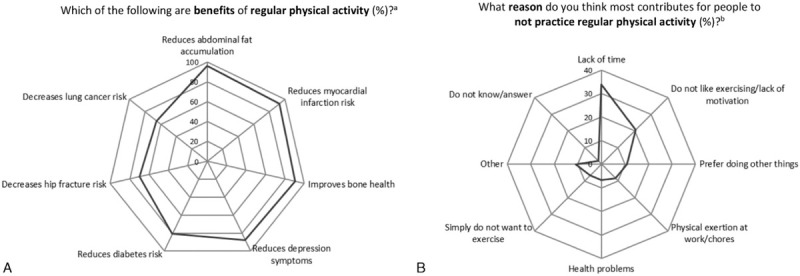
The most reported benefits of PA were "reduces abdominal fat accumulation" (95.8%), "reduces myocardial infarction risk" (92.9%) and "improves bone health" (90.7%), these were less referred by older participants, while more often identified by those who exercise daily. The most referred barrier for people to not practice PA regularly was "lack of time" (33.9%) with differences observed by sex, age, education, employment and health literacy. Over two-thirds of participants correctly identified at least 2 of 3 PAs ("running", "soccer" and "tennis") that require the most energy, particularly males, those with higher health literacy and who exercise twice or more times a week.
An adequate PA-related awareness and knowledge was observed, and differences according to age, health literacy levels and frequency of exercise were found. As such, awareness-raising interventions to increase regular PA through improving physical literacy and motivation should focus on older adults, those with limited health literacy and who do not exercise.
先前的研究表明,与充足身体活动(PA,定义为任何需要消耗能量的身体运动)相关的意识和知识对于促进规律的PA至关重要。因此,本研究旨在描述PA意识和知识的特征,并量化其与社会人口学特征、健康素养和运动频率的关联。
在2012年进行的一项横断面研究中,通过使用结构化问卷进行面对面访谈,对葡萄牙大陆1624名讲葡萄牙语的居民(16 - 79岁)进行了评估。使用回归计算的调整患病率比来量化与PA意识和知识的关联。
PA最常被提及的益处是“减少腹部脂肪堆积”(95.8%)、“降低心肌梗死风险”(92.9%)和“改善骨骼健康”(90.7%),老年参与者提及这些益处的频率较低,而每天锻炼的人提及的频率更高。人们不经常进行PA最常提到的障碍是“缺乏时间”(33.9%),在性别、年龄、教育程度、就业情况和健康素养方面存在差异。超过三分之二的参与者正确识别出了3种最消耗能量的PA(“跑步”、“足球”和“网球”)中的至少2种,特别是男性、健康素养较高以及每周锻炼两次或更多次的人。
观察到了与PA相关的充足意识和知识,并且发现了年龄、健康素养水平和运动频率方面的差异。因此,通过提高身体素养和动机来增加规律PA的提高意识干预措施应侧重于老年人、健康素养有限以及不运动的人群。