Rúa-Alonso María, Bovolini Antonio, Costa-Brito Ana Raquel, Vaz Cláudia, Marques Ermelinda, Serra Nuno, Lopes Vítor P, Vila-Chã Carolina
Polytechnic of Guarda, 6300-559 Guarda, Portugal.
Research Center in Sports Sciences, Health Sciences, and Human Development (CIDESD), 5001-801 Vila Real, Portugal.
Healthcare (Basel). 2023 Nov 11;11(22):2948. doi: 10.3390/healthcare11222948.
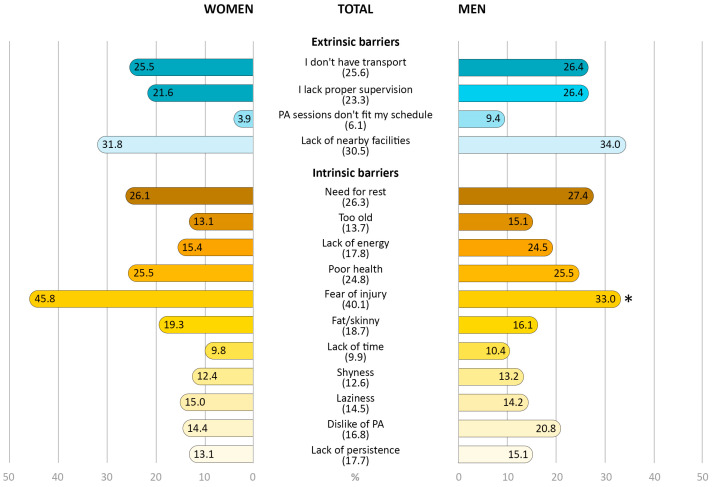
Older people in low-population density regions tend to have fewer resources to engage in regular physical activity (PA) compared to their counterparts in urban areas. Moreover, PA assumes different dimensions, and the amount of PA related to each dimension may differ between women and men, predisposing them to different PA practices. Therefore, this cross-sectional study aims to describe the prevalence of barriers to PA, gender differences, and their associations with different PA dimensions. A total of 259 older adults (153 women and 106 men; age, 75.17 ± 8.05 years old) living in the community in the region of Guarda (Portugal) were interviewed face to face to record their sociodemographic characteristics, general health status (comorbidity index and self-reported health), PA behaviour, and barriers to PA. Women were more likely to report "low" income and living alone ( ≤ 0.05), while men reported a higher negative health status than women ( < 0.05). Two intrinsic ("Fear of injury" (40.1%) and "Need for rest" (26.3%)) and two extrinsic barriers ("Lack of nearby facilities" (30.5%) and "I don't have transport" (25.6%)) were the most prevalent. For women, age, self-reported health, comorbidity index, and intrinsic and extrinsic barriers were similarly associated with the different PA dimensions. However, only self-reported health and extrinsic barriers were the variables associated with the different PA dimensions in men. Therefore, strategies to promote active ageing in low-population density regions should be focused on reducing intrinsic and extrinsic barriers based on gender and the PA dimension to be achieved.
与城市地区的老年人相比,人口低密度地区的老年人进行定期体育活动(PA)的资源往往较少。此外,体育活动具有不同维度,与每个维度相关的体育活动量在男性和女性之间可能存在差异,使他们倾向于不同的体育活动方式。因此,这项横断面研究旨在描述体育活动障碍的患病率、性别差异及其与不同体育活动维度的关联。对居住在葡萄牙瓜尔达地区社区的259名老年人(153名女性和106名男性;年龄75.17±8.05岁)进行了面对面访谈,以记录他们的社会人口学特征、总体健康状况(合并症指数和自我报告的健康状况)、体育活动行为以及体育活动障碍。女性更有可能报告“低收入”和独居(≤0.05),而男性报告的负面健康状况高于女性(<0.05)。两种内在障碍(“害怕受伤”(40.1%)和“需要休息”(26.3%))和两种外在障碍(“附近缺乏设施”(30.5%)和“我没有交通工具”(25.6%))最为普遍。对于女性,年龄、自我报告的健康状况、合并症指数以及内在和外在障碍与不同的体育活动维度同样相关。然而,只有自我报告的健康状况和外在障碍是与男性不同体育活动维度相关的变量。因此,在人口低密度地区促进积极老龄化的策略应侧重于根据性别和要实现的体育活动维度减少内在和外在障碍。