Toloui Amirmohammad, Moshrefiaraghi Donya, Madani Neishaboori Arian, Yousefifard Mahmoud, Haji Aghajani Mohammad
Physiology Research Center, Iran University of Medical Sciences, Tehran, Iran.
Prevention of Cardiovascular Disease Research Center, Shahid Beheshti University of Medical Sciences, Tehran, Iran.
Arch Acad Emerg Med. 2021 Feb 13;9(1):e18. doi: 10.22037/aaem.v9i1.1071. eCollection 2021.
Raising knowledge over cardiac complications and managing them can play a key role in their recovery. In this study, we aim to investigate the evidence regarding the prevalence of cardiac complications and the resulting mortality rate in COVID-19 patients.
Search was conducted in electronic databases of Medline (using PubMed), Embase, Scopus, and Web of Science, in addition to the manual search in preprint databases, and Google and Google scholar search engines, for articles published from 2019 until April 30, 2020. Inclusion criterion was reviewing and reporting cardiac complications in patients with confirmed COVID-19.
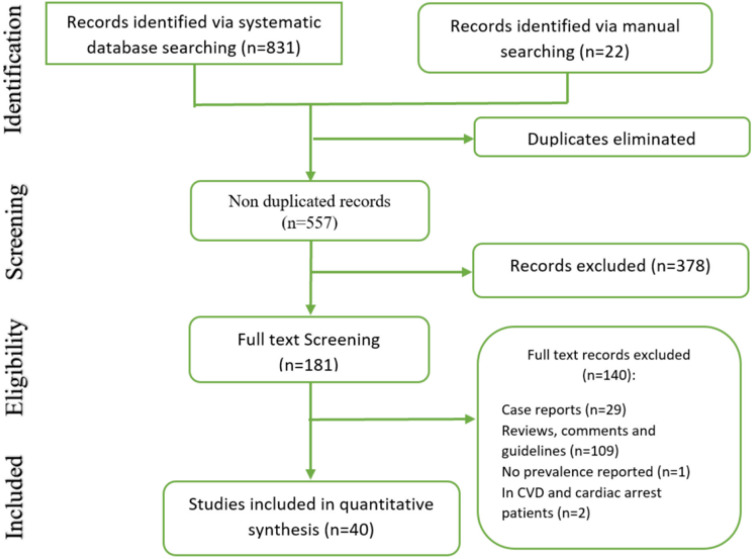
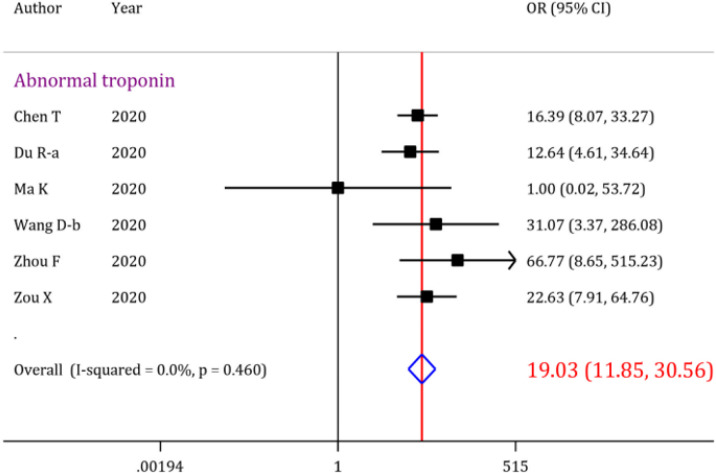
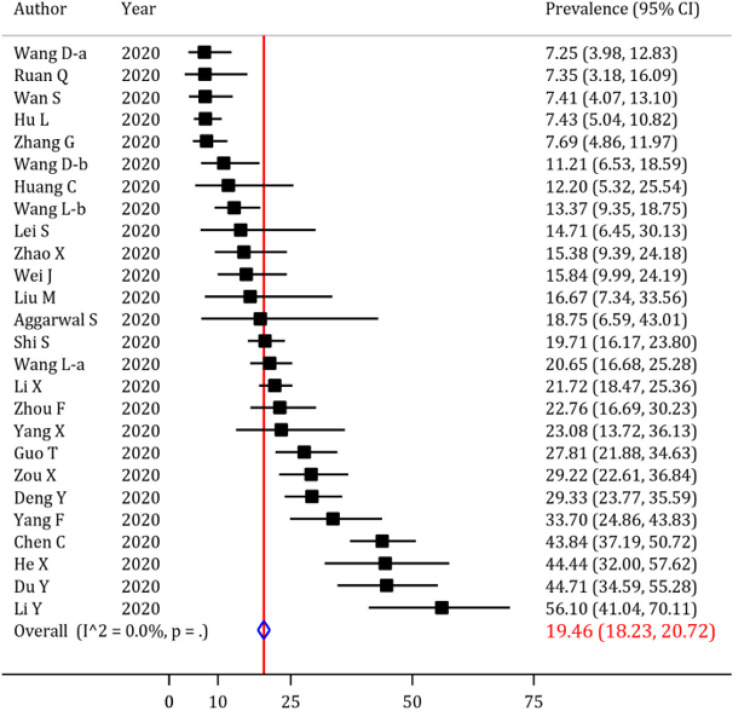
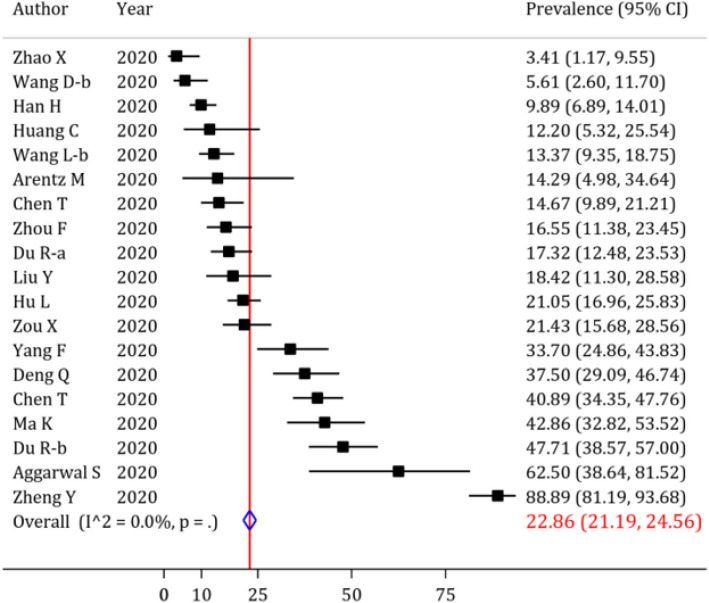
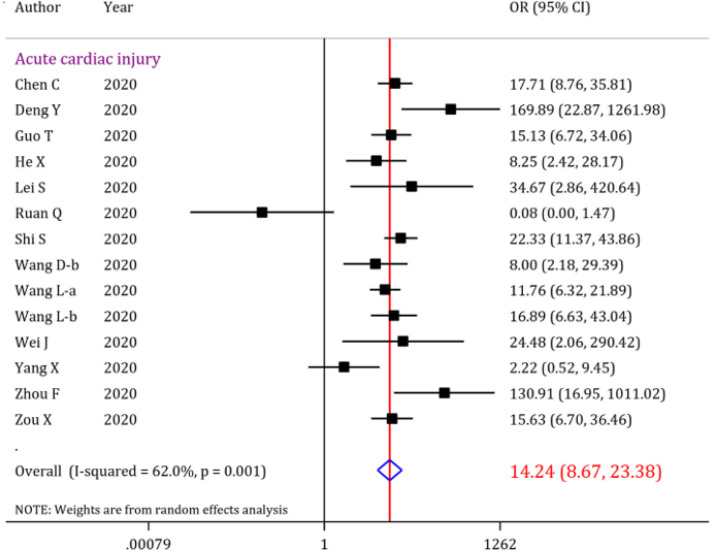
The initial search resulted in 853 records, out of which 40 articles were included. Overall analysis showed that the prevalence of acute cardiac injury, heart failure and cardiac arrest were 19.46% (95% CI: 18.23-20.72), 19.07% (95% CI: 15.38-23.04) and 3.44% (95% CI: 3.08-3.82), respectively. Moreover, abnormal serum troponin level was observed in 22.86% (95% CI: 21.19-24.56) of the COVID-19 patients. Further analysis revealed that the overall odds of mortality is 14.24 (95% CI: 8.67-23.38) times higher when patients develop acute cardiac injury. The pooled odds ratio of mortality when the analysis was limited to abnormal serum troponin level was 19.03 (95% CI: 11.85-30.56).
Acute cardiac injury and abnormal serum troponin level were the most prevalent cardiac complications/abnormalities in COVID-19 patients. The importance of cardiac complications is emphasized due to the higher mortality rate among patients with these complications. Thus, troponin screenings and cardiac evaluations are recommended to be performed in routine patient assessments.
提高对心脏并发症的认识并对其进行管理对患者康复起着关键作用。在本研究中,我们旨在调查有关新冠病毒病(COVID-19)患者心脏并发症患病率及由此导致的死亡率的证据。
除了在预印本数据库以及谷歌和谷歌学术搜索引擎中进行人工检索外,还在Medline(使用PubMed)、Embase、Scopus和Web of Science等电子数据库中检索了2019年至2020年4月30日发表的文章。纳入标准为回顾和报告确诊COVID-19患者的心脏并发症。
初步检索得到853条记录,其中纳入40篇文章。总体分析表明,急性心脏损伤、心力衰竭和心脏骤停的患病率分别为19.46%(95%置信区间:18.23 - 20.72)、19.07%(95%置信区间:15.38 - 23.04)和3.44%(95%置信区间:3.08 - 3.82)。此外,22.86%(95%置信区间:21.19 - 24.56)的COVID-19患者血清肌钙蛋白水平异常。进一步分析显示,患者发生急性心脏损伤时,总体死亡几率高出14.24倍(95%置信区间:8.67 - 23.38)。当分析限于血清肌钙蛋白水平异常时,合并的死亡比值比为19.03(95%置信区间:11.85 - 30.56)。
急性心脏损伤和血清肌钙蛋白水平异常是COVID-19患者中最常见的心脏并发症/异常情况。由于这些并发症患者的死亡率较高,强调了心脏并发症的重要性。因此,建议在常规患者评估中进行肌钙蛋白筛查和心脏评估。