Welsh Claire E, Matthews Fiona E, Jagger Carol
Population Health Sciences Institute, Faculty of Medical Sciences, Newcastle University, England United Kingdom.
Lancet Reg Health Eur. 2021 Mar;2:100023. doi: 10.1016/j.lanepe.2020.100023.
As society ages, promoting the health of the extra years of life is of paramount importance for health, social care and pension provision. Increases in life expectancy in the UK and elsewhere have slowed in recent years, but the reasons for this are unclear. No formal comparison of trends in healthy life years between the UK and the other countries of the EU28 in recent times has been published. These countries are geographically proximate, and share many social, cultural and demographic properties, making them interesting and useful comparators, especially as the UK prepared to leave the European Union in 2020.
We calculated sex-specific healthy life years (HLY), unhealthy life years (ULY), mild and severe ULY at birth and age 65 using life tables and age-specific prevalence of activity limitation amongst the EU28 between 2008 and 2016 from EuroHex. Trends in life expectancy, HLY, ULY and proportion of life spent healthy (HLY%) were compared. We then decomposed HLY temporal changes into relative effects of changes in healthy life and mortality, by age group.
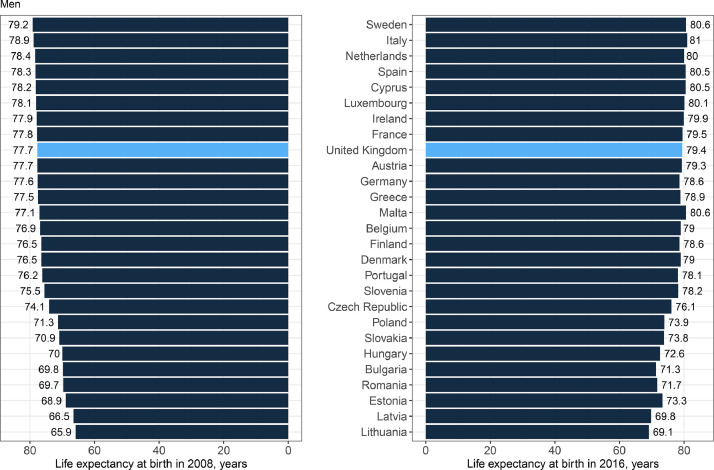
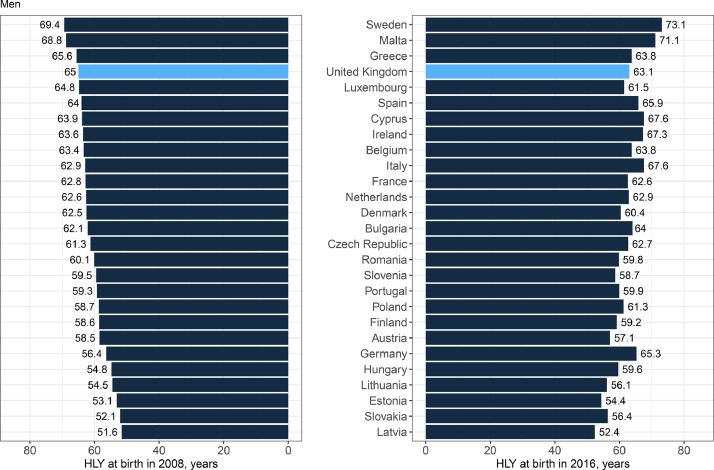
Life expectancy at birth, and age 65, in the UK were increasing rapidly in 2008 but slowed around 2011. Germany, Portugal and France showed evidence of a similar slowing. HLY at birth in the UK decreased, whereas it increased in most EU28 countries. The UK experienced a period of absolute expansion of unhealthy life in both sexes. The reduction in HLY at birth in the UK was mainly attributable to increases in unhealthy life in younger age groups.
The UK's performance relative to the other countries of the EU28 was poor after 2011, combining static life expectancy and reductions in healthy life years. These trends suggest that the UK government's Ageing Society Grand Challenge (to increase the healthy life expectancy by five years by 2035) will be difficult to attain.
National Institute for Health Research (NIHR) Policy Research Programme conducted through the NIHR Older People and Frailty Policy Research Unit, PR-PRU-1217-21502. The views expressed are those of the authors and not necessarily those of the NIHR or the Department of Health and Social Care.
随着社会老龄化,促进延长寿命期间的健康对于健康、社会护理和养老金供应至关重要。近年来,英国及其他地区的预期寿命增长有所放缓,但其原因尚不清楚。近期尚未发表关于英国与欧盟28国其他国家健康生命年趋势的正式比较。这些国家地理位置相近,具有许多社会、文化和人口特征,使其成为有趣且有用的比较对象,特别是在英国准备于2020年脱离欧盟之际。
我们利用生命表以及2008年至2016年欧盟28国活动受限的年龄别患病率(来自EuroHex),计算了出生时和65岁时按性别划分的健康生命年(HLY)、不健康生命年(ULY)、轻度和重度ULY。比较了预期寿命、HLY、ULY和健康生命年占生命的比例(HLY%)的趋势。然后,我们按年龄组将HLY的时间变化分解为健康生命变化和死亡率变化的相对影响。
2008年英国出生时和65岁时的预期寿命增长迅速,但在2011年左右放缓。德国、葡萄牙和法国也出现了类似的放缓迹象。英国出生时的HLY下降,而大多数欧盟28国的HLY上升。英国男女均经历了不健康生命的绝对扩张期。英国出生时HLY的下降主要归因于年轻年龄组不健康生命的增加。
2011年后,英国相对于欧盟28国其他国家的表现不佳,预期寿命停滞不前且健康生命年减少。这些趋势表明,英国政府的老龄化社会重大挑战(到2035年将健康预期寿命提高五年)将难以实现。
通过国家卫生研究院(NIHR)老年人与衰弱政策研究单位开展的NIHR政策研究项目,PR-PRU-1217-21502。所表达的观点为作者观点,不一定代表NIHR或卫生与社会保健部的观点。