Aberdeen Fertility Centre, NHS Grampian and University of Aberdeen, Aberdeen, UK.
National Perinatal Epidemiology Unit, Nuffield Department of Population Health, University of Oxford, Oxford, UK.
Hum Reprod. 2022 Mar 1;37(3):476-487. doi: 10.1093/humrep/deab279.
Does a policy of elective freezing of embryos, followed by frozen embryo transfer result in a higher healthy baby rate, after first embryo transfer, when compared with the current policy of transferring fresh embryos?
This study, although limited by sample size, provides no evidence to support the adoption of a routine policy of elective freeze in preference to fresh embryo transfer in order to improve IVF effectiveness in obtaining a healthy baby.
The policy of freezing all embryos followed by frozen embryo transfer is associated with a higher live birth rate for high responders but a similar/lower live birth after first embryo transfer and cumulative live birth rate for normal responders. Frozen embryo transfer is associated with a lower risk of ovarian hyperstimulation syndrome (OHSS), preterm delivery and low birthweight babies but a higher risk of large babies and pre-eclampsia. There is also uncertainty about long-term outcomes, hence shifting to a policy of elective freezing for all remains controversial given the delay in treatment and extra costs involved in freezing all embryos.
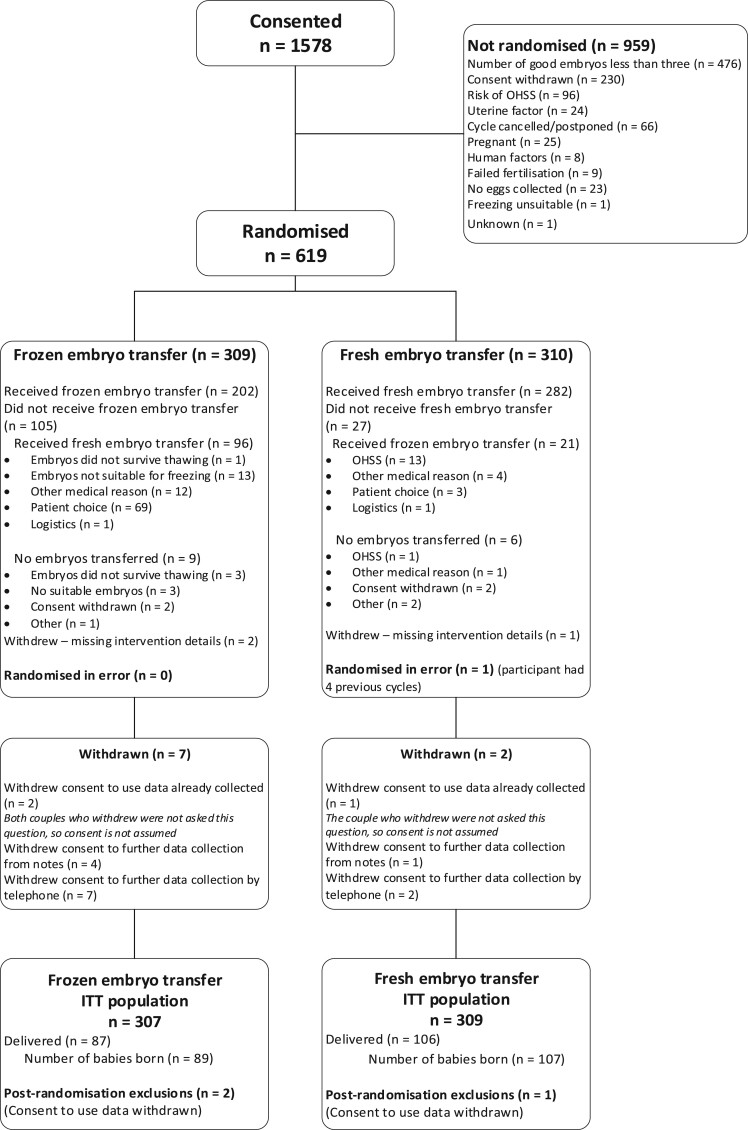
STUDY DESIGN, SIZE, DURATION: A pragmatic two-arm parallel randomized controlled trial (E-Freeze) was conducted across 18 clinics in the UK from 2016 to 2019. A total of 619 couples were randomized (309 to elective freeze/310 to fresh). The primary outcome was a healthy baby after first embryo transfer (term, singleton live birth with appropriate weight for gestation); secondary outcomes included OHSS, live birth, clinical pregnancy, pregnancy complications and cost-effectiveness.
PARTICIPANTS/MATERIALS, SETTING, METHODS: Couples undergoing their first, second or third cycle of IVF/ICSI treatment, with at least three good quality embryos on Day 3 where the female partner was ≥18 and <42 years of age were eligible. Those using donor gametes, undergoing preimplantation genetic testing or planning to freeze all their embryos were excluded. IVF/ICSI treatment was carried out according to local protocols. Women were followed up for pregnancy outcome after first embryo transfer following randomization.
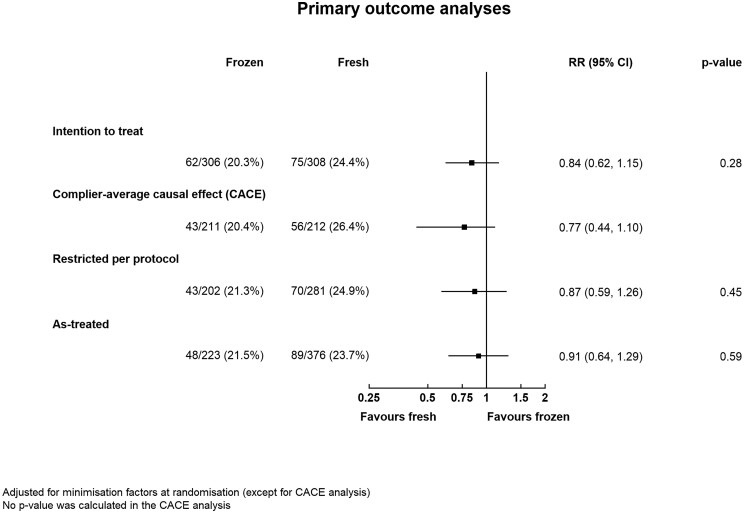
Of the 619 couples randomized, 307 and 309 couples in the elective freeze and fresh transfer arms, respectively, were included in the primary analysis. There was no evidence of a statistically significant difference in outcomes in the elective freeze group compared to the fresh embryo transfer group: healthy baby rate {20.3% (62/307) versus 24.4% (75/309); risk ratio (RR), 95% CI: 0.84, 0.62 to 1.15}; OHSS (3.6% versus 8.1%; RR, 99% CI: 0.44, 0.15 to 1.30); live birth rate (28.3% versus 34.3%; RR, 99% CI 0.83, 0.65 to 1.06); and miscarriage (14.3% versus 12.9%; RR, 99% CI: 1.09, 0.72 to 1.66). Adherence to allocation was poor in the elective freeze group. The elective freeze approach was more costly and was unlikely to be cost-effective in a UK National Health Service context.
LIMITATIONS, REASONS FOR CAUTION: We have only reported on first embryo transfer after randomization; data on the cumulative live birth rate requires further follow-up. Planned target sample size was not obtained and the non-adherence to allocation rate was high among couples in the elective freeze arm owing to patient preference for fresh embryo transfer, but an analysis which took non-adherence into account showed similar results.
Results from the E-Freeze trial do not lend support to the policy of electively freezing all for everyone, taking both efficacy, safety and costs considerations into account. This method should only be adopted if there is a definite clinical indication.
STUDY FUNDING/COMPETING INTEREST(S): NIHR Health Technology Assessment programme (13/115/82). This research was funded by the National Institute for Health Research (NIHR) (NIHR unique award identifier) using UK aid from the UK Government to support global health research. The views expressed in this publication are those of the author(s) and not necessarily those of the NIHR or the UK Department of Health and Social Care. J.L.B., C.C., E.J., P.H., J.J.K., L.L. and G.S. report receipt of funding from NIHR, during the conduct of the study. J.L.B., E.J., P.H., K.S. and L.L. report receipt of funding from NIHR, during the conduct of the study and outside the submitted work. A.M. reports grants from NIHR personal fees from Merck Serono, personal fees for lectures from Merck Serono, Ferring and Cooks outside the submitted work; travel/meeting support from Ferring and Pharmasure and participation in a Ferring advisory board. S.B. reports receipt of royalties and licenses from Cambridge University Press, a board membership role for NHS Grampian and other financial or non-financial interests related to his roles as Editor-in-Chief of Human Reproduction Open and Editor and Contributing Author of Reproductive Medicine for the MRCOG, Cambridge University Press. D.B. reports grants from NIHR, during the conduct of the study; grants from European Commission, grants from Diabetes UK, grants from NIHR, grants from ESHRE, grants from MRC, outside the submitted work. Y.C. reports speaker fees from Merck Serono, and advisory board role for Merck Serono and shares in Complete Fertility. P.H. reports membership of the HTA Commissioning Committee. E.J. reports membership of the NHS England and NIHR Partnership Programme, membership of five Data Monitoring Committees (Chair of two), membership of six Trial Steering Committees (Chair of four), membership of the Northern Ireland Clinical Trials Unit Advisory Group and Chair of the board of Oxford Brain Health Clinical Trials Unit. R.M. reports consulting fees from Gedeon Richter, honorarium from Merck, support fees for attendance at educational events and conferences for Merck, Ferring, Bessins and Gedeon Richter, payments for participation on a Merck Safety or Advisory Board, Chair of the British Fertility Society and payments for an advisory role to the Human Fertilisation and Embryology Authority. G.S. reports travel and accommodation fees for attendance at a health economic advisory board from Merck KGaA, Darmstadt, Germany. N.R.-F. reports shares in Nurture Fertility. Other authors' competing interests: none declared.
ISRCTN: 61225414.
29 December 2015.
DATE OF FIRST PATIENT’S ENROLMENT: 16 February 2016.
与当前的新鲜胚胎移植政策相比,胚胎冷冻后再移植的策略是否会在首次胚胎移植后提高健康婴儿的出生率?
尽管这项研究受到样本量的限制,但它没有提供证据支持采用常规的选择性冷冻策略,以优先于新鲜胚胎移植来提高体外受精获得健康婴儿的效果。
对所有胚胎进行冷冻并随后进行冷冻胚胎移植的策略与高反应者的活产率较高有关,但与正常反应者的首次胚胎移植后活产率和累积活产率相似/较低。冷冻胚胎移植与卵巢过度刺激综合征(OHSS)、早产和低体重儿的风险降低有关,但与巨大儿和先兆子痫的风险增加有关。对于长期结局也存在不确定性,因此,鉴于治疗的延迟和冷冻所有胚胎所涉及的额外成本,转向选择性冷冻的策略仍然存在争议。
研究设计、规模、持续时间:2016 年至 2019 年,英国 18 家诊所开展了一项实用的两臂平行随机对照试验(E-Freeze)。共有 619 对夫妇被随机分配(309 对进行选择性冷冻/310 对进行新鲜胚胎移植)。主要结局是首次胚胎移植后的健康婴儿(足月、单胎活产且胎龄适当);次要结局包括 OHSS、活产、临床妊娠、妊娠并发症和成本效益。
参与者/材料、设置、方法:年龄在 18 岁至 42 岁之间的女性伴侣至少有 3 个优质胚胎的第 3 天接受首次、第二次或第三次 IVF/ICSI 治疗的夫妇有资格参加。使用供体配子、进行植入前遗传学检测或计划冷冻所有胚胎的夫妇被排除在外。根据当地方案进行 IVF/ICSI 治疗。女性在随机分组后随访首次胚胎移植后的妊娠结局。
在 619 对随机分配的夫妇中,307 对和 309 对分别进入选择性冷冻和新鲜胚胎移植组进行主要分析。与新鲜胚胎移植组相比,选择性冷冻组的结局没有统计学意义上的显著差异:健康婴儿率[20.3%(62/307)与 24.4%(75/309);风险比(RR),95%置信区间:0.84,0.62 至 1.15];OHSS[3.6%(22/307)与 8.1%(25/309);RR,99%置信区间:0.44,0.15 至 1.30];活产率[28.3%(87/307)与 34.3%(106/309);RR,99%置信区间:0.83,0.65 至 1.06];和流产率[14.3%(44/307)与 12.9%(39/309);RR,99%置信区间:1.09,0.72 至 1.66]。选择性冷冻组对分配的依从性很差。选择性冷冻方法在英国国家医疗服务体系背景下成本更高,不太可能具有成本效益。
局限性、谨慎原因:我们只报告了随机分组后的首次胚胎移植情况;累积活产率的数据需要进一步随访。计划的目标样本量未达到,由于患者偏爱新鲜胚胎移植,选择性冷冻组的分配依从性率较高,但对考虑分配不依从性的分析显示了类似的结果。
E-Freeze 试验的结果不支持对所有人进行选择性冷冻的策略,既要考虑疗效、安全性和成本因素。只有在有明确的临床指征的情况下,才应采用这种方法。
研究资金/利益冲突:英国国民健康保险制度(NHS)健康技术评估计划(13/115/82)。这项研究由英国国民健康保险制度(NIHR)资助,由英国政府利用英国援助资金支持全球健康研究。本文所表达的观点是作者的观点,而不是英国国民健康保险制度或英国卫生部的观点。J.L.B.、C.C.、E.J.、P.H.、J.J.K.、L.L.和 G.S.报告在研究期间从 NIHR 获得资金。J.L.B.、E.J.、P.H.、K.S.和 L.L.报告在研究期间和研究之外从 NIHR 获得资金。A.M.报告从 NIHR 获得资金,个人从默克雪兰诺获得演讲费,个人从默克雪兰诺、Ferring 和 Cooks 获得讲课费,个人从默克雪兰诺获得专利费,个人从剑桥大学出版社获得版权费,个人从英国国民健康保险制度获得 Ferring 和 Pharmasure 的旅行/会议支持,个人从英国国民健康保险制度获得剑桥大学出版社的董事会成员角色。S.B.报告在剑桥大学出版社有版税和许可证收入,在 Reproductive Medicine for the MRCOG 和 Human Reproduction Open 担任编辑和撰稿人,与他在 NHS Grampian 的编辑委员会角色和其他财务或非财务利益相关。D.B.报告在研究期间从 NIHR 获得资金;从欧洲委员会获得资金;从糖尿病协会获得资金;从 NIHR 获得资金;从 ESHRE 获得资金;从 MRC 获得资金;从 Merck Serono 获得资金。Y.C.报告从默克雪兰诺获得演讲费,从默克雪兰诺、Complete Fertility 获得咨询委员会角色。P.H. 担任 HTA 委托委员会成员。E.J. 担任 NHS England 和 NIHR 合作计划委员会成员;担任五个数据监测委员会主席(其中四个担任主席);担任六个试验指导委员会成员(四个担任主席);担任牛津脑健康临床试验单位咨询小组的成员和董事会主席;担任 Merck、Ferring、Bessins 和 Gedeon Richter 的董事会成员;担任 Merck 安全性或咨询委员会主席;担任英国生育协会主席;担任 Merck KGaA,达姆施塔特,德国的健康经济咨询委员会成员。R.M.报告从 Gedeon Richter 获得咨询费,从 Merck 获得讲课费,从 Merck、Ferring、Bessins 和 Gedeon Richter 获得参加会议和活动的费用,从 Merck 获得参加 Merck Safety 或 Advisory Board 的费用,从 Bessins 获得董事会主席职位,从 Human Fertilisation and Embryology Authority 获得报酬。G.S.报告从默克雪兰诺获得出席 Merck KGaA,达姆施塔特,德国的健康经济咨询委员会的旅行和住宿费用。N.R.-F.报告从 Nurture Fertility 获得股份。其他作者的竞争利益:无。
ISRCTN:61225414。
2015 年 12 月 29 日。
2016 年 2 月 16 日。