Schroedl Clara J, Frogameni Alexandra, Barsuk Jeffrey H, Cohen Elaine R, Sivarajan Lakshmi, Wayne Diane B
Department of Medicine, Northwestern University Feinberg School of Medicine, Chicago, Illinois.
ATS Sch. 2020 Dec 23;2(1):34-48. doi: 10.34197/ats-scholar.2020-0023OC.
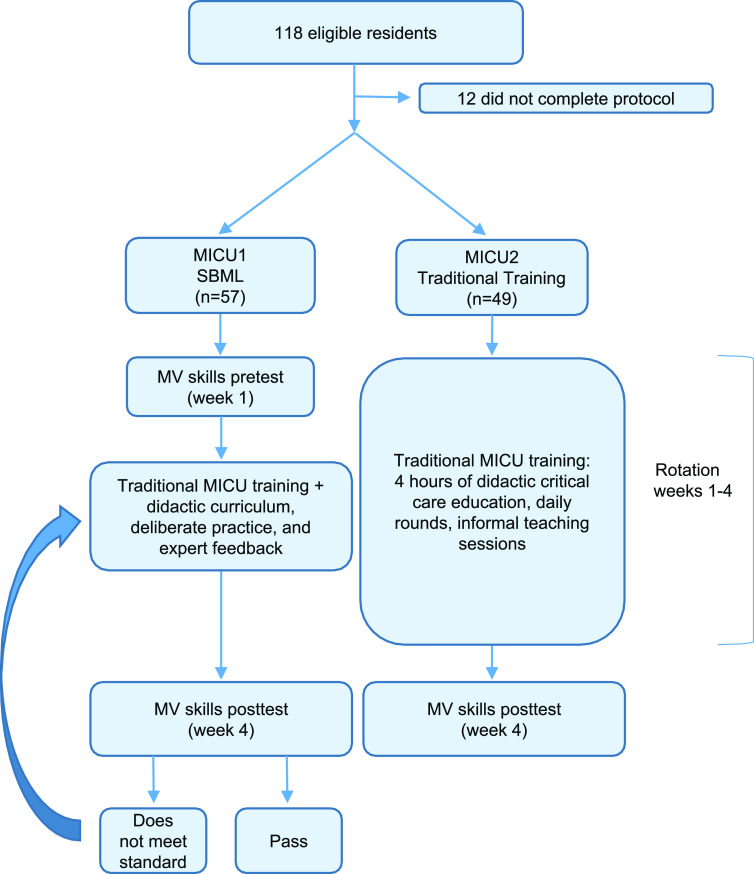
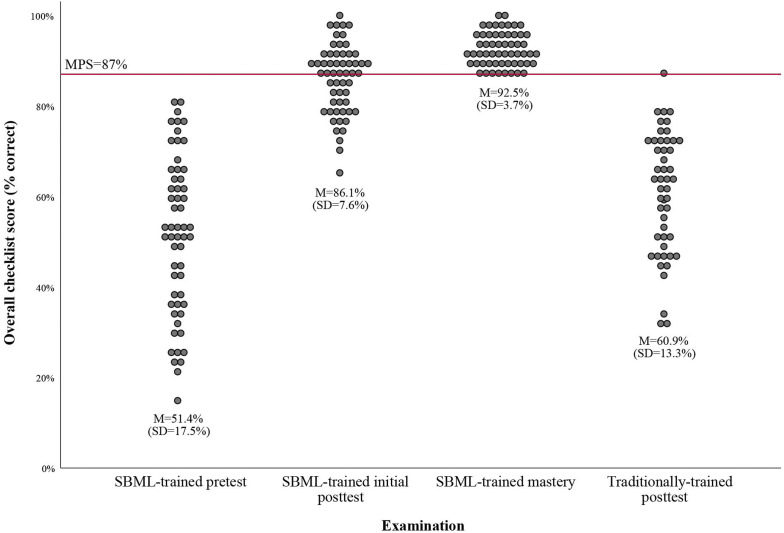
Caring for patients requiring mechanical ventilation is complex, and residents may lack adequate skill for managing these patients. Simulation-based mastery learning (SBML) is an educational model that trains clinicians to a high standard and can reduce complications. The mastery learning model has not been applied to ventilator management. The purpose of this study was to determine whether SBML, as compared with traditional training, is an effective strategy for teaching residents the skills necessary to manage patients requiring mechanical ventilation. We developed an SBML curriculum and a 47-item skills checklist to test ventilator management for patients with normal, restricted, and obstructed lung physiology. A minimum passing standard (MPS) on the checklist was set using the Mastery Angoff method. Residents rotating through the medical intensive care unit in Academic Year 2017-2018 were assigned to SBML or traditional training based on their medical intensive care unit team. The SBML group was pretested on a ventilator simulator using the skills checklist. They then received a 1.5-hour session (45 min didactic and 45 min deliberate practice on the simulator with feedback). At rotation completion, they were posttested on the simulator using the checklist until the MPS was met. Both SBML-trained and traditionally trained groups received teaching during daily bedside rounds and twice weekly didactic lectures. At rotation completion, traditionally trained residents were tested using the same skills checklist on the simulator. We compared pretest and posttest performance among SBML-trained residents and end of the rotation test performances between the SBML-trained and traditionally trained residents. The MPS was set at 87% on the checklist. Fifty-seven residents were assigned to the SBML-trained group and 49 were assigned to the traditionally trained group. Mean checklist scores for SBML-trained residents improved from 51.4% (standard deviation [SD] = 17.5%) at pretest to 86.1% (SD = 7.6%) at initial posttest and 92.5% (SD = 3.7%) at final (mastery) posttest (both < 0.001). Forty-two percent of residents required more than one attempt at the posttest to meet or exceed the MPS. At rotation completion, the traditionally trained residents had a mean test score of 60.9% (SD = 13.3%). SBML is an effective strategy to train residents on mechanical ventilator management. An SBML curriculum may augment traditional training methods to further equip residents to safely manage ventilated patients.
护理需要机械通气的患者情况复杂,住院医师可能缺乏管理这类患者的足够技能。基于模拟的掌握学习(SBML)是一种能将临床医生训练至高标准并可减少并发症的教育模式。掌握学习模式尚未应用于呼吸机管理。本研究的目的是确定与传统培训相比,SBML是否是一种向住院医师传授管理需要机械通气患者所需技能的有效策略。我们制定了一份SBML课程和一份包含47项技能的清单,以测试针对肺生理正常、受限和阻塞患者的呼吸机管理。使用安格夫掌握法设定了清单上的最低及格标准(MPS)。2017 - 2018学年在医学重症监护病房轮转的住院医师根据其所在的医学重症监护病房团队被分配至SBML组或传统培训组。SBML组使用技能清单在呼吸机模拟器上进行预测试。然后他们接受了一个1.5小时的课程(45分钟理论教学和45分钟在模拟器上的刻意练习并给予反馈)。在轮转结束时,他们使用清单在模拟器上进行后测试,直至达到MPS。接受SBML培训和传统培训的两组在每日床边查房期间以及每周两次的理论讲座中都接受教学。在轮转结束时,对接受传统培训的住院医师使用相同的技能清单在模拟器上进行测试。我们比较了接受SBML培训的住院医师的预测试和后测试表现,以及接受SBML培训和传统培训的住院医师在轮转结束时的测试表现。清单上的MPS设定为87%。57名住院医师被分配至SBML培训组,49名被分配至传统培训组。接受SBML培训的住院医师的清单平均得分从预测试时的51.4%(标准差[SD]=17.5%)提高到初次后测试时的86.1%(SD = 7.6%)以及最终(掌握)后测试时的92.5%(SD = 3.7%)(两者均P<0.001)。42%的住院医师在后测试时需要不止一次尝试才能达到或超过MPS。在轮转结束时,接受传统培训的住院医师的平均测试成绩为60.9%(SD = 13.3%)。SBML是培训住院医师进行机械通气管理的有效策略。一份SBML课程可能会增强传统培训方法,以进一步使住院医师有能力安全地管理使用呼吸机的患者。