Purkayastha Purboja, Pendyala Kavya, Saxena Ayush S, Hakimjavadi Hesamedin, Chamala Srikar, Dixit Purushottam, Baer Charles F, Lele Tanmay P
Artie McFerrin Department of Chemical Engineering, Texas A&M University, College Station, TX, USA.
Department of Biomedical Engineering, Texas A&M University, College Station, TX, USA.
Mol Biol Evol. 2021 Jul 29;38(8):3279-3293. doi: 10.1093/molbev/msab102.
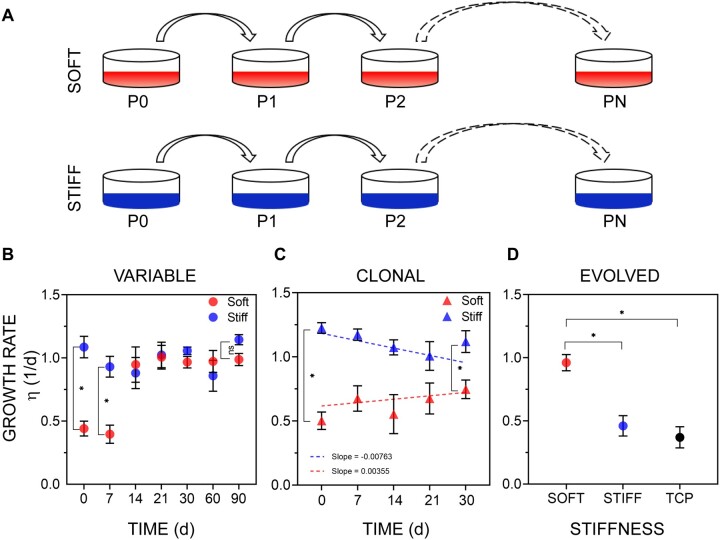
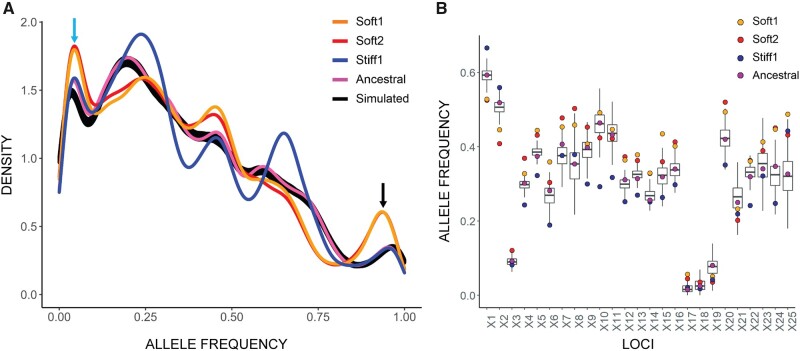
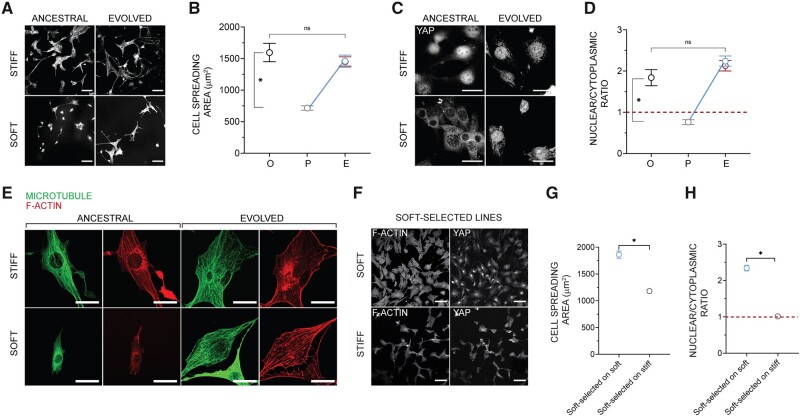
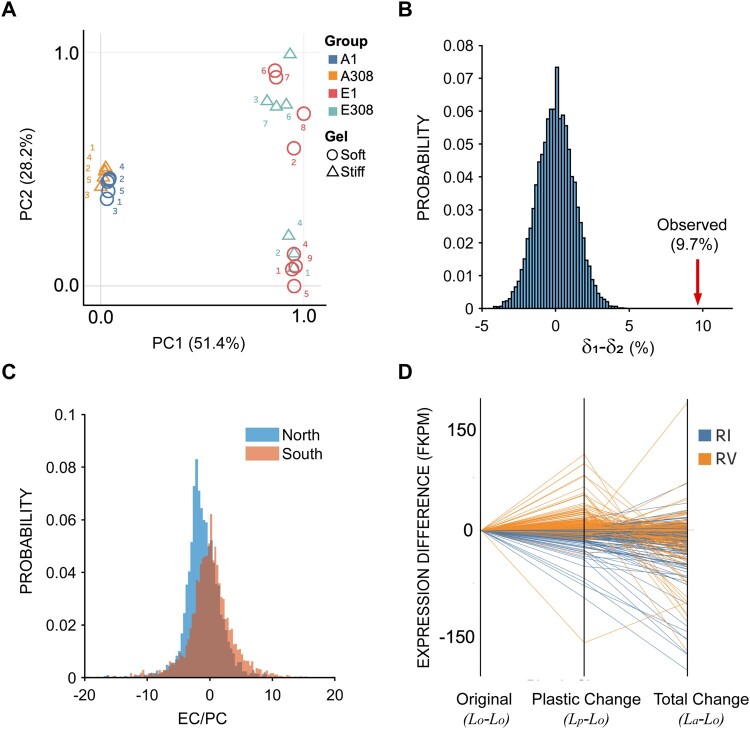
Mechanical properties such as substrate stiffness are a ubiquitous feature of a cell's environment. Many types of animal cells exhibit canonical phenotypic plasticity when grown on substrates of differing stiffness, in vitro and in vivo. Whether such plasticity is a multivariate optimum due to hundreds of millions of years of animal evolution, or instead is a compromise between conflicting selective demands, is unknown. We addressed these questions by means of experimental evolution of populations of mouse fibroblasts propagated for approximately 90 cell generations on soft or stiff substrates. The ancestral cells grow twice as fast on stiff substrate as on soft substrate and exhibit the canonical phenotypic plasticity. Soft-selected lines derived from a genetically diverse ancestral population increased growth rate on soft substrate to the ancestral level on stiff substrate and evolved the same multivariate phenotype. The pattern of plasticity in the soft-selected lines was opposite of the ancestral pattern, suggesting that reverse plasticity underlies the observed rapid evolution. Conversely, growth rate and phenotypes did not change in selected lines derived from clonal cells. Overall, our results suggest that the changes were the result of genetic evolution and not phenotypic plasticity per se. Whole-transcriptome analysis revealed consistent differentiation between ancestral and soft-selected populations, and that both emergent phenotypes and gene expression tended to revert in the soft-selected lines. However, the selected populations appear to have achieved the same phenotypic outcome by means of at least two distinct transcriptional architectures related to mechanotransduction and proliferation.
诸如底物硬度之类的力学性质是细胞环境中普遍存在的特征。许多类型的动物细胞在体外和体内生长在不同硬度的底物上时,会表现出典型的表型可塑性。这种可塑性是由于数亿年的动物进化而形成的多变量最优状态,还是相反,是相互冲突的选择需求之间的一种折衷,目前尚不清楚。我们通过在软或硬底物上繁殖约90个细胞世代的小鼠成纤维细胞群体的实验进化来解决这些问题。祖先细胞在硬底物上的生长速度是软底物上的两倍,并表现出典型的表型可塑性。从遗传多样的祖先群体衍生而来的软选择系在软底物上的生长速度提高到了祖先细胞在硬底物上的水平,并进化出了相同的多变量表型。软选择系中的可塑性模式与祖先模式相反,这表明反向可塑性是观察到的快速进化的基础。相反,从克隆细胞衍生而来的选择系中的生长速度和表型没有变化。总体而言,我们的结果表明这些变化是遗传进化的结果,而不是表型可塑性本身。全转录组分析揭示了祖先群体和软选择群体之间的一致分化,并且在软选择系中,新兴表型和基因表达都倾向于恢复。然而,选择群体似乎通过与机械转导和增殖相关的至少两种不同的转录结构实现了相同的表型结果。