RAND Corporation, 20 Park Plaza #920, Boston, MA, 02216, USA.
RAND Corporation, 20 Park Plaza #920, Boston, MA, 02216, USA.
Drug Alcohol Depend. 2021 Jun 1;223:108710. doi: 10.1016/j.drugalcdep.2021.108710. Epub 2021 Apr 20.
To assess whether per capita buprenorphine distribution varies by regional racial/ethnic composition, Medicaid expansion status, and time period.
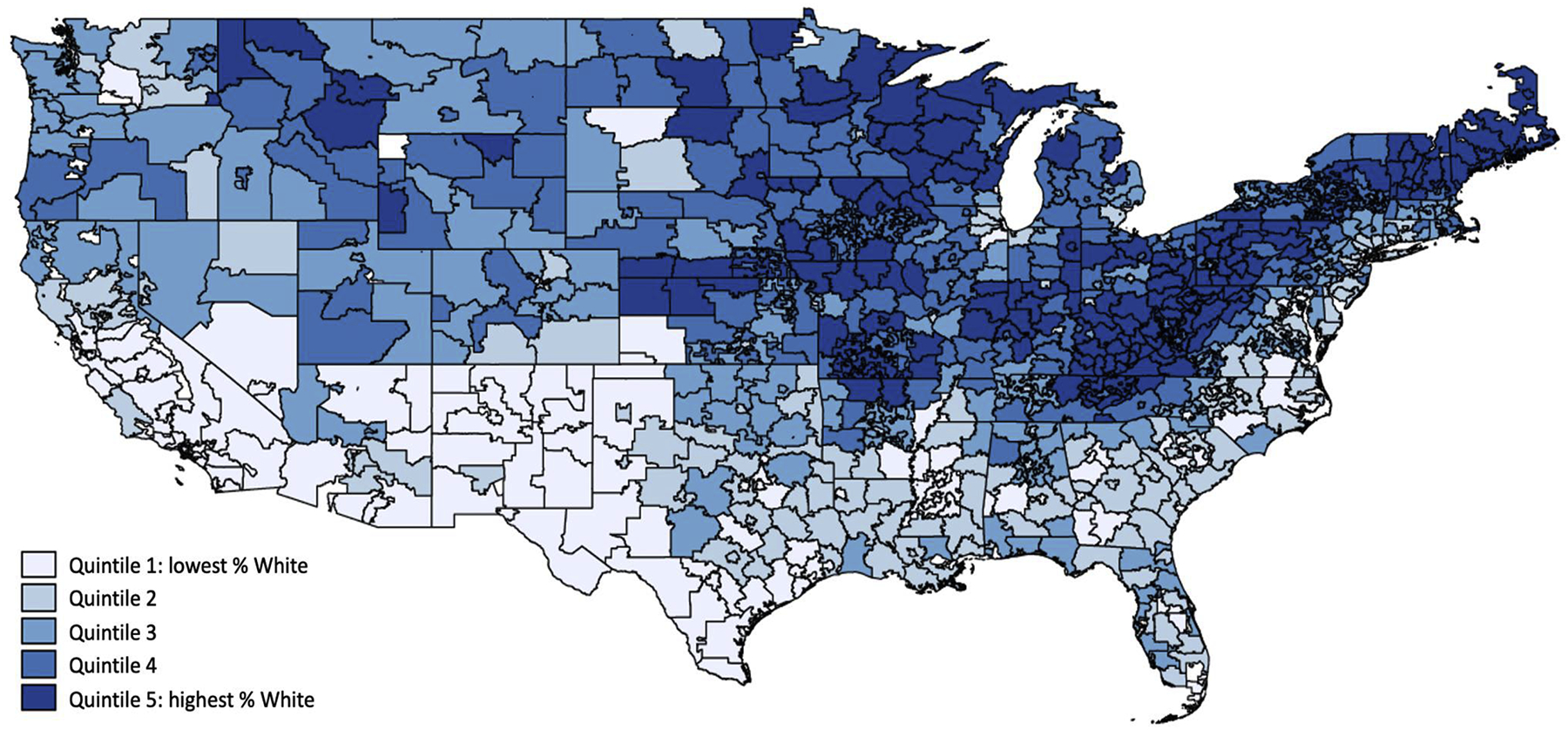
Our unit of analysis -- three-digit ZIP codes ("ZIP3s") -- was classified into quintiles based on percentage of White residents. A weighted linear regression model of buprenorphine distribution -- including White resident quintile, waivered prescriber rate, overdose rate, sociodemographic factors, and year fixed effects -- was estimated using national buprenorphine distribution data from 2007 to 2017. We report predictive margins of the buprenorphine distribution rate by quintile, as well as average marginal effects of waivered prescriber rate on buprenorphine distribution rate for each quintile. Analyses were stratified by Medicaid expansion status and time period (2007-2010, 2011-2014, 2015-2017).
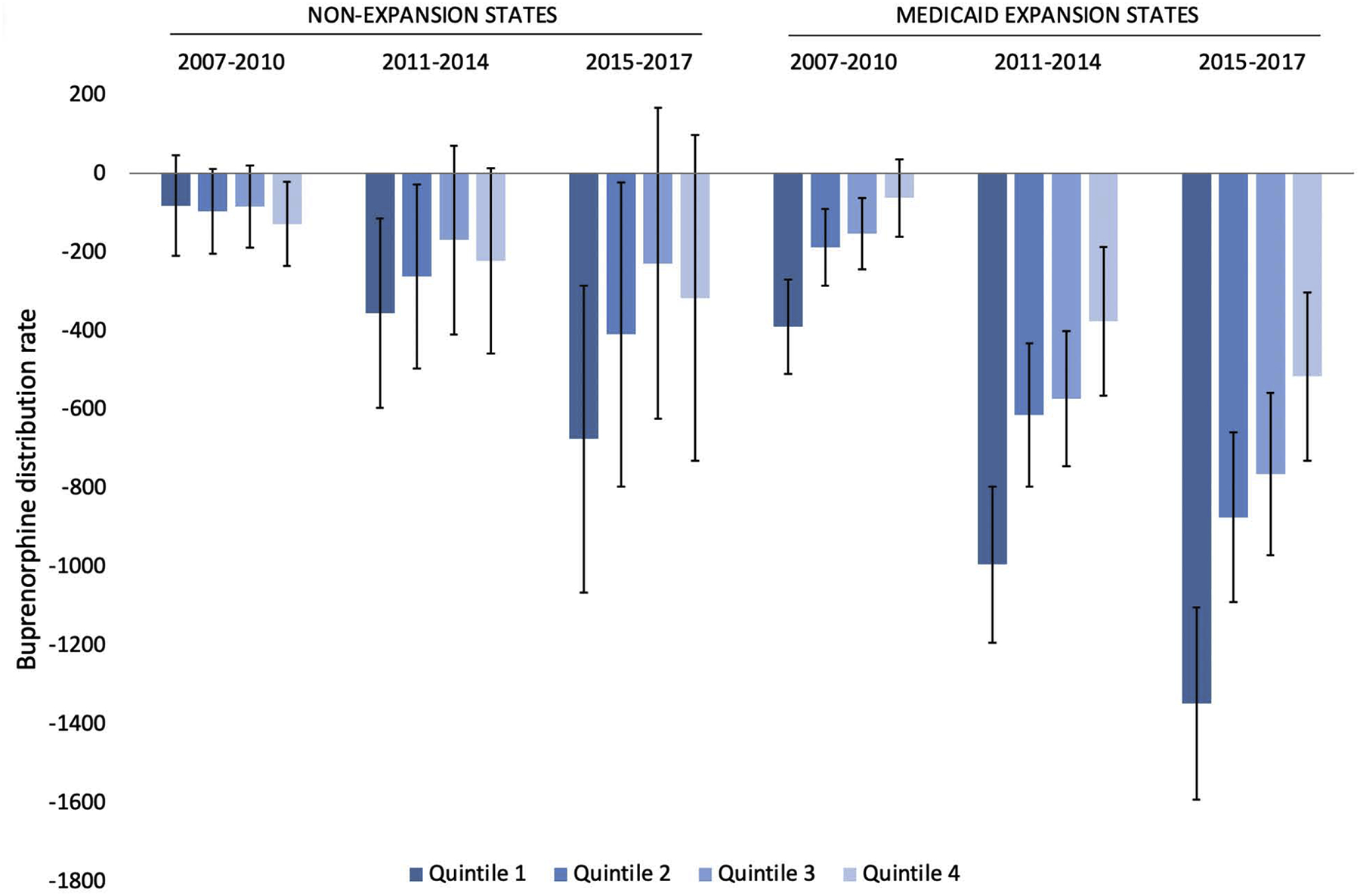
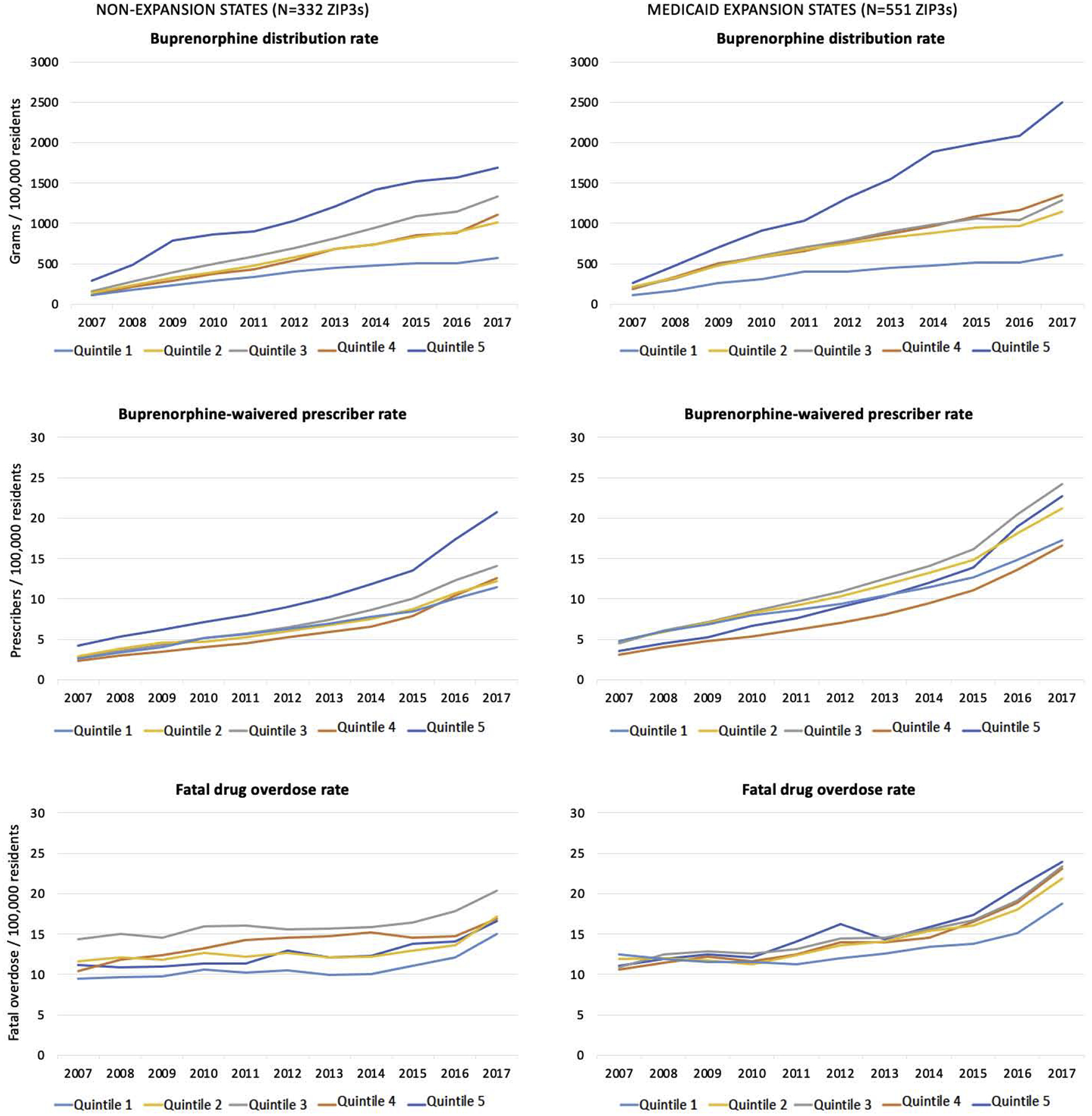
Buprenorphine distribution increased nationally during 2007-2017, yet growth was disproportionately greater for ZIP3s with higher percentages of White residents. Medicaid expansion states exhibited significant differences in buprenorphine distribution across ZIP3 quintiles during 2007-2010, the magnitude of which increased across time periods. Non-expansion states exhibited significant quintile differences during 2011-2014 and 2015-2017. The average marginal effect of increasing the waivered prescriber rate on the distribution rate was consistently smaller in ZIP3s with lower percentages of White residents, particularly in expansion states.
We find ecological evidence consistent with racial/ethnic disparities in buprenorphine distribution. Our finding that increasing the waivered prescriber rate had differential effects by ZIP3 racial/ethnic composition suggest that broad initiatives to increase the number of waivered prescribers are likely insufficient to achieve equitable buprenorphine access. Rather, targeted and tailored policy efforts are warranted.
评估人均丁丙诺啡分布是否因地区种族/民族构成、医疗补助扩展状况和时间段而异。
我们的分析单位——三位数邮政编码(“ZIP3”)——根据白人居民的百分比分为五等份。使用 2007 年至 2017 年全国丁丙诺啡分布数据,采用包括白人居民五等份、豁免处方率、过量率、社会人口因素和年度固定效应的丁丙诺啡分布加权线性回归模型,报告五等份丁丙诺啡分布率的预测边际值,以及每个五等份豁免处方率对丁丙诺啡分布率的平均边际效应。分析按医疗补助扩展状况和时间段(2007-2010 年、2011-2014 年、2015-2017 年)分层。
2007 年至 2017 年间,全国丁丙诺啡的分布有所增加,但白人居民比例较高的 ZIP3 地区的增长幅度不成比例。在 2007-2010 年期间,医疗补助扩展州的 ZIP3 五等份之间的丁丙诺啡分布存在显著差异,而随着时间的推移,这种差异的幅度有所增加。在 2011-2014 年和 2015-2017 年期间,非扩展州的 ZIP3 之间也存在显著的五分位差异。在白人居民比例较低的 ZIP3 中,增加豁免处方率对分布率的平均边际效应始终较小,尤其是在扩展州。
我们发现的生态证据与丁丙诺啡分布的种族/民族差异一致。我们发现,增加豁免处方率对 ZIP3 种族/民族构成的影响存在差异,这表明增加豁免处方者数量的广泛举措可能不足以实现丁丙诺啡的公平获取。相反,需要有针对性和量身定制的政策努力。