Department of Chest Medicine, Taipei Veterans General Hospital, No. 201, Sec. 2, Shih-Pai Road, Taipei, 112, Taiwan, ROC.
School of Medicine, National Yang-Ming University, Taipei, Taiwan, ROC.
Sci Rep. 2021 Apr 19;11(1):8425. doi: 10.1038/s41598-021-86179-1.
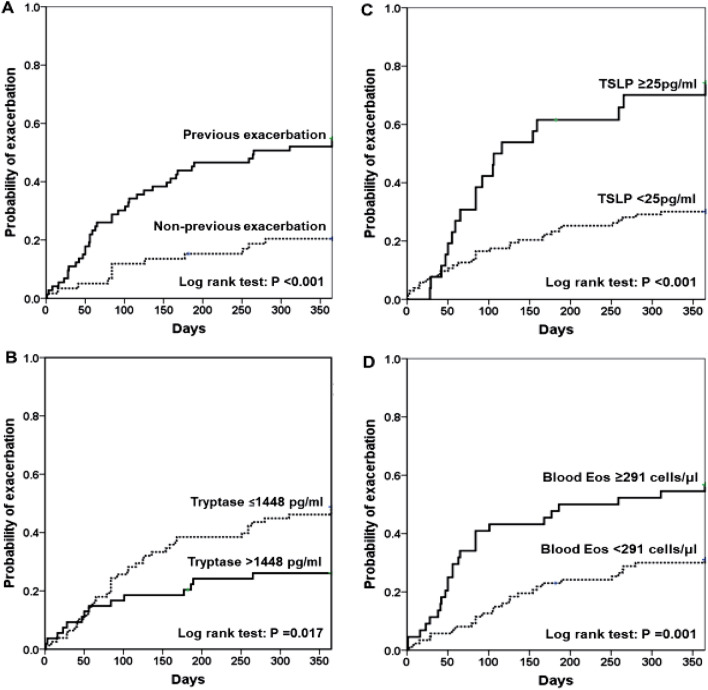
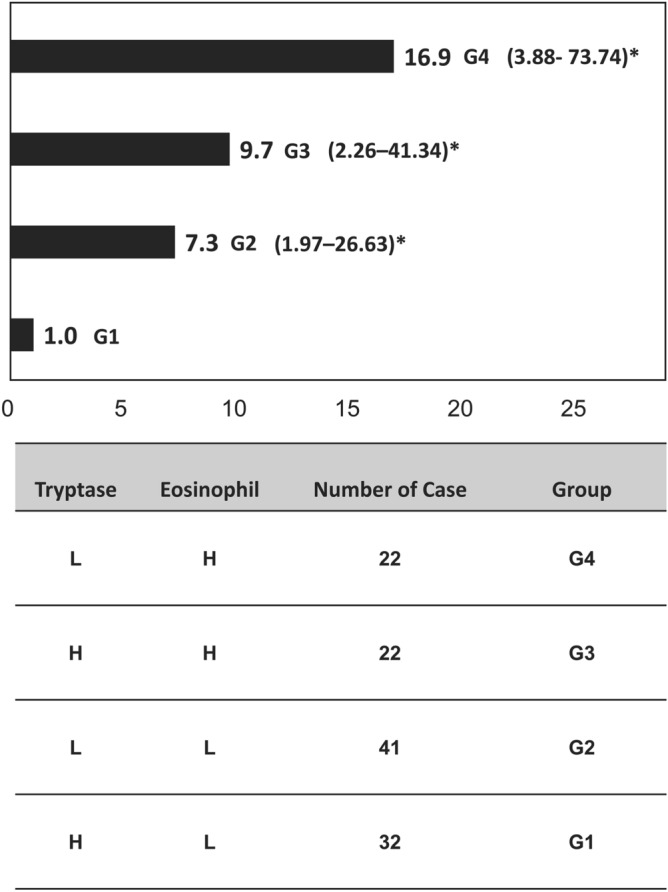
Some patients with severe asthma experience exacerbations despite receiving multiple therapy. The risk of exacerbation and heterogeneous response to treatment may be associated with specific inflammatory molecules that are responsive or resistant to corticosteroids. We aimed to identify the independent factors predictive for the future risk of exacerbation in patients with severe asthma. In this multi-center prospective observational study, 132 patients with severe asthma were enrolled and divided into exacerbation (n = 52) and non-exacerbation (n = 80) groups on the basis of exacerbation rate after a 1-year follow-up period. We found that previous history of severe-to-serious exacerbation, baseline blood eosinophil counts (≥ 291cells/μL), and serum tryptase (≤ 1448 pg/mL) and thrymic stromal lymphopoietin (TSLP) levels (≥ 25 pg/mL) independently predicted the future development of exacerbation with adjusted odds ratios (AOR) of 3.27, 6.04, 2.53 and 8.67, respectively. Notably, the patients with high blood eosinophil counts and low tryptase levels were likely to have more exacerbations than those with low blood eosinophil counts and high tryptase levels (AOR 16.9). TSLP potentially played the pathogenic role across different asthma phenotypes. TSLP and tryptase levels may be implicated in steroid resistance and responsiveness in the asthma inflammatory process. High blood eosinophil counts and low serum tryptase levels predict a high probability of future asthma exacerbation.
一些严重哮喘患者尽管接受了多种治疗仍会出现恶化。恶化的风险和对治疗的异质性反应可能与对皮质类固醇有反应或耐药的特定炎症分子有关。我们旨在确定严重哮喘患者未来恶化风险的独立预测因素。在这项多中心前瞻性观察研究中,我们招募了 132 名严重哮喘患者,并根据 1 年随访期间的恶化率将其分为恶化组(n=52)和非恶化组(n=80)。我们发现,既往严重至严重恶化史、基线血嗜酸性粒细胞计数(≥291 个细胞/μL)以及血清胰蛋白酶(≤1448 pg/mL)和胸腺基质淋巴细胞生成素(TSLP)水平(≥25 pg/mL)可独立预测未来恶化的发展,调整后的优势比(AOR)分别为 3.27、6.04、2.53 和 8.67。值得注意的是,高血嗜酸性粒细胞计数和低胰蛋白酶水平的患者比低血嗜酸性粒细胞计数和高胰蛋白酶水平的患者更容易出现更多的恶化(AOR 16.9)。TSLP 可能在不同的哮喘表型中发挥致病作用。TSLP 和胰蛋白酶水平可能与哮喘炎症过程中的类固醇耐药性和反应性有关。高血嗜酸性粒细胞计数和低血清胰蛋白酶水平预示着未来发生哮喘恶化的可能性较大。