Department of Public Health and Preventive Medicine, St. George's University School of Medicine, True Blue, Grenada, West Indies.
J Epidemiol Glob Health. 2021 Jun;11(2):143-145. doi: 10.2991/jegh.k.210401.001. Epub 2021 Apr 8.
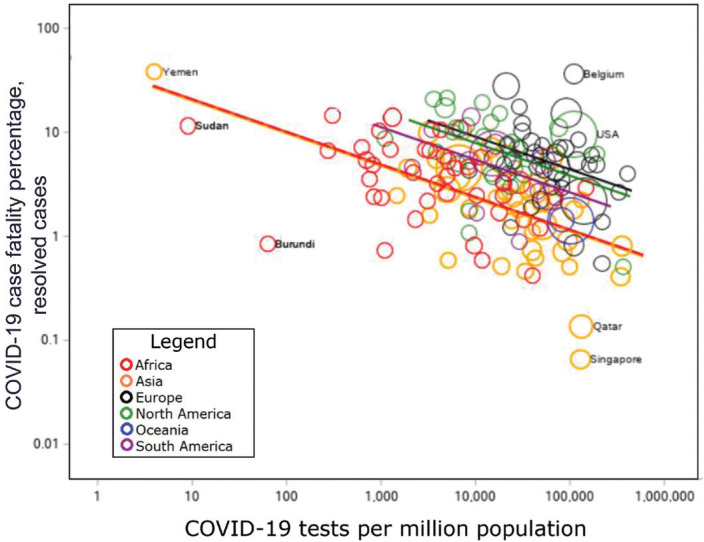
Case fatality rate (CFR) is used to calculate mortality burden of COVID-19 under different scenarios, thus informing risk-benefit balance of interventions both pharmaceutical and nonpharmaceutical. However, observed CFR is driven by testing: as more low-risk cases are identified, observed CFR will decline. This report quantifies test bias by modeling observed CFR as log-log-linear function of test density (tests per population) in 163 countries. CFR declined almost 20% (e.g. from 5% to 4%) for each doubling of test density ( < 0.0001); this association did not vary by continent (interaction > 0.10) although at any given test density CFR was higher in Europe or North America than in Asia or Africa. This effect of test density on observed CFR is adequate to hide all but the largest true differences in case survivorship. Published estimates of CFR should specify test density, and comparisons should correct for it such as by applying the provided model.
病死率(CFR)用于计算不同情况下 COVID-19 的死亡负担,从而告知药物和非药物干预措施的风险效益平衡。然而,观察到的 CFR 受到检测的驱动:随着更多低风险病例被识别,观察到的 CFR 将下降。本报告通过将观察到的 CFR 建模为测试密度(每人口的测试数)的对数-线性函数,量化了测试偏倚在 163 个国家/地区。测试密度每增加一倍(例如,从 5%增加到 4%),CFR 下降近 20%(<0.0001);这种关联不因大陆而异(交互作用> 0.10),尽管在任何给定的测试密度下,欧洲或北美国家的 CFR 高于亚洲或非洲。测试密度对观察到的 CFR 的这种影响足以掩盖病例存活率的所有但最大的真实差异。发表的 CFR 估计应指定测试密度,并且应通过应用提供的模型对其进行校正,例如进行校正。