Guerrini Christi J, Wickenheiser Ray A, Bettinger Blaine, McGuire Amy L, Fullerton Stephanie M
Baylor College of Medicine, Center for Medical Ethics and Health Policy, Houston, TX 77030, USA.
New York State Police Crime Laboratory System, Albany, NY 12226, USA.
J Law Biosci. 2021 Apr 13;8(1):lsab001. doi: 10.1093/jlb/lsab001. eCollection 2021 Jan-Jun.
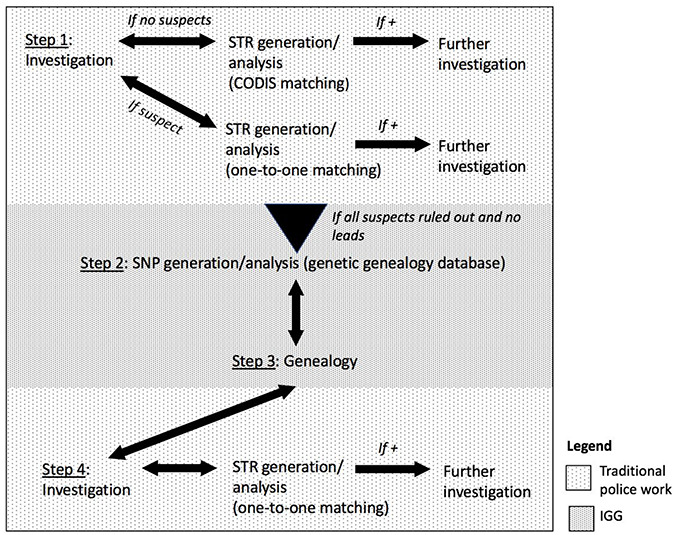
Investigative genetic genealogy (IGG) is a new technique for identifying criminal suspects that has sparked controversy. The technique involves uploading a crime scene DNA profile to one or more genetic genealogy databases with the intention of identifying a criminal offender's genetic relatives and, eventually, locating the offender within the family tree. IGG was used to identify the Golden State Killer in 2018 and it is now being used in connection with hundreds of cases in the USA. Yet, as more law enforcement agencies conduct IGG, the privacy implications of the technique have come under scrutiny. While these issues deserve careful attention, we are concerned that their discussion is, at times, based on misunderstandings related to how IGG is used in criminal investigations and how IGG departs from traditional investigative techniques. Here, we aim to clarify and sharpen the public debate by addressing four misconceptions about IGG. We begin with a detailed description of IGG as it is currently practiced: what it is and-just as important-what it is not. We then examine misunderstood or not widely known aspects of IGG that are potentially confusing efforts to have constructive discussions about its future. We conclude with recommendations intended to support the productivity of those discussions.
调查性遗传系谱学(IGG)是一种用于识别犯罪嫌疑人的新技术,引发了争议。该技术包括将犯罪现场的DNA图谱上传到一个或多个遗传系谱数据库,目的是识别罪犯的遗传亲属,并最终在家族树中找到罪犯。2018年,IGG被用于识别金州杀手,目前美国有数百起案件都在使用该技术。然而,随着越来越多的执法机构采用IGG,该技术对隐私的影响受到了审视。虽然这些问题值得密切关注,但我们担心,有时对这些问题的讨论是基于对IGG在刑事调查中的使用方式以及IGG与传统调查技术的差异的误解。在此,我们旨在通过解决关于IGG的四个误解来澄清并深化公众辩论。我们首先详细描述当前实践中的IGG:它是什么,以及同样重要的,它不是什么。然后,我们审视IGG中被误解或鲜为人知的方面,这些方面可能会干扰关于其未来进行建设性讨论的努力。我们最后提出建议,以支持这些讨论的成效。