Department of Psychology, Promenta Research Centre, University of Oslo, Oslo, Norway.
The Norwegian Institute of Public Health, Oslo, Norway.
Sci Rep. 2021 Apr 21;11(1):8624. doi: 10.1038/s41598-021-87581-5.
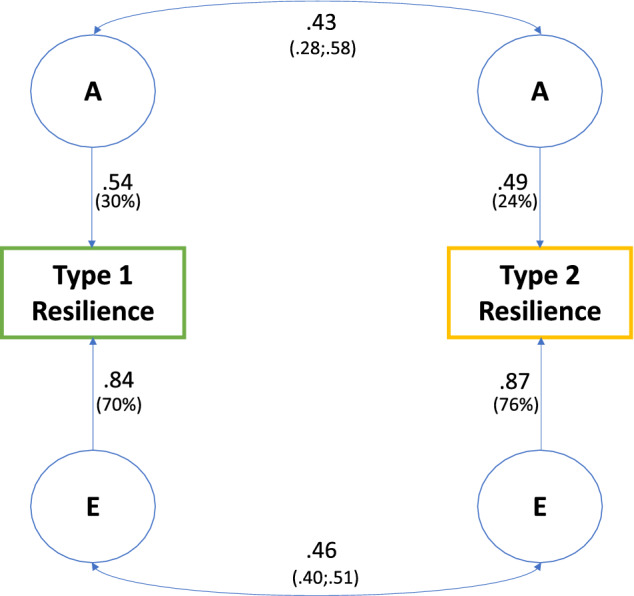
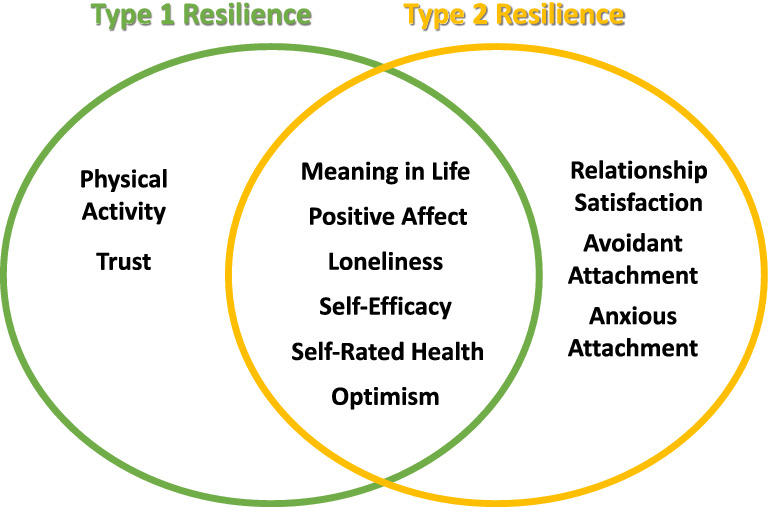
Psychological resilience is indicated when individuals demonstrate good mental health despite exposure to significant stress or adversity. Good mental health may involve low levels of illbeing and/or high levels of wellbeing. There is still very limited knowledge about the potential differences between these outcomes in relation to stressors. We propose a distinction between type 1 and type 2 resilience, examine their underlying genetic and environmental architecture, and identify modifiable resilience factors. The data come from a population-based twin sample (N = 1987, mean age = 63) in the Norwegian Twin Registry. Type 1 and type 2 resilience are operationalised as the residual of anxiety/depression symptoms and life satisfaction, respectively, after lifetime cumulative adversity has been regressed out. We used biometric modelling and cotwin-control linear mixed models to estimate underlying factors and identify predictors while controlling for genetic confounding. The results support the notion of two separate, but partly overlapping types of resilience. We find heritabilities of 0.30 (type 1) and 0.24 (type 2) and a genetic correlation of 0.43. Potentially causal resilience factors include, but are not limited to, meaning in life, physical activity, positive affect and relationship satisfaction. Whereas some factors are associated with both resilience types, other factors are unique to each type.
当个体在面临重大压力或逆境时表现出良好的心理健康时,就表明其具有心理弹性。良好的心理健康可能表现为较低的不适水平和/或较高的幸福感水平。关于这些压力源相关的结果之间的潜在差异,目前的知识仍然非常有限。我们提出了 1 型和 2 型弹性之间的区别,研究了它们潜在的遗传和环境结构,并确定了可改变的弹性因素。这些数据来自挪威双胞胎登记处的基于人群的双胞胎样本(N=1987,平均年龄 63 岁)。1 型和 2 型弹性分别表示焦虑/抑郁症状和生活满意度的残差,分别在回归了终生累积逆境后。我们使用生物计量建模和同卵双胞胎对照线性混合模型来估计潜在因素,并在控制遗传混杂的情况下确定预测因素。结果支持了两种独立但部分重叠的弹性类型的概念。我们发现 1 型的遗传率为 0.30,2 型的遗传率为 0.24,遗传相关性为 0.43。潜在的因果弹性因素包括但不限于生活意义、体育活动、积极情绪和关系满意度。虽然有些因素与两种弹性类型都有关,但其他因素则是每种类型所特有的。