Department of Molecular Biology, Faculty of Science, Radboud University, 6525GA, Nijmegen, The Netherlands.
Murdoch Children's Research Institute, Royal Children's Hospital, Flemington Rd, Parkville, Melbourne, VIC, 3052, Australia.
Cell Mol Life Sci. 2021 May;78(10):4507-4519. doi: 10.1007/s00018-021-03797-8. Epub 2021 Apr 21.
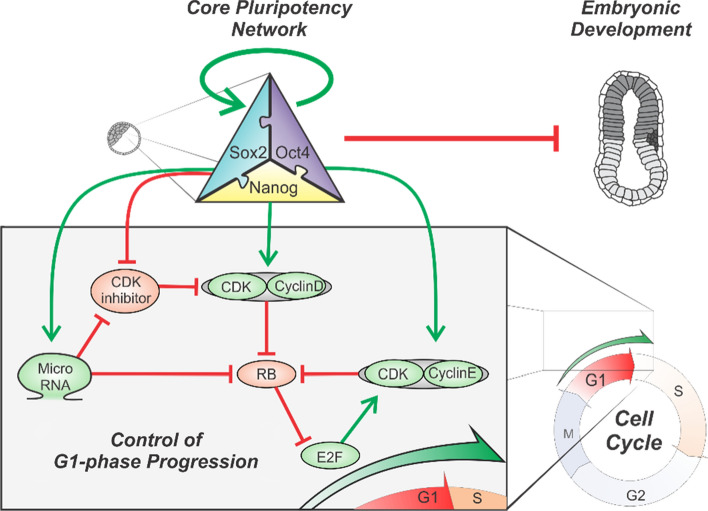
During early embryonic development both the rapid increase in cell number and the expression of genes that control developmental decisions are tightly regulated. Accumulating evidence has indicated that these two seemingly independent processes are mechanistically intertwined. The picture that emerges from studies on the cell cycle of embryonic stem cells is one in which proteins that promote cell cycle progression prevent differentiation and vice versa. Here, we review which transcription factors and signalling pathways play a role in both maintenance of pluripotency as well as cell cycle progression. We will not only describe the mechanism behind their function but also discuss the role of these regulators in different states of mouse pluripotency. Finally, we elaborate on how canonical cell cycle regulators impact on the molecular networks that control the maintenance of pluripotency and lineage specification.
在胚胎早期发育过程中,细胞数量的快速增加和控制发育决策的基因表达都受到严格调控。越来越多的证据表明,这两个看似独立的过程在机制上是相互交织的。胚胎干细胞细胞周期研究的结果表明,促进细胞周期进程的蛋白质可以防止分化,反之亦然。在这里,我们回顾了哪些转录因子和信号通路在维持多能性和细胞周期进程中发挥作用。我们不仅描述了它们功能背后的机制,还讨论了这些调节剂在小鼠多能性不同状态下的作用。最后,我们详细阐述了经典细胞周期调节剂如何影响控制多能性和谱系特化的分子网络。