Chen Hung-Chen, Chen Yung-Che, Wang Tsu-Nai, Fang Wen-Feng, Chang Ya-Chun, Chen Yu-Mu, Chen I-Ya, Lin Meng-Chih, Yang Ming-Yu
Division of Pulmonary and Critical Care Medicine, Department of Medicine, Chang Gung Memorial Hospital-Kaohsiung Medical Center, Chang Gung University College of Medicine, Kaohsiung, Taiwan.
Graduate Institute of Clinical Medical Sciences, College of Medicine, Chang Gung University, Tao-Yuan, Taiwan.
J Asthma Allergy. 2021 Apr 16;14:371-380. doi: 10.2147/JAA.S302508. eCollection 2021.
Circadian clock is synchronized to the 24-hour day by the daily light-dark cycle and proper function of circadian rhythm is essential for many physiological processes. Disruption of circadian rhythm can affect disease processes and influence disease severity, treatment responses, and even survivorship. In this retrospective case-controlled study, we tried to explore whether expression of circadian clock genes was disturbed in patients with bronchial asthma.
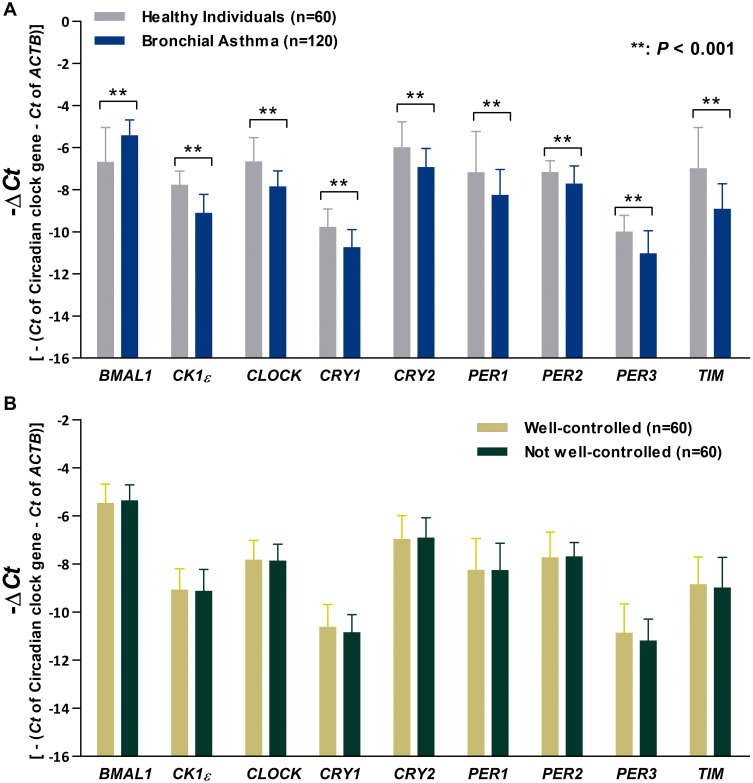
We performed real-time quantitative reverse transcriptase-polymerase chain reactions to examine the expression of the nine core circadian clock genes (, , , , , , , , and ) in total leukocytes of peripheral blood collected at chest clinics from 120 patients with asthma and 60 health individuals.
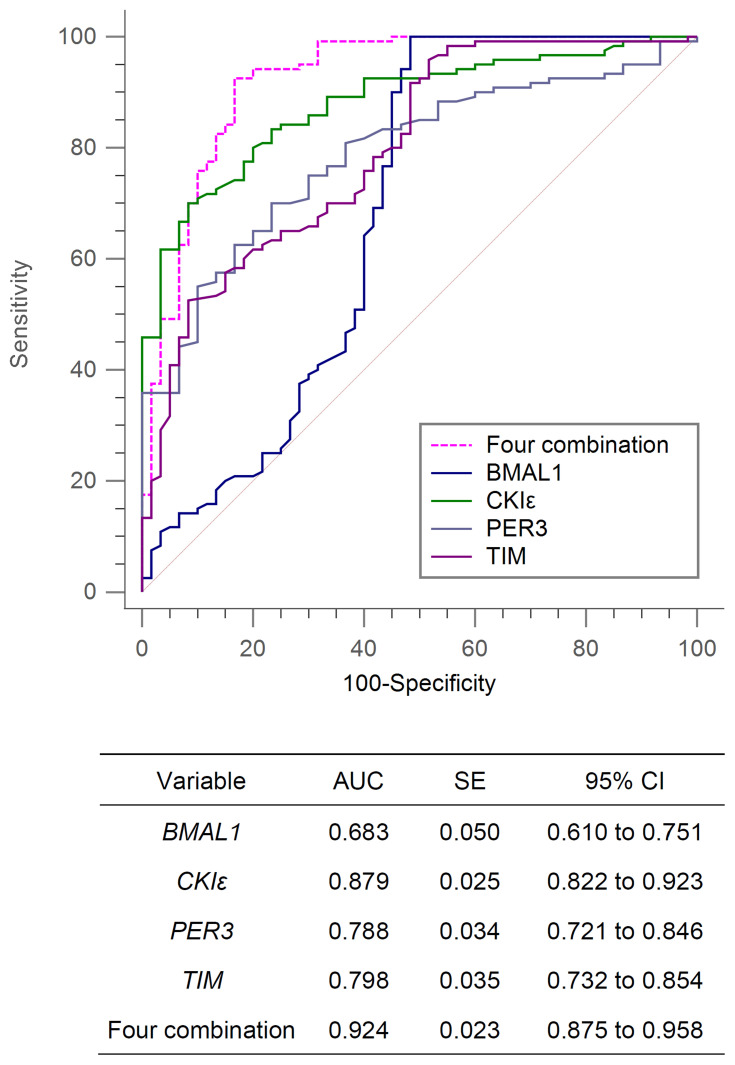
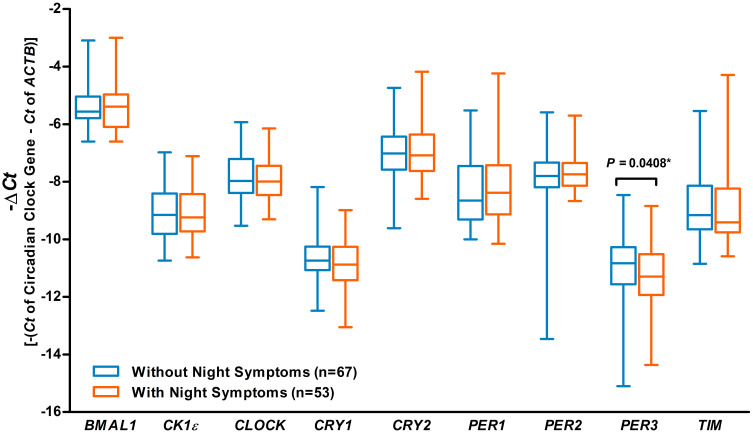
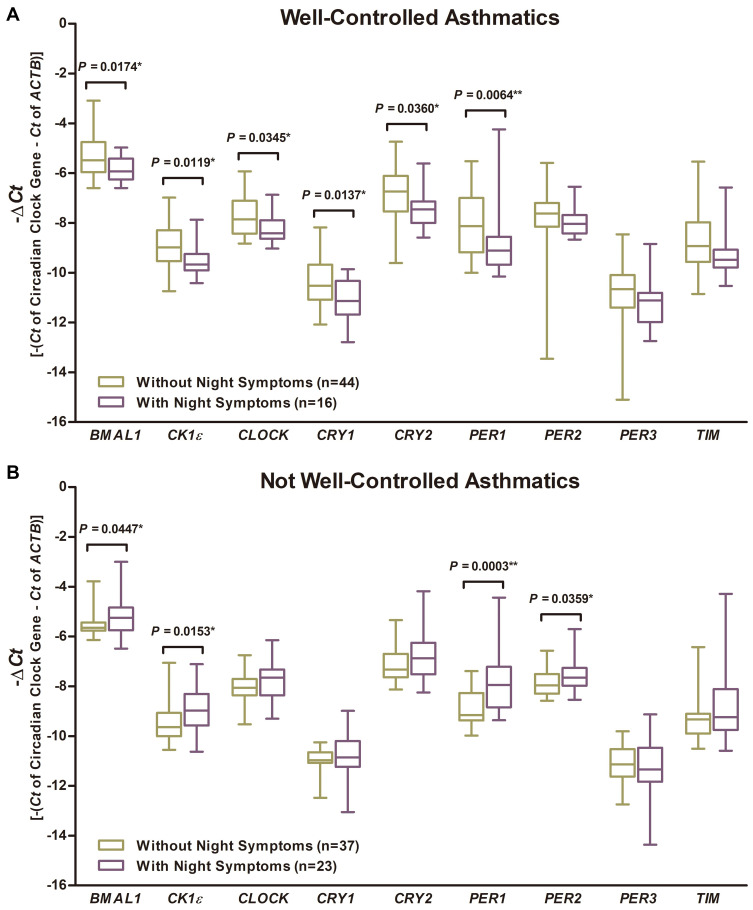
Expression levels of the nine circadian clock genes were significantly different between patients and healthy individuals, but not associated with the asthma control status. We also noted the difference of expression in asthmatic patients with and without nocturnal symptoms. In well-controlled asthmatics, expression of , , , , , and was significantly lower in patients with nocturnal symptoms than those without nocturnal symptoms. However, in not well-controlled asthmatics, expression of only , , , and was significantly different between patients with and without nocturnal symptoms. Binary logistic regression analysis selected , , , and as independent factors for bronchial asthma and ROC curves showed the combined expression of these four genes enhanced the capability of predicting asthma (AUC=0.924; 95% CI=0.875-0.958; <0.001).
Our results showed altered expression of circadian clock genes in patients with bronchial asthma and down-regulated in patients with nocturnal symptoms. Altered expression of circadian clock genes was also observed in asthmatics with or without nocturnal symptoms in well- or not well-controlled subgroups. Combined expression of , , , and could be a potential predictor for bronchial asthma.
昼夜节律时钟通过每日的明暗循环与24小时的一天同步,昼夜节律的正常功能对于许多生理过程至关重要。昼夜节律的破坏会影响疾病进程并影响疾病严重程度、治疗反应甚至生存。在这项回顾性病例对照研究中,我们试图探讨支气管哮喘患者中昼夜节律时钟基因的表达是否受到干扰。
我们进行了实时定量逆转录聚合酶链反应,以检测从120例哮喘患者和60名健康个体的胸部诊所采集的外周血总白细胞中九个核心昼夜节律时钟基因( 、 、 、 、 、 、 、 和 )的表达。
九个昼夜节律时钟基因的表达水平在患者和健康个体之间存在显著差异,但与哮喘控制状态无关。我们还注意到有和没有夜间症状的哮喘患者中 表达的差异。在控制良好的哮喘患者中,有夜间症状的患者中 、 、 、 、 和 的表达明显低于没有夜间症状的患者。然而,在控制不佳的哮喘患者中,只有 、 、 、 和 的表达在有和没有夜间症状的患者之间存在显著差异。二元逻辑回归分析选择 、 、 、 和 作为支气管哮喘的独立因素,ROC曲线显示这四个基因的联合表达增强了预测哮喘的能力(AUC = 0.924;95% CI = 0.875 - 0.958;<0.001)。
我们的结果表明支气管哮喘患者中昼夜节律时钟基因表达改变,有夜间症状的患者中 表达下调。在控制良好或控制不佳的亚组中,有或没有夜间症状的哮喘患者中也观察到昼夜节律时钟基因表达改变。 、 、 、 和 的联合表达可能是支气管哮喘的潜在预测指标。