Zheng Qingyuan, Zhang Shuijun, Guo Wen-Zhi, Li Xiao-Kang
Department of Hepatobiliary and Pancreatic Surgery, The First Affiliated Hospital of Zhengzhou University, Zhengzhou, China.
Division of Transplantation Immunology, National Research Institute for Child Health and Development, Tokyo, Japan.
Front Immunol. 2021 Apr 6;12:659621. doi: 10.3389/fimmu.2021.659621. eCollection 2021.
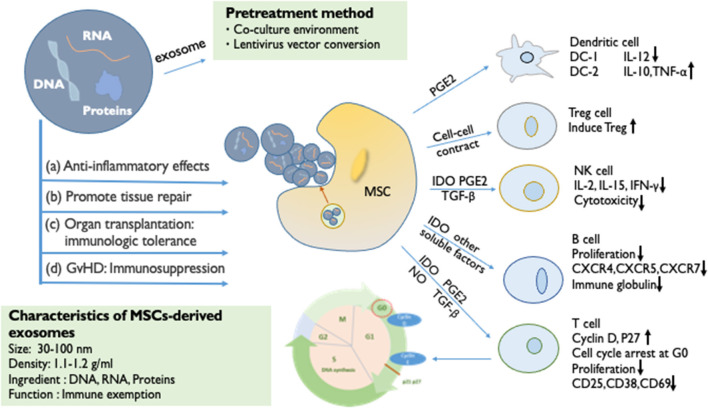
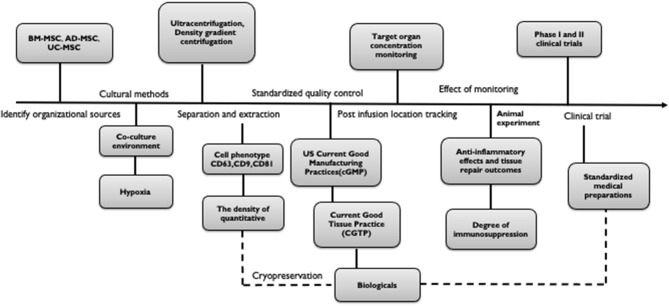
Methods for suppressing the host immune system over the long term and improving transplantation tolerance remain a primary issue in organ transplantation. Cell therapy is an emerging therapeutic strategy for immunomodulation after transplantation. Mesenchymal stem cells (MSCs) are adult multipotent stem cells with wide differentiation potential and immunosuppressive properties, which are mostly used in regenerative medicine and immunomodulation. In addition, emerging research suggests that MSC-derived exosomes have the same therapeutic effects as MSCs in many diseases, while avoiding many of the risks associated with cell transplantation. Their unique immunomodulatory properties are particularly important in the immune system-overactive graft environment. In this paper, we review the effects of MSC-derived exosomes in the immune regulation mechanism after organ transplantation and graft-versus-host disease (GvHD) from various perspectives, including immunosuppression, influencing factors, anti-inflammatory properties, mediation of tissue repair and regeneration, and the induction of immune tolerance. At present, the great potential of MSC-derived exosomes in immunotherapy has attracted a great deal of attention. Furthermore, we discuss the latest insights on MSC-derived exosomes in organ transplantation and GvHD, especially its commercial production concepts, which aim to provide new strategies for improving the prognosis of organ transplantation patients.
长期抑制宿主免疫系统并提高移植耐受性的方法仍然是器官移植中的首要问题。细胞疗法是移植后免疫调节的一种新兴治疗策略。间充质干细胞(MSCs)是具有广泛分化潜能和免疫抑制特性的成体多能干细胞,主要用于再生医学和免疫调节。此外,新出现的研究表明,源自间充质干细胞的外泌体在许多疾病中具有与间充质干细胞相同的治疗效果,同时避免了许多与细胞移植相关的风险。它们独特的免疫调节特性在免疫系统过度活跃的移植环境中尤为重要。在本文中,我们从多个角度综述了源自间充质干细胞的外泌体在器官移植和移植物抗宿主病(GvHD)后免疫调节机制中的作用,包括免疫抑制、影响因素、抗炎特性、组织修复和再生的介导以及免疫耐受的诱导。目前,源自间充质干细胞的外泌体在免疫治疗中的巨大潜力已引起广泛关注。此外,我们讨论了关于源自间充质干细胞的外泌体在器官移植和GvHD方面的最新见解,特别是其商业化生产概念,旨在为改善器官移植患者的预后提供新策略。