Mason Joel, Wellmann Kai, Groll Andreas, Braumann Klaus-Michael, Junge Astrid, Hollander Karsten, Zech Astrid
Institute of Sports Science, University of Jena, Jena, Germany.
Department of Statistics, TU Dortmund University, Dortmund, Germany.
Orthop J Sports Med. 2021 Apr 6;9(4):2325967121995167. doi: 10.1177/2325967121995167. eCollection 2021 Apr.
Identifying factors that contribute to the occurrence of injury is an important step in designing training programs to minimize the risk of injury. However, despite high injury rates, variables contributing to injury in field hockey players remain relatively unexplored.
To identify factors that may predict injury in professional and youth field hockey players.
Cohort study; Level of evidence, 2.
Professional and youth hockey players completed preseason neuromuscular performance testing and were monitored for injuries, training, and game exposure throughout the subsequent 12-month indoor and outdoor hockey season. Least absolute shrinkage and selection operator analysis was conducted to identify injury risk factors. Receiver operating characteristic curves were then calculated to determine the individual predictive accuracy of the identified variables.
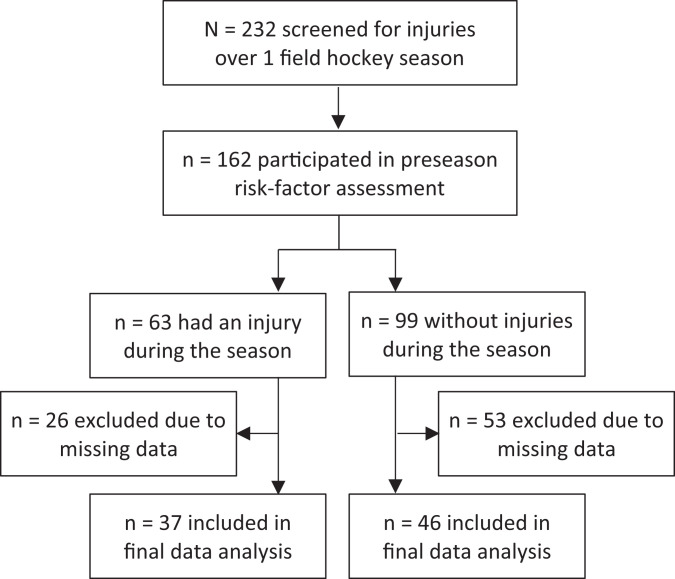
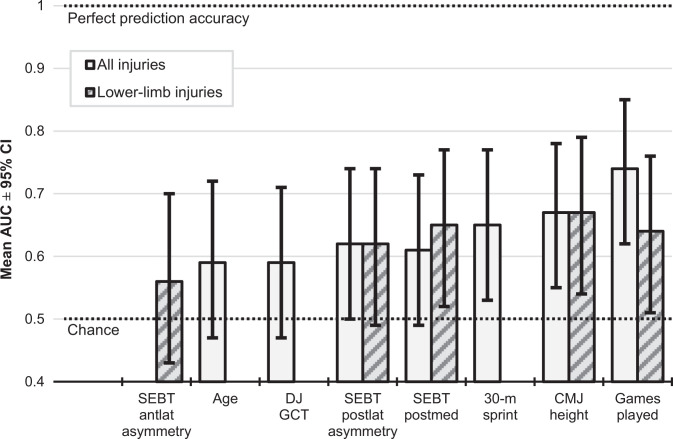
A total of 83 players (mean ± SD age, 20.7 ± 4.9 years; 34.9% female) with complete performance, injury, and exposure data were included for data analysis. Almost half of players (44.6%) sustained a time-loss injury during the season, and 73% of these injuries occurred in the lower limb. Playing more games and having an older age, asymmetrical and poor dynamic postural control, and better explosive performance were identified as jointly influencing the risk of injury. When considered individually, number of games played throughout the season was the most accurate predictor of injury risk (area under the curve [AUC] = 0.74; < .001), while asymmetrical and poor dynamic postural control (AUCs = 0.61-0.65; = .01-.04) and better explosive athletic performance (AUCs = 0.65-0.67; < .01) were identified as moderate individual predictors of sustaining a general or lower limb injury.
A number of modifiable factors were individually and jointly associated with an increased injury risk in field hockey players, providing initial evidence for the design of targeted and sport-specific training programs to mitigate the risk of injury.
确定导致受伤的因素是设计训练计划以将受伤风险降至最低的重要一步。然而,尽管曲棍球运动员的受伤率很高,但导致其受伤的相关变量仍未得到充分研究。
确定可能预测职业和青少年曲棍球运动员受伤的因素。
队列研究;证据等级,2级。
职业和青少年曲棍球运动员在季前进行了神经肌肉性能测试,并在随后为期12个月的室内和室外曲棍球赛季中对其受伤情况、训练和比赛情况进行监测。采用最小绝对收缩和选择算子分析来确定受伤风险因素。然后计算受试者工作特征曲线,以确定所识别变量的个体预测准确性。
共有83名运动员(平均年龄±标准差为20.7±4.9岁;女性占34.9%)的完整性能、受伤和暴露数据纳入数据分析。几乎一半的运动员(44.6%)在赛季中遭受了导致停赛的伤病,其中73%的伤病发生在下肢。比赛场次较多、年龄较大、动态姿势控制不对称和较差以及爆发力较好被确定为共同影响受伤风险的因素。单独考虑时,整个赛季的比赛场次是受伤风险最准确的预测指标(曲线下面积[AUC]=0.74;P<.001),而动态姿势控制不对称和较差(AUC=0.61-0.65;P=.01-.04)以及爆发力较好(AUC=0.65-0.67;P<.01)被确定为发生一般性或下肢伤病的中度个体预测指标。
一些可改变的因素与曲棍球运动员受伤风险增加单独或共同相关,为设计针对性的、特定运动的训练计划以降低受伤风险提供了初步证据。