Mason Joel, Kniewasser Christoph, Hollander Karsten, Zech Astrid
Department of Human Movement Science and Exercise Physiology, Friedrich Schiller University Jena, Seidelstraße 20, 07749, Jena, Germany.
Institute of Interdisciplinary Exercise Science and Sports Medicine, Medical School Hamburg, Hamburg, Germany.
Sports Med Open. 2022 Nov 18;8(1):139. doi: 10.1186/s40798-022-00530-y.
Ankle sprains remain prevalent across most team sports. However, despite divergent ankle sprain injury rates in male and female athletes, little is known about potential sex-specific risk factors for ankle sprain.
To systematically investigate the sex-specific risk factors for ankle sprain.
Combinations of the key terms were entered into PubMed, Web of Science, Embase and Cochrane Library databases, and prospective studies reporting ankle sprain risk factors in males or females were included for meta-analysis.
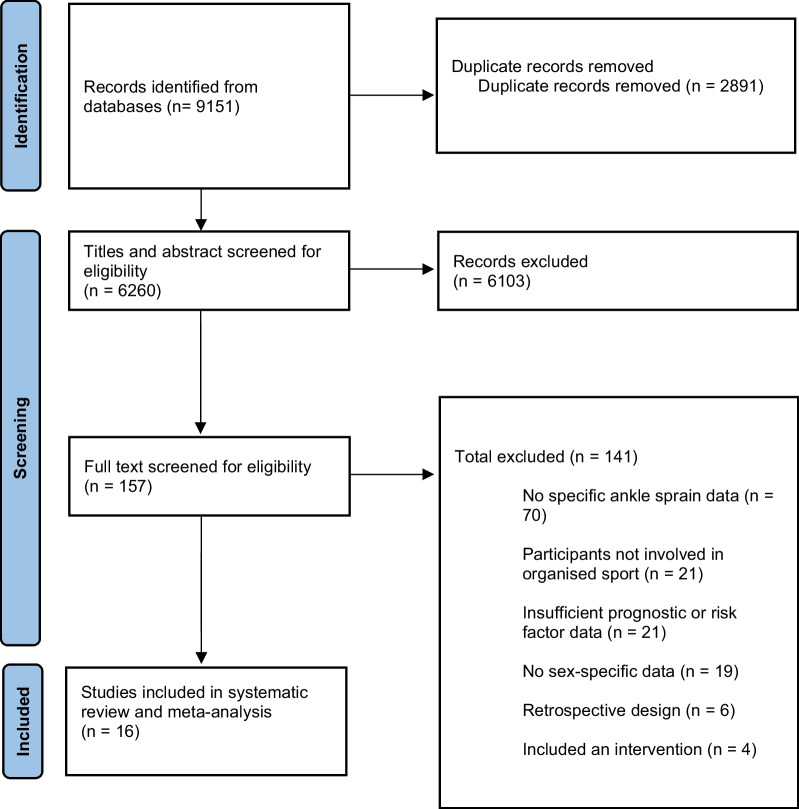
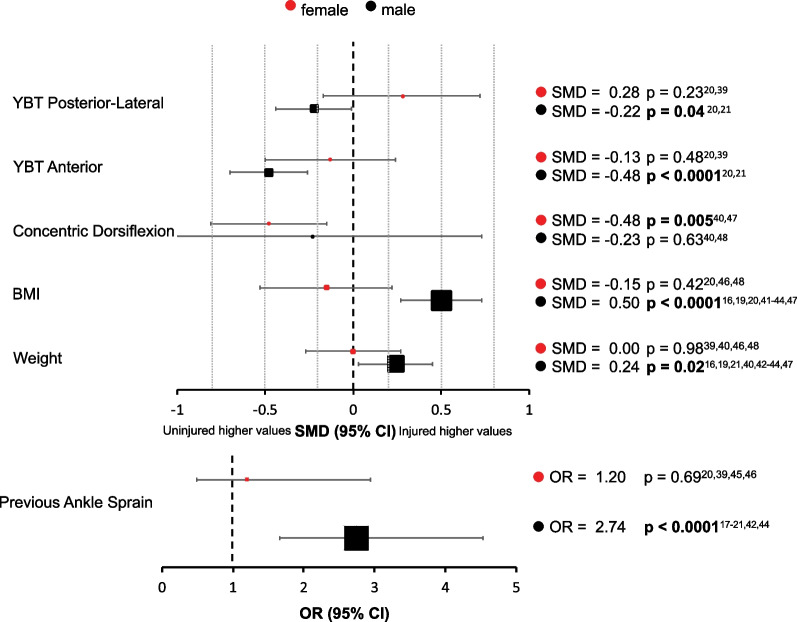
Sixteen studies were eligible for inclusion, for a total of 3636 athletes (735 female) and 576 ankle sprains (117 female). Out of 21 prognostic factors, previous ankle sprain injury (odds ratio = 2.74, P < .001), higher body mass index (SMD = 0.50, P < 0.001), higher weight (SMD = 0.24, P = 0.02), lower isometric hip abduction strength (SMD = - 0.52, P < 0.0001) and lower dynamic balance performance (SMD = - 0.48 to - 0.22, P < 0.001-0.04) were identified as risk factors in male athletes. In female athletes, out of 18 factors eligible for meta-analysis, only lower concentric dorsiflexion strength was identified as a risk factor (SMD = - 0.48, P = 0.005).
This meta-analysis provides novel evidence for different risk factor profiles for ankle sprain injuries between female and male athletes. Further studies, particularly in female athletes, are needed to strengthen the evidence.
在大多数团队运动中,踝关节扭伤仍然很常见。然而,尽管男女运动员的踝关节扭伤发生率存在差异,但对于踝关节扭伤潜在的性别特异性风险因素却知之甚少。
系统地研究踝关节扭伤的性别特异性风险因素。
将关键术语组合输入到PubMed、科学网、Embase和Cochrane图书馆数据库中,并纳入报告男性或女性踝关节扭伤风险因素的前瞻性研究进行荟萃分析。
16项研究符合纳入标准,共有3636名运动员(735名女性)和576例踝关节扭伤(117例女性)。在21个预后因素中,既往踝关节扭伤史(优势比=2.74,P<0.001)、较高的体重指数(标准化均数差=0.50,P<0.001)、较高的体重(标准化均数差=0.24,P=0.02)、较低的等长髋关节外展力量(标准化均数差=-0.52,P<0.0001)和较低的动态平衡能力(标准化均数差=-0.48至-0.22,P<0.001-0.04)被确定为男性运动员的风险因素。在女性运动员中,在18个符合荟萃分析条件的因素中,只有较低的向心背屈力量被确定为风险因素(标准化均数差=-0.48,P=0.005)。
这项荟萃分析为男女运动员踝关节扭伤损伤的不同风险因素特征提供了新的证据。需要进一步的研究,特别是针对女性运动员的研究,以加强证据。