Yang Tse-Chuan, Kim Seulki, Zhao Yunhan, Choi Seung-Won Emily
Department of Sociology, University at Albany, SUNY, 351 AS, 1400 Washington Ave., Albany, NY, 12222, USA.
Department of Sociology, Anthropology, and Social Work, Texas Tech University, 66 Holden Hall, 1011 Boston Ave, Lubbock, TX, 79409, USA.
Health Place. 2021 May;69:102574. doi: 10.1016/j.healthplace.2021.102574. Epub 2021 Apr 17.
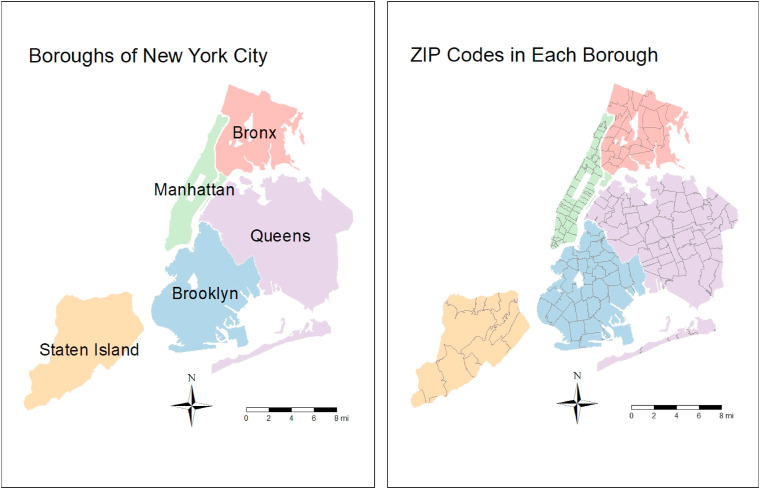
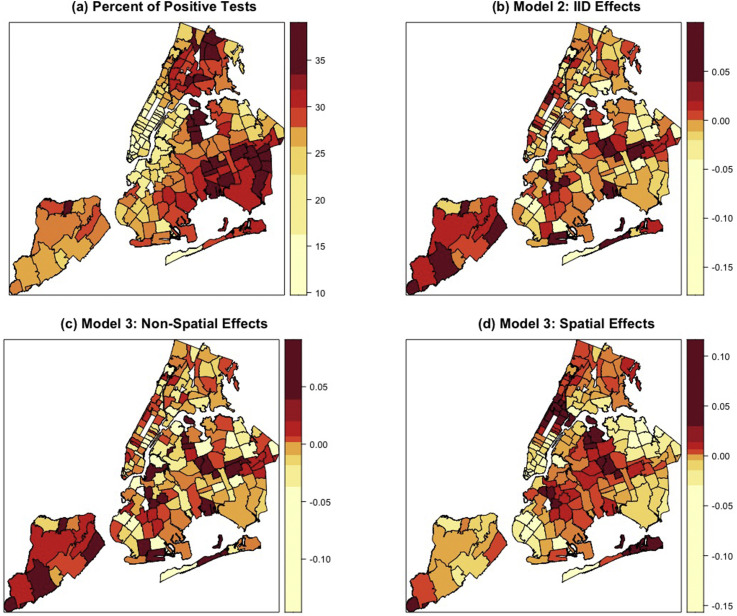
We aim to understand the spatial inequality in Coronavirus disease 2019 (COVID-19) positivity rates across New York City (NYC) ZIP codes. Applying Bayesian spatial negative binomial models to a ZIP-code level dataset (N = 177) as of May 31st, 2020, we find that (1) the racial/ethnic minority groups are associated with COVID-19 positivity rates; (2) the percentages of remote workers are negatively associated with positivity rates, whereas older population and household size show a positive association; and (3) while ZIP codes in the Bronx and Queens have higher COVID-19 positivity rates, the strongest spatial effects are clustered in Brooklyn and Manhattan.
我们旨在了解纽约市(NYC)邮政编码区域内2019冠状病毒病(COVID-19)阳性率的空间不平等情况。将贝叶斯空间负二项式模型应用于截至2020年5月31日的邮政编码区域数据集(N = 177),我们发现:(1)少数族裔群体与COVID-19阳性率相关;(2)远程工作者的比例与阳性率呈负相关,而老年人口和家庭规模则呈正相关;(3)虽然布朗克斯区和皇后区的邮政编码区域COVID-19阳性率较高,但最强的空间效应集中在布鲁克林区和曼哈顿区。