MOE Key Laboratory of Gene Function and Regulation, State Key Laboratory of Biocontrol, School of Life Sciences, Sun Yat-sen University, Guangzhou, Guangdong, China.
State Key Laboratory of Respiratory Disease, Guangzhou Institute of Respiratory Disease, The First Affiliated Hospital of Guangzhou Medical University, Guangzhou, Guangdong, China.
Signal Transduct Target Ther. 2021 Apr 24;6(1):167. doi: 10.1038/s41392-021-00575-7.
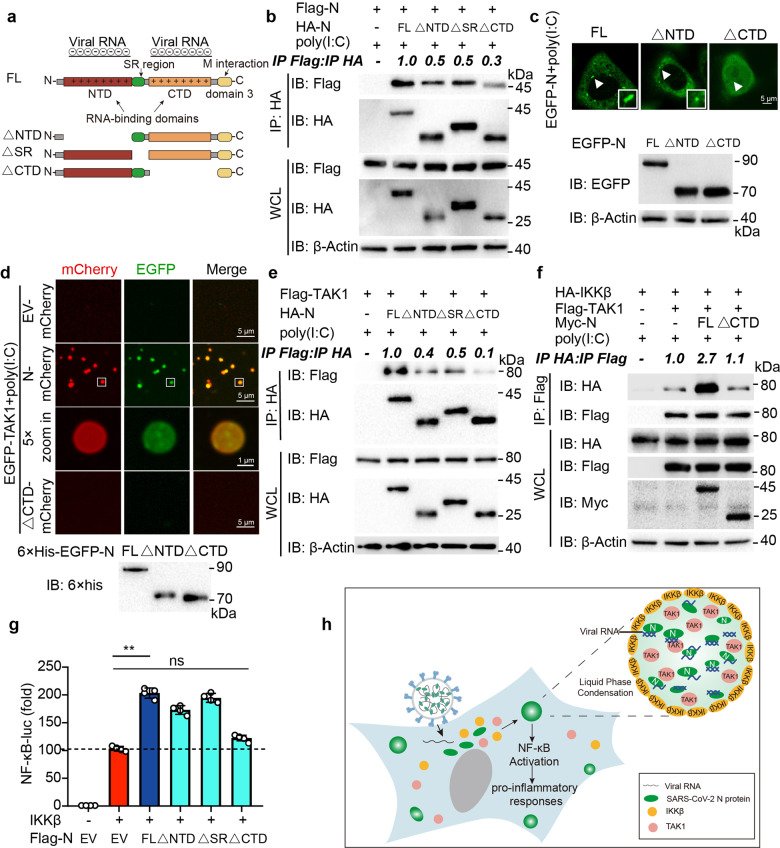
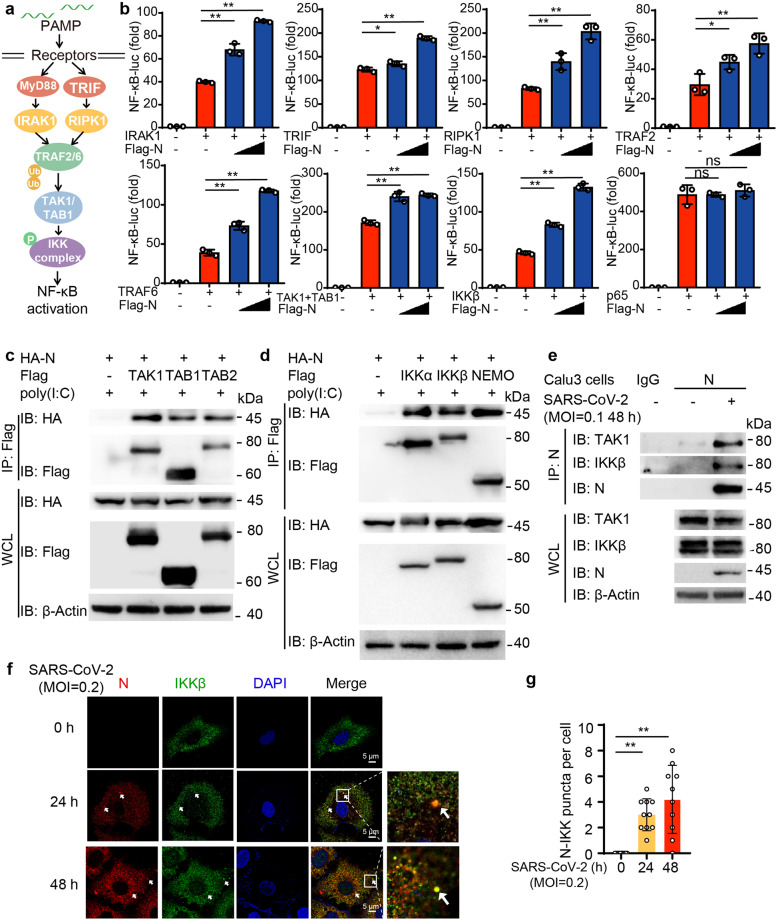
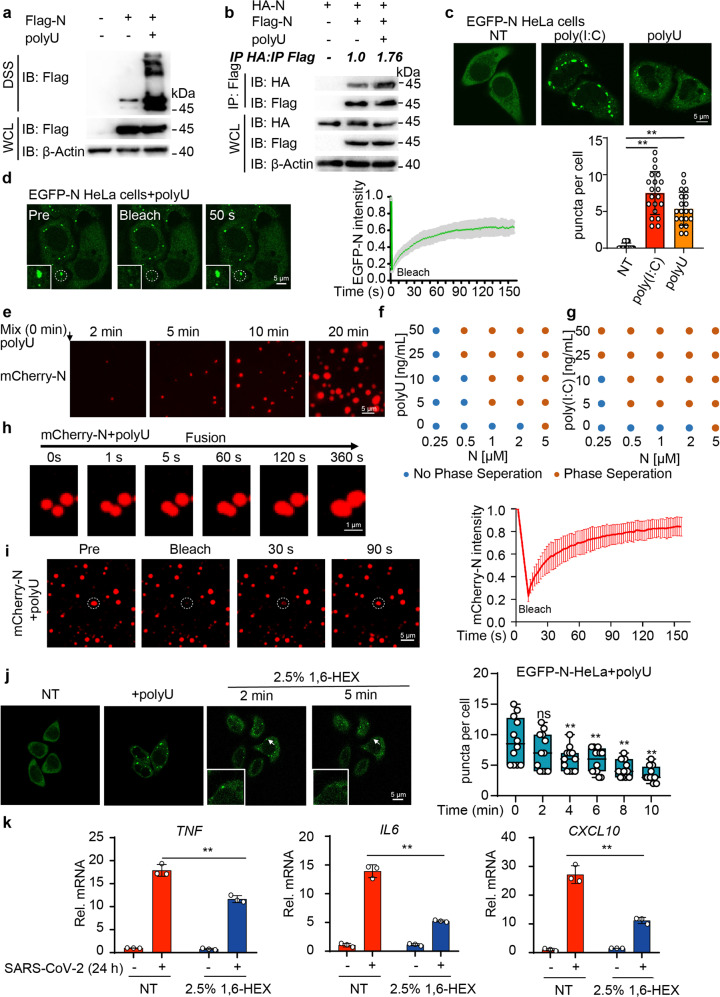
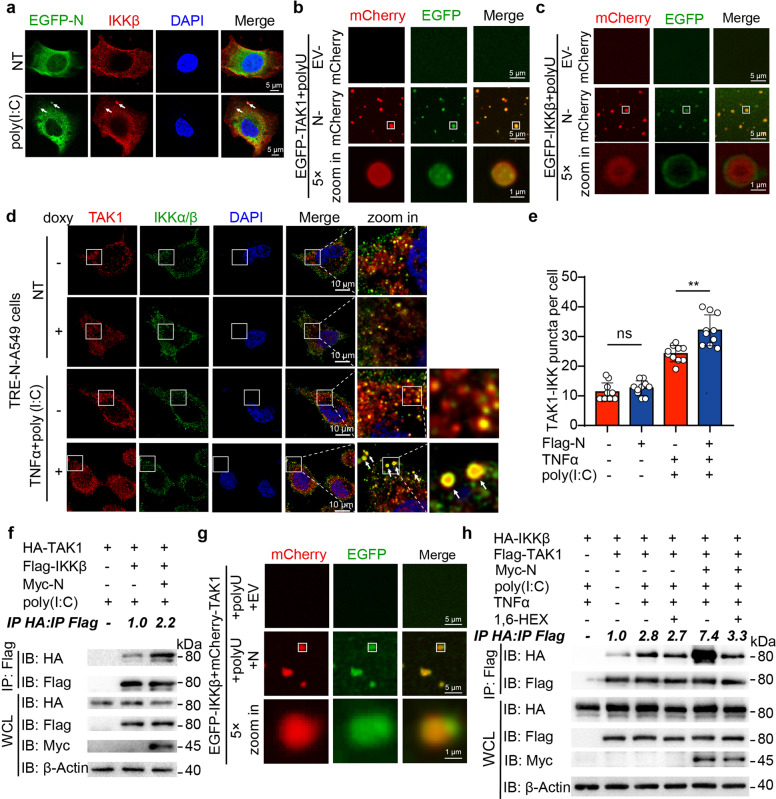
The ongoing 2019 novel coronavirus disease (COVID-19) caused by SARS-CoV-2 has posed a worldwide pandemic and a major global public health threat. The severity and mortality of COVID-19 are associated with virus-induced dysfunctional inflammatory responses and cytokine storms. However, the interplay between host inflammatory responses and SARS-CoV-2 infection remains largely unknown. Here, we demonstrate that SARS-CoV-2 nucleocapsid (N) protein, the major structural protein of the virion, promotes the virus-triggered activation of NF-κB signaling. After binding to viral RNA, N protein robustly undergoes liquid-liquid phase separation (LLPS), which recruits TAK1 and IKK complex, the key kinases of NF-κB signaling, to enhance NF-κB activation. Moreover, 1,6-hexanediol, the inhibitor of LLPS, can attenuate the phase separation of N protein and restrict its regulatory functions in NF-κB activation. These results suggest that LLPS of N protein provides a platform to induce NF-κB hyper-activation, which could be a potential therapeutic target against COVID-19 severe pneumonia.
由 SARS-CoV-2 引起的 2019 年新型冠状病毒病 (COVID-19) 已构成全球性大流行和重大的全球公共卫生威胁。COVID-19 的严重程度和死亡率与病毒诱导的功能失调性炎症反应和细胞因子风暴有关。然而,宿主炎症反应与 SARS-CoV-2 感染之间的相互作用在很大程度上仍不清楚。在这里,我们证明了 SARS-CoV-2 核衣壳 (N) 蛋白,病毒粒子的主要结构蛋白,可促进病毒触发的 NF-κB 信号转导的激活。N 蛋白与病毒 RNA 结合后,会强烈发生液-液相分离 (LLPS),从而募集 TAK1 和 IKK 复合物,即 NF-κB 信号转导的关键激酶,以增强 NF-κB 的激活。此外,LLPS 的抑制剂 1,6-己二醇可以减弱 N 蛋白的相分离,并限制其在 NF-κB 激活中的调节功能。这些结果表明,N 蛋白的液-液相分离为诱导 NF-κB 过度激活提供了一个平台,这可能是治疗 COVID-19 重症肺炎的一个潜在治疗靶点。