Xue Jin, Allaband Celeste, Zhou Dan, Poulsen Orit, Martino Cameron, Jiang Lingjing, Tripathi Anupriya, Elijah Emmanuel, Dorrestein Pieter C, Knight Rob, Zarrinpar Amir, Haddad Gabriel G
Department of Pediatrics, University of California, San Diego, San Diego, CA, United States.
Biomedical Sciences Program, University of California, San Diego, San Diego, CA, United States.
Front Physiol. 2021 Apr 8;12:663950. doi: 10.3389/fphys.2021.663950. eCollection 2021.
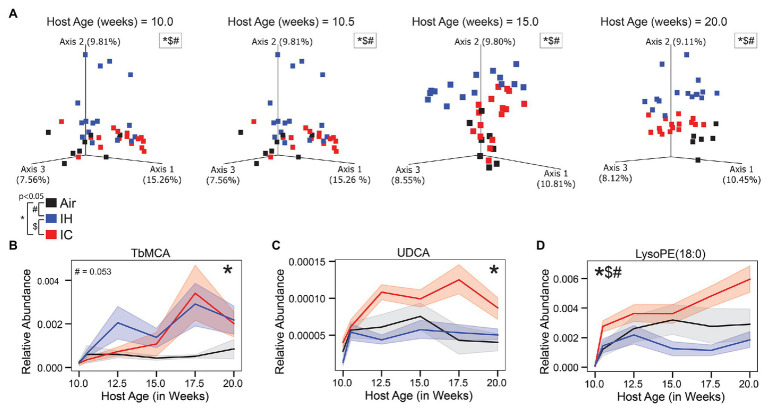
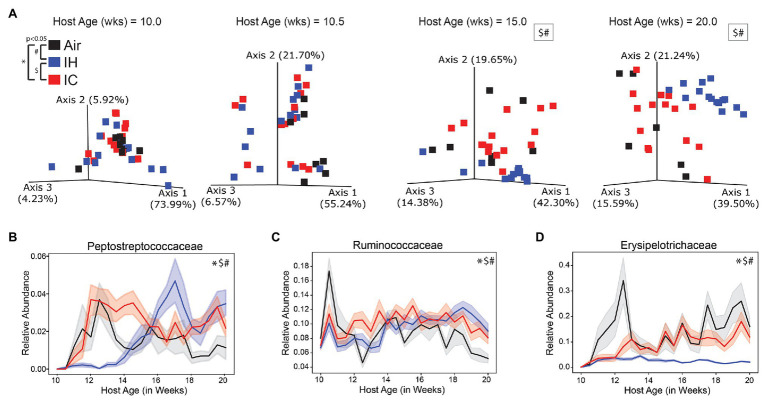
Obstructive sleep apnea (OSA), a common sleep disorder characterized by intermittent hypoxia and hypercapnia (IHC), increases atherosclerosis risk. However, the contribution of intermittent hypoxia (IH) or intermittent hypercapnia (IC) in promoting atherosclerosis remains unclear. Since gut microbiota and metabolites have been implicated in atherosclerosis, we examined whether IH or IC alters the microbiome and metabolome to induce a pro-atherosclerotic state. Apolipoprotein E deficient mice ( ), treated with IH or IC on a high-fat diet (HFD) for 10 weeks, were compared to Air controls. Atherosclerotic lesions were examined, gut microbiome was profiled using 16S rRNA gene amplicon sequencing and metabolome was assessed by untargeted mass spectrometry. In the aorta, IC-induced atherosclerosis was significantly greater than IH and Air controls (aorta, IC 11.1 ± 0.7% vs. IH 7.6 ± 0.4%, < 0.05 vs. Air 8.1 ± 0.8%, < 0.05). In the pulmonary artery (PA), however, IH, IC, and Air were significantly different from each other in atherosclerotic formation with the largest lesion observed under IH (PA, IH 40.9 ± 2.0% vs. IC 20.1 ± 2.6% vs. Air 12.2 ± 1.5%, < 0.05). The most differentially abundant microbial families ( < 0.001) were Peptostreptococcaceae, Ruminococcaceae, and Erysipelotrichaceae. The most differentially abundant metabolites ( < 0.001) were tauro-β-muricholic acid, ursodeoxycholic acid, and lysophosphoethanolamine (18:0). We conclude that IH and IC (a) modulate atherosclerosis progression differently in distinct vascular beds with IC, unlike IH, facilitating atherosclerosis in both aorta and PA and (b) promote an atherosclerotic luminal gut environment that is more evident in IH than IC. We speculate that the resulting changes in the gut metabolome and microbiome interact differently with distinct vascular beds.
阻塞性睡眠呼吸暂停(OSA)是一种常见的睡眠障碍,其特征为间歇性缺氧和高碳酸血症(IHC),会增加动脉粥样硬化风险。然而,间歇性缺氧(IH)或间歇性高碳酸血症(IC)在促进动脉粥样硬化中的作用仍不明确。由于肠道微生物群和代谢产物与动脉粥样硬化有关,我们研究了IH或IC是否会改变微生物组和代谢组,从而诱导促动脉粥样硬化状态。将高脂饮食(HFD)喂养10周并接受IH或IC处理的载脂蛋白E缺陷小鼠与空气对照组进行比较。检查动脉粥样硬化病变,使用16S rRNA基因扩增子测序分析肠道微生物组,并通过非靶向质谱法评估代谢组。在主动脉中,IC诱导的动脉粥样硬化明显大于IH和空气对照组(主动脉,IC为11.1±0.7%,IH为7.6±0.4%,与空气对照组8.1±0.8%相比,P<0.05;与空气对照组相比,P<0.05)。然而,在肺动脉(PA)中,IH、IC和空气对照组在动脉粥样硬化形成方面存在显著差异,在IH条件下观察到的病变最大(PA,IH为40.9±2.0%,IC为20.1±2.6%,空气对照组为12.2±1.5%,P<0.05)。差异最显著的微生物科(P<0.001)为消化链球菌科、瘤胃球菌科和丹毒丝菌科。差异最显著的代谢产物(P<0.001)为牛磺-β-鼠胆酸、熊去氧胆酸和溶血磷脂酰乙醇胺(18:0)。我们得出结论:(a)IH和IC在不同血管床中对动脉粥样硬化进展的调节方式不同,与IH不同,IC在主动脉和PA中均促进动脉粥样硬化;(b)促进动脉粥样硬化的肠腔环境,在IH中比在IC中更明显。我们推测,肠道代谢组和微生物组的变化与不同血管床的相互作用方式不同。