Allaband Celeste, Lingaraju Amulya, Martino Cameron, Russell Baylee, Tripathi Anupriya, Poulsen Orit, Dantas Machado Ana Carolina, Zhou Dan, Xue Jin, Elijah Emmanuel, Malhotra Atul, Dorrestein Pieter C, Knight Rob, Haddad Gabriel G, Zarrinpar Amir
Division of Gastroenterology, University of California, San Diego, La Jolla, California, USA.
Biomedical Sciences Graduate Program, University of California, San Diego, La Jolla, California, USA.
mSystems. 2021 Jun 29;6(3):e0011621. doi: 10.1128/mSystems.00116-21.
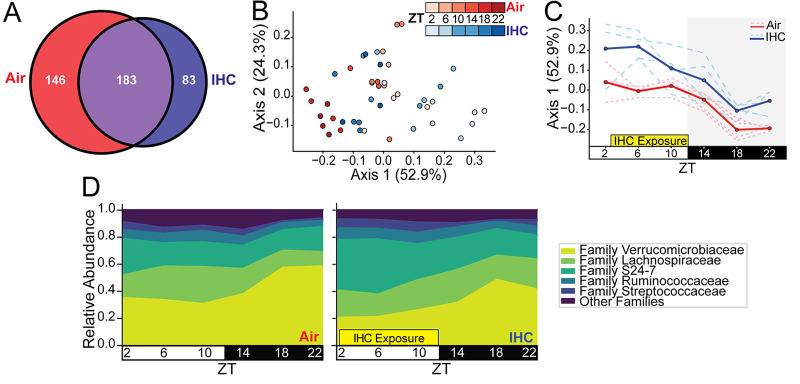
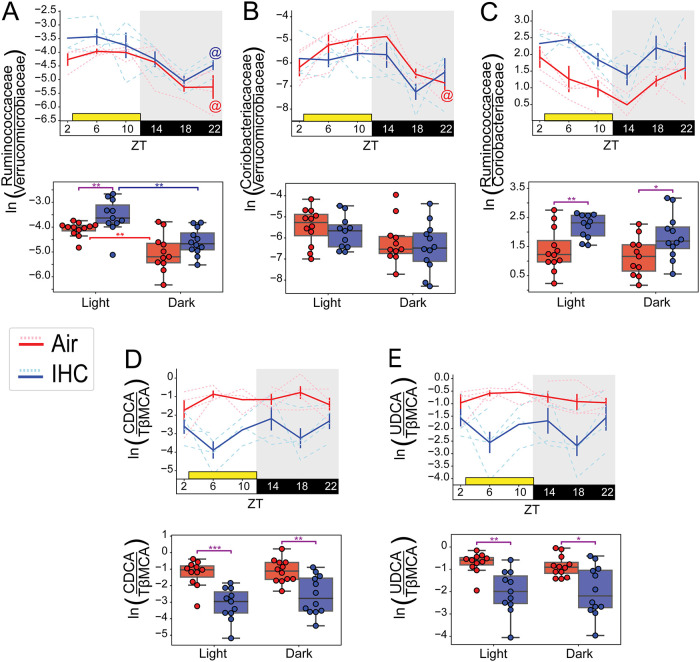
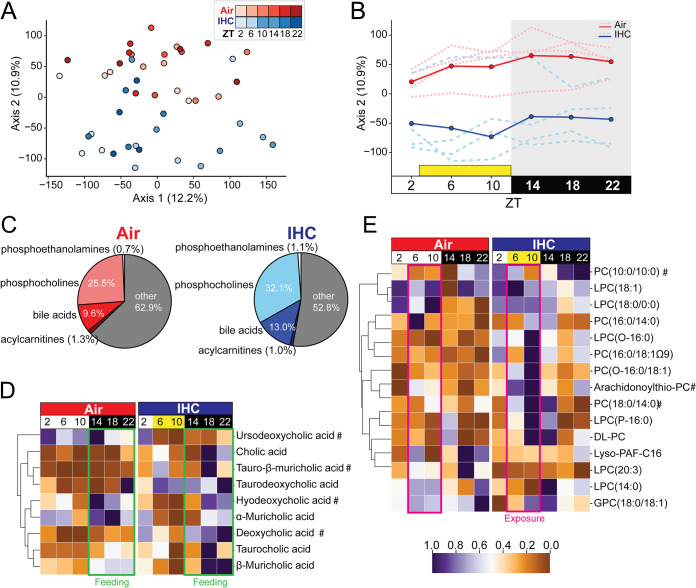
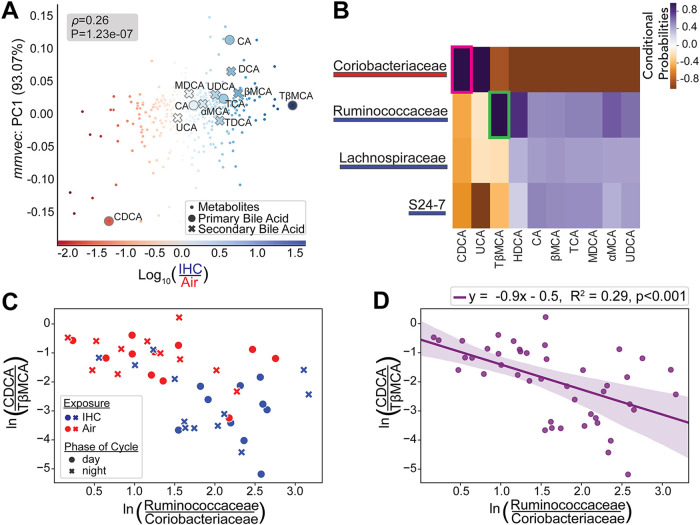
Obstructive sleep apnea (OSA), characterized by intermittent hypoxia and hypercapnia (IHC), affects the composition of the gut microbiome and metabolome. The gut microbiome has diurnal oscillations that play a crucial role in regulating circadian and overall metabolic homeostasis. Thus, we hypothesized that IHC adversely alters the gut luminal dynamics of key microbial families and metabolites. The objective of this study was to determine the diurnal dynamics of the fecal microbiome and metabolome of mice after a week of IHC exposure. Individually housed, 10-week-old mice on an atherogenic diet were split into two groups. One group was exposed to daily IHC conditions for 10 h (Zeitgeber time 2 [ZT2] to ZT12), while the other was maintained in room air. Six days after the initiation of the IHC conditions, fecal samples were collected every 4 h for 24 h (6 time points). We performed 16S rRNA gene amplicon sequencing and untargeted liquid chromatography-mass spectrometry (LC-MS) to assess changes in the microbiome and metabolome. IHC induced global changes in the cyclical dynamics of the gut microbiome and metabolome. , , S24-7, and had the greatest shifts in their diurnal oscillations. In the metabolome, bile acids, glycerolipids (phosphocholines and phosphoethanolamines), and acylcarnitines were greatly affected. Multi-omic analysis of these results demonstrated that and tauro-β-muricholic acid (TβMCA) cooccur and are associated with IHC conditions and that and chenodeoxycholic acid (CDCA) cooccur and are associated with control conditions. IHC significantly change the diurnal dynamics of the fecal microbiome and metabolome, increasing members and metabolites that are proinflammatory and proatherogenic while decreasing protective ones. People with obstructive sleep apnea are at a higher risk of high blood pressure, type 2 diabetes, cardiac arrhythmias, stroke, and sudden cardiac death. We wanted to understand whether the gut microbiome changes induced by obstructive sleep apnea could potentially explain some of these medical problems. By collecting stool from a mouse model of this disease at multiple time points during the day, we studied how obstructive sleep apnea changed the day-night patterns of microbes and metabolites of the gut. Since the oscillations of the gut microbiome play a crucial role in regulating metabolism, changes in these oscillations can explain why these patients can develop so many metabolic problems. We found changes in microbial families and metabolites that regulate many metabolic pathways contributing to the increased risk for heart disease seen in patients with obstructive sleep apnea.
阻塞性睡眠呼吸暂停(OSA)以间歇性缺氧和高碳酸血症(IHC)为特征,会影响肠道微生物组和代谢组的组成。肠道微生物组具有昼夜节律振荡,在调节昼夜节律和整体代谢稳态中起着关键作用。因此,我们假设IHC会对关键微生物家族和代谢物的肠道腔内动态产生不利影响。本研究的目的是确定暴露于IHC一周后小鼠粪便微生物组和代谢组的昼夜动态。将单独饲养的、10周龄的、食用致动脉粥样化饮食的小鼠分为两组。一组每天在IHC条件下暴露10小时(授时时间2 [ZT2]至ZT12),而另一组则置于室内空气中。在开始IHC条件6天后,每4小时收集一次粪便样本,共收集24小时(6个时间点)。我们进行了16S rRNA基因扩增子测序和非靶向液相色谱 - 质谱联用(LC-MS),以评估微生物组和代谢组的变化。IHC引起了肠道微生物组和代谢组循环动态的整体变化。 、 、S24 - 7和 在其昼夜振荡中变化最大。在代谢组中,胆汁酸、甘油脂(磷酸胆碱和磷酸乙醇胺)和酰基肉碱受到很大影响。对这些结果的多组学分析表明, 和牛磺-β-鼠胆酸(TβMCA)同时出现且与IHC条件相关,而 和鹅去氧胆酸(CDCA)同时出现且与对照条件相关。IHC显著改变了粪便微生物组和代谢组的昼夜动态,增加了促炎和促动脉粥样化的成员和代谢物,同时减少了具有保护作用的成员和代谢物。阻塞性睡眠呼吸暂停患者患高血压、2型糖尿病(T2DM)、心律失常、中风和心源性猝死的风险更高。我们想了解阻塞性睡眠呼吸暂停引起的肠道微生物组变化是否可能解释其中一些医学问题。通过在一天中的多个时间点从这种疾病的小鼠模型中收集粪便,我们研究了阻塞性睡眠呼吸暂停如何改变肠道微生物和代谢物的昼夜模式。由于肠道微生物组的振荡在调节新陈代谢中起着关键作用,这些振荡的变化可以解释为什么这些患者会出现如此多的代谢问题。我们发现微生物家族和代谢物的变化调节了许多代谢途径,这导致阻塞性睡眠呼吸暂停患者患心脏病的风险增加。