Buche Hélène, Michel Aude, Piccoli Christina, Blanc Nathalie
Laboratoire Epsylon EA 4556, Université Paul Valéry, Montpellier III, Montpellier, France.
Montpellier Institut du Sein, Clinique Clémentville, Montpellier, France.
Front Psychol. 2021 Apr 8;12:631186. doi: 10.3389/fpsyg.2021.631186. eCollection 2021.
Even though virtual reality (VR) is more and more considered for its power of distraction in different medical contexts, the optimal conditions for its use still have to be determined in order to design interfaces adapted to therapeutic support in oncology.
The objective of this study was to examine the benefits of VR using two immersion methods (i.e., one participatory, one contemplative) and comparing them with each other in a population of women with breast cancer who have undergone breast surgery, during scar massage sessions.
In a physiotherapy center, each patient participated in four experimental conditions in a random order: two sessions used virtual immersion (i.e., one participatory and one contemplative), one session proposed musical listening and the fourth one was a standard session care. The impact of the level of patient involvement in the virtual world was apprehended through the evaluation of the feeling of presence; the estimation of elapsed time of the physiotherapy sessions and particular attention was paid to the evaluation of patient emotional state.
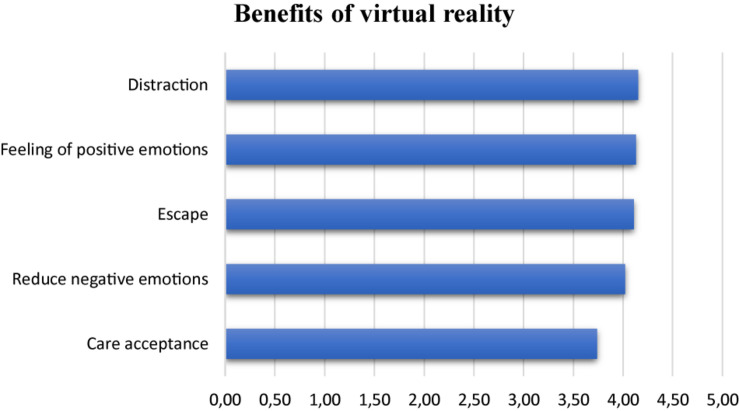
Our study showed an increase in positive emotions (i.e., joy and happiness) and a decrease in anxiety regardless which support methods were offered. Participatory VR created a feeling of more intense spatial presence.
Our results highlight the importance of the context in which VR should be offered. The presence of the practitioner and his interactions with the patient can provide a context just as favorable in reducing anxiety as the emotional regulation tools used (VR, music). The use of technological tools should be favored when the practitioner is unavailable during the treatment phase or, even, in order to reduce the monotonous nature of repetitive therapeutic sessions.
尽管虚拟现实(VR)因其在不同医疗环境中的分散注意力能力而越来越受到关注,但仍需确定其使用的最佳条件,以便设计适用于肿瘤治疗支持的界面。
本研究的目的是在接受乳房手术的乳腺癌女性群体中,在疤痕按摩疗程期间,使用两种沉浸方法(即一种参与式、一种沉思式)来检验VR的益处,并将它们相互比较。
在一个物理治疗中心,每位患者以随机顺序参与四种实验条件:两个疗程使用虚拟沉浸(即一个参与式和一个沉思式),一个疗程提供音乐聆听,第四个疗程是标准的护理疗程。通过对临场感的评估来了解患者在虚拟世界中的参与程度;估计物理治疗疗程的持续时间,并特别关注患者情绪状态的评估。
我们的研究表明,无论提供哪种支持方法,积极情绪(即喜悦和幸福)都会增加,焦虑会减少。参与式VR营造出更强烈的空间临场感。
我们的结果强调了提供VR的背景的重要性。从业者的在场及其与患者的互动可以提供一个与所使用的情绪调节工具(VR、音乐)同样有利于减轻焦虑的背景。当在治疗阶段从业者无法在场时,甚至为了减少重复治疗疗程的单调性,应优先使用技术工具。