Bielęda Grzegorz, Zwierzchowski Grzegorz, Rosłan Katarzyna, Adamus Agnieszka, Malicki Julian
Electroradiology Department, Poznan' University of Medical Sciences, Poznan', Poland.
Medical Physics Department, Greater Poland Cancer Centre, Poznan', Poland.
J Contemp Brachytherapy. 2021 Apr;13(2):188-194. doi: 10.5114/jcb.2021.105287. Epub 2021 Apr 14.
3D printing has become a popular and widely available technique of rapid prototyping. The impact of used materials on the dose distribution has been studied for high energy sources. However, brachytherapy sources emit lower energy photons, and materials used in 3D printing may differ. This study was conducted to analyze the influence of common materials (polylactic acid - PLA and acrylonitrile butadiene styrene - ABS) used in stereolithography.
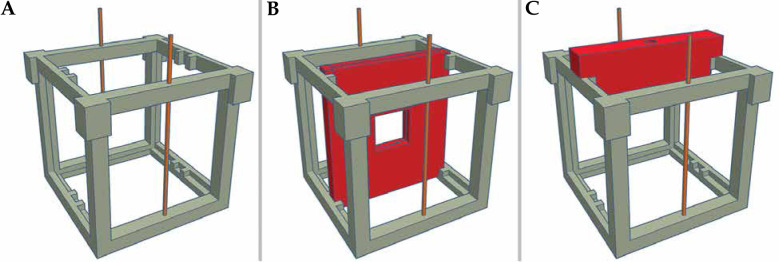
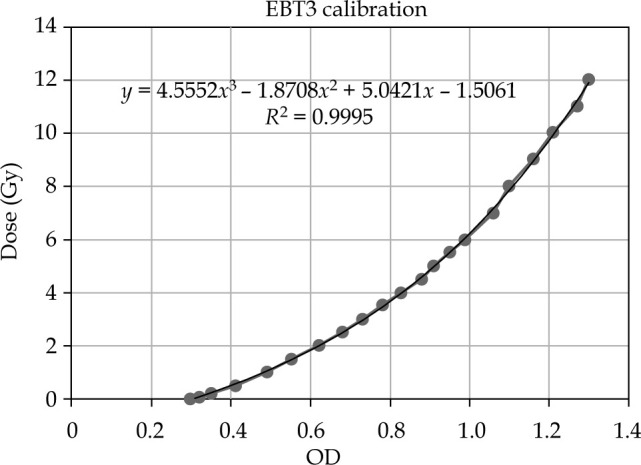
A 3D-printed phantom was designed, printed, and used to calibrate Gafchromic films. In the next step, a range of 1 mm thick plates of PLA and ABS (from zero to thirty) were inserted between source and detector to measure the impact of studied materials on delivered dose. Measurements were performed using a calibrated radiochromic film and Farmer ionization chamber in water.
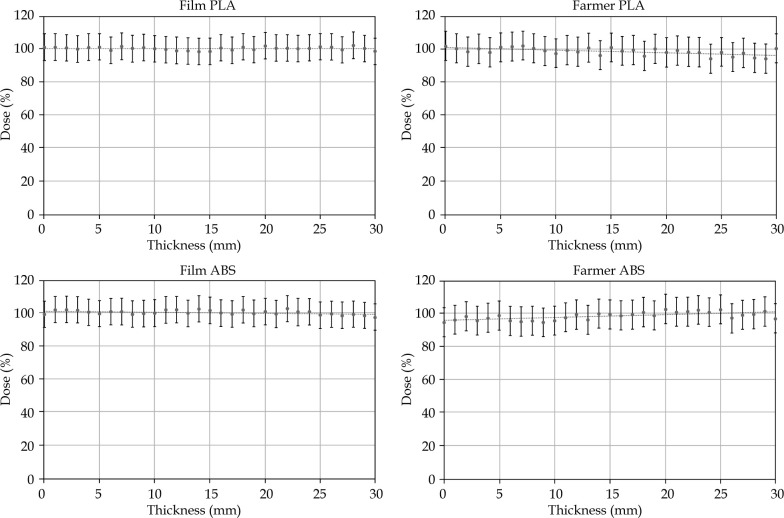
No statistically significant correlation ( = 0.4854) between the thickness of inserted PLA and the dose delivered to the film was obtained. With ionization chamber, Spearman's rank order test showed a significant correlation ( = 0.00004); however, the correlation was found weak. In case of ABS measurement, a statistically significant ( = 0.0159), yet weak negative correlation was found between the thickness of used material and the dose delivered to the film. On the other hand, a weak statistically significant ( = 0.0212) but positive correlation was found when the dose was measured with Farmer ionization chamber. We find these correlations false, as all measured doses were within the measurement uncertainty range (film ±8.0%, Farmer ±8.8%) from 100% of the prescribed dose.
According to obtained results, with the accuracy of measurement under clinical conditions, the impact of highly filled PLA and ABS printed objects on the dose distribution from an Ir source in water can be omitted.
3D打印已成为一种流行且广泛应用的快速成型技术。对于高能源,已研究了所用材料对剂量分布的影响。然而,近距离放射治疗源发射的光子能量较低,且3D打印中使用的材料可能有所不同。本研究旨在分析立体光刻中常用材料(聚乳酸 - PLA和丙烯腈丁二烯苯乙烯 - ABS)的影响。
设计并打印了一个3D打印体模,用于校准Gafchromic胶片。接下来,在源和探测器之间插入一系列厚度为1毫米的PLA和ABS板(从零到三十),以测量所研究材料对传递剂量的影响。测量使用校准后的放射变色胶片和水中的Farmer电离室进行。
插入的PLA厚度与传递到胶片的剂量之间未获得统计学上显著的相关性( = 0.4854)。使用电离室时,Spearman等级顺序检验显示存在显著相关性( = 0.00004);然而,发现相关性较弱。在ABS测量中,所用材料的厚度与传递到胶片的剂量之间发现了统计学上显著的( = 0.0159)但较弱的负相关性。另一方面,当使用Farmer电离室测量剂量时,发现了较弱的统计学上显著的( = 0.0212)但正相关性。我们认为这些相关性是错误的,因为所有测量剂量均在规定剂量的100%的测量不确定度范围内(胶片±8.0%,Farmer±8.8%)。
根据所得结果,在临床条件下的测量精度范围内,可以忽略高填充PLA和ABS打印物体对水中Ir源剂量分布的影响。