Mariotti Roberto, Pandolfi Saverio, De Cauwer Isabelle, Saumitou-Laprade Pierre, Vernet Philippe, Rossi Martina, Baglivo Federica, Baldoni Luciana, Mousavi Soraya
Institute of Biosciences and Bioresources CNR Perugia Italy.
CNRS UMR 8198 - Evo-Eco-Paleo Univ. Lille Lille France.
Evol Appl. 2021 Mar 5;14(4):983-995. doi: 10.1111/eva.13175. eCollection 2021 Apr.
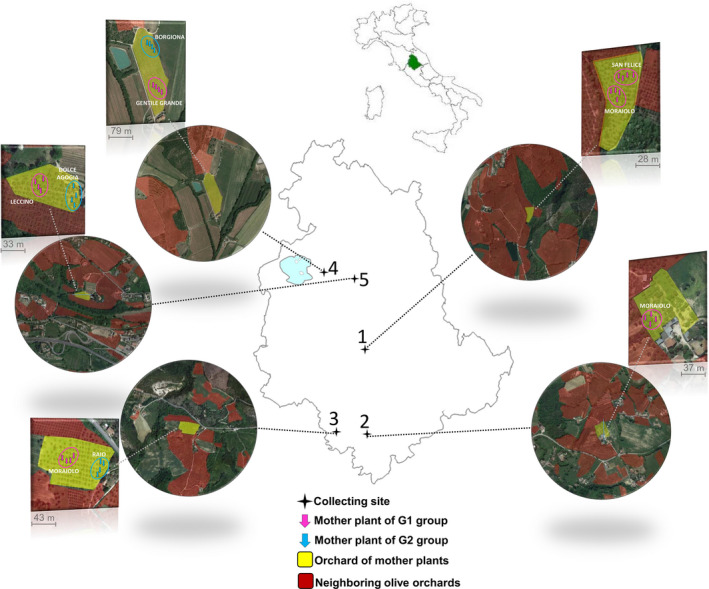
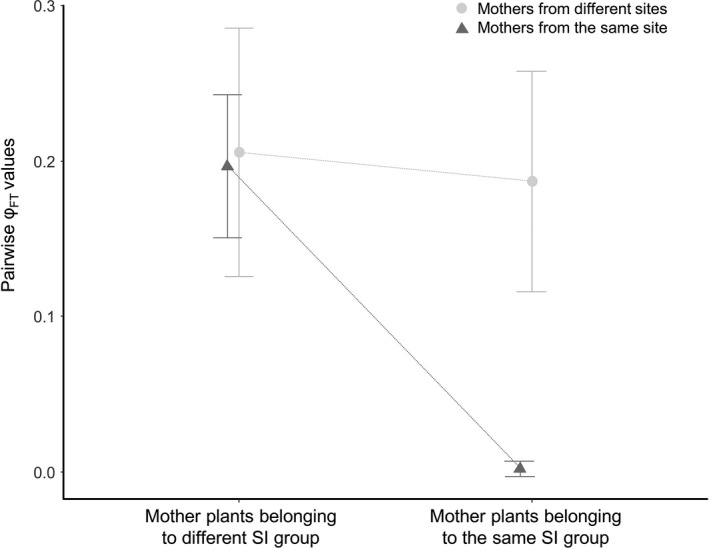
Self-incompatibility (SI) in flowering plants potentially represents a major obstacle for sexual reproduction, especially when the number of S-alleles is low. The situation is extreme in the commercially important olive tree, where in vitro pollination assays suggested the existence of a diallelic SI (DSI) system involving only two groups (G1 and G2). Varieties belonging to the same SI group cannot fertilize each other, such that successful fruit production is predicted to require pollination between varieties of different groups. To test this prediction, we explored the extent to which the DSI system determines fertilization patterns under field conditions. One hundred and seventeen olive cultivars were first genotyped using 10 highly polymorphic dinucleotide Simple Sequence Repeat (SSR) markers to ascertain varietal identity. Cultivars were then phenotyped through controlled pollination tests to assign each of them to one of the two SI groups. We then collected and genotyped 1440 open pollinated embryos from five different orchards constituted of seven local cultivars with known group of incompatibility groups. Embryos genotype information were used: (i) to assign embryos to the most likely pollen donor genotype in the neighbourhood using paternity analysis, and (ii) to compare the composition of the pollen cloud genetic among recipient trees in the five sites. The paternity analysis showed that the DSI system is the main determinant of fertilization success under field open pollination conditions: G1 cultivars sired seeds exclusively on G2 cultivars, and reciprocally. No self-fertilization events were observed. Our results demonstrate that DSI is a potent force determining pollination success among varieties within olive orchards used for production. They have the potential to improve management practices by guiding the selection of compatible varieties to avoid planting orchards containing sets of varieties with strongly unbalanced SI groups, as these would lead to suboptimal olive production.
开花植物中的自交不亲和性(SI)可能是有性繁殖的一个主要障碍,尤其是当S等位基因数量较少时。在具有重要商业价值的橄榄树中,这种情况极为严重,体外授粉试验表明存在一种仅涉及两个组(G1和G2)的双等位基因自交不亲和(DSI)系统。属于同一SI组的品种不能相互授粉,因此预计成功结果需要不同组的品种之间进行授粉。为了验证这一预测,我们探究了DSI系统在田间条件下决定受精模式的程度。首先使用10个高度多态性的二核苷酸简单序列重复(SSR)标记对117个橄榄品种进行基因分型,以确定品种身份。然后通过控制授粉试验对品种进行表型分析,将每个品种归入两个SI组之一。接着,我们从由7个已知不亲和组的当地品种组成的5个不同果园中收集了1440个开放授粉的胚胎,并对其进行基因分型。胚胎的基因型信息被用于:(i)通过亲权分析将胚胎分配给附近最可能的花粉供体基因型,以及(ii)比较五个地点受体树之间花粉云遗传组成。亲权分析表明,DSI系统是田间开放授粉条件下受精成功的主要决定因素:G1品种仅在G2品种上产生种子,反之亦然。未观察到自花受精事件。我们的结果表明,DSI是决定用于生产的橄榄园品种间授粉成功的一股强大力量。它们有可能通过指导选择相容品种来改善管理实践,以避免种植含有SI组严重失衡的品种组合的果园,因为这些会导致橄榄产量不理想。