Geange Sonya R, von Oppen Jonathan, Strydom Tanya, Boakye Mickey, Gauthier Tasha-Leigh J, Gya Ragnhild, Halbritter Aud H, Jessup Laura H, Middleton Sara L, Navarro Jocelyn, Pierfederici Maria Elisa, Chacón-Labella Julia, Cotner Sehoya, Farfan-Rios William, Maitner Brian S, Michaletz Sean T, Telford Richard J, Enquist Brian J, Vandvik Vigdis
Department of Biological Sciences University of Bergen Bergen Norway.
Bjerknes Center for Climate Research Bergen Norway.
Ecol Evol. 2020 Nov 20;11(8):3577-3587. doi: 10.1002/ece3.7009. eCollection 2021 Apr.
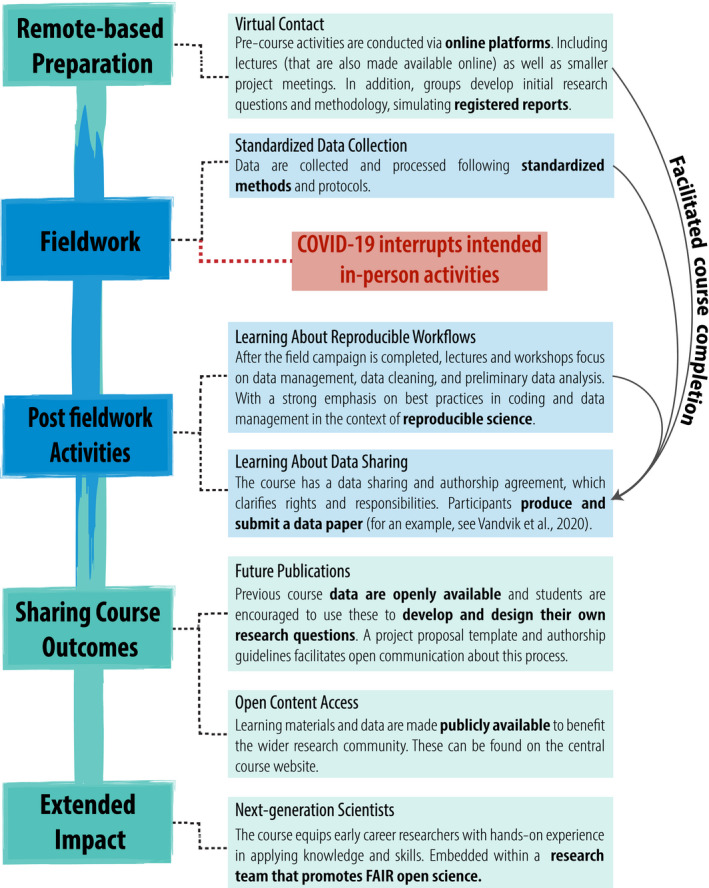
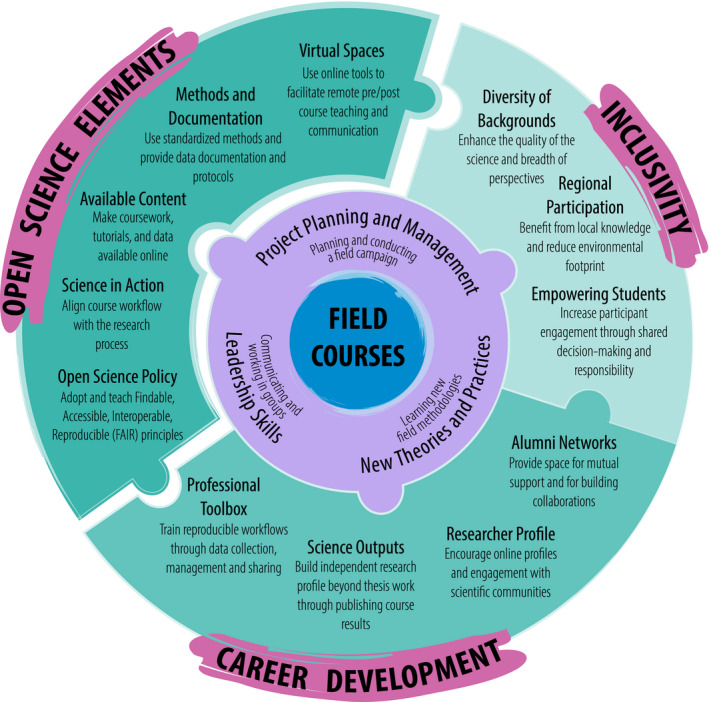
As Open Science practices become more commonplace, there is a need for the next generation of scientists to be well versed in these aspects of scientific research. Yet, many training opportunities for early career researchers (ECRs) could better emphasize or integrate Open Science elements. Field courses provide opportunities for ECRs to apply theoretical knowledge, practice new methodological approaches, and gain an appreciation for the challenges of real-life research, and could provide an excellent platform for integrating training in Open Science practices. Our recent experience, as primarily ECRs engaged in a field course interrupted by COVID-19, led us to reflect on the potential to enhance learning outcomes in field courses by integrating Open Science practices and online learning components. Specifically, we highlight the opportunity for field courses to align teaching activities with the recent developments and trends in how we conduct research, including training in: publishing registered reports, collecting data using standardized methods, adopting high-quality data documentation, managing data through reproducible workflows, and sharing and publishing data through appropriate channels. We also discuss how field courses can use online tools to optimize time in the field, develop open access resources, and cultivate collaborations. By integrating these elements, we suggest that the next generation of field courses will offer excellent arenas for participants to adopt Open Science practices.
随着开放科学实践变得越来越普遍,下一代科学家需要精通科学研究的这些方面。然而,许多针对早期职业研究人员(ECR)的培训机会可以更好地强调或整合开放科学元素。野外课程为ECR提供了应用理论知识、实践新方法以及了解现实研究挑战的机会,并且可以为整合开放科学实践培训提供一个绝佳的平台。我们最近的经历,主要是作为参与了一门被COVID-19中断的野外课程的ECR,促使我们思考通过整合开放科学实践和在线学习组件来提高野外课程学习成果的潜力。具体而言,我们强调野外课程有机会使教学活动与我们开展研究的最新发展和趋势保持一致,包括以下方面的培训:发表注册报告、使用标准化方法收集数据、采用高质量的数据记录、通过可重复的工作流程管理数据以及通过适当渠道共享和发布数据。我们还讨论了野外课程如何利用在线工具来优化在野外的时间、开发开放获取资源以及培养合作。通过整合这些元素,我们建议下一代野外课程将为参与者采用开放科学实践提供绝佳的场所。