Nazareth Lynn, St John James, Murtaza Mariyam, Ekberg Jenny
Menzies Health Institute Queensland, Griffith University, Southport, QLD, Australia.
Clem Jones Centre for Neurobiology and Stem Cell Research, Griffith University, Nathan, QLD, Australia.
Front Cell Dev Biol. 2021 Apr 8;9:660259. doi: 10.3389/fcell.2021.660259. eCollection 2021.
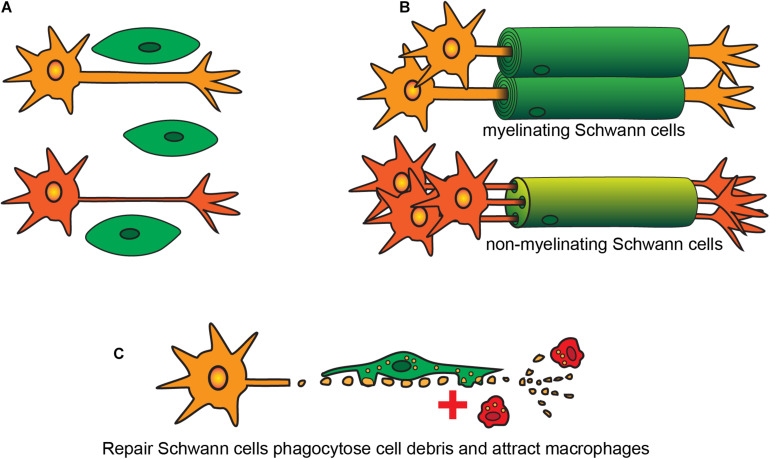
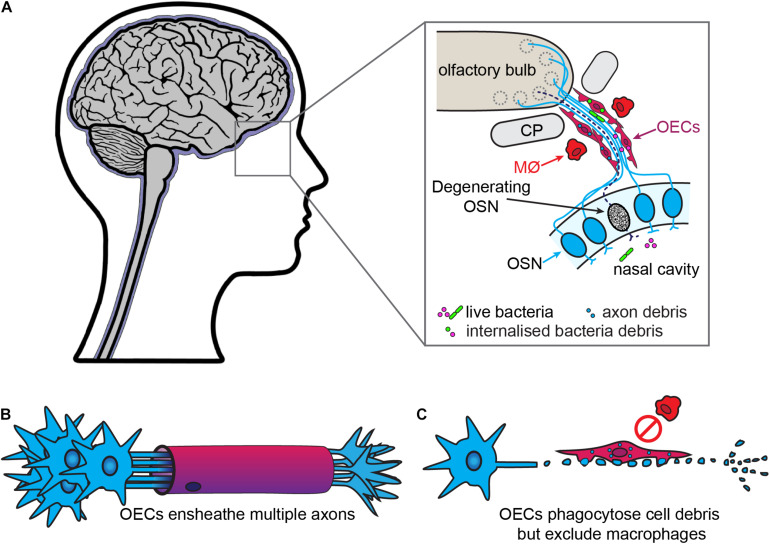
The central nervous system (CNS) has very limited capacity to regenerate after traumatic injury or disease. In contrast, the peripheral nervous system (PNS) has far greater capacity for regeneration. This difference can be partly attributed to variances in glial-mediated functions, such as axon guidance, structural support, secretion of growth factors and phagocytic activity. Due to their growth-promoting characteristic, transplantation of PNS glia has been trialed for neural repair. After peripheral nerve injuries, Schwann cells (SCs, the main PNS glia) phagocytose myelin debris and attract macrophages to the injury site to aid in debris clearance. One peripheral nerve, the olfactory nerve, is unique in that it continuously regenerates throughout life. The olfactory nerve glia, olfactory ensheathing cells (OECs), are the primary phagocytes within this nerve, continuously clearing axonal debris arising from the normal regeneration of the nerve and after injury. In contrast to SCs, OECs do not appear to attract macrophages. SCs and OECs also respond to and phagocytose bacteria, a function likely critical for tackling microbial invasion of the CNS via peripheral nerves. However, phagocytosis is not always effective; inflammation, aging and/or genetic factors may contribute to compromised phagocytic activity. Here, we highlight the diverse roles of SCs and OECs with the focus on their phagocytic activity under physiological and pathological conditions. We also explore why understanding the contribution of peripheral glia phagocytosis may provide us with translational strategies for achieving axonal regeneration of the injured nervous system and potentially for the treatment of certain neurological diseases.
中枢神经系统(CNS)在创伤性损伤或疾病后再生能力非常有限。相比之下,周围神经系统(PNS)具有更强的再生能力。这种差异部分可归因于神经胶质介导的功能差异,如轴突导向、结构支持、生长因子分泌和吞噬活性。由于其促进生长的特性,周围神经胶质细胞移植已被用于神经修复试验。周围神经损伤后,施万细胞(SCs,主要的周围神经胶质细胞)吞噬髓鞘碎片并吸引巨噬细胞到损伤部位以帮助清除碎片。一条周围神经,即嗅神经,其独特之处在于它在一生中持续再生。嗅神经胶质细胞,即嗅鞘细胞(OECs),是这条神经内的主要吞噬细胞,不断清除神经正常再生和损伤后产生的轴突碎片。与施万细胞不同,嗅鞘细胞似乎不会吸引巨噬细胞。施万细胞和嗅鞘细胞也对细菌做出反应并吞噬细菌,这一功能可能对于应对微生物通过周围神经侵入中枢神经系统至关重要。然而,吞噬作用并不总是有效的;炎症、衰老和/或遗传因素可能导致吞噬活性受损。在这里,我们重点介绍施万细胞和嗅鞘细胞的多种作用,重点关注它们在生理和病理条件下的吞噬活性。我们还探讨了为什么了解周围神经胶质细胞吞噬作用的贡献可能为我们提供实现受损神经系统轴突再生以及潜在治疗某些神经疾病的转化策略。