Gillis Chelsia, Davies Sarah J, Carli Francesco, Wischmeyer Paul E, Wootton Stephen A, Jackson Alan A, Riedel Bernhard, Marino Luise V, Levett Denny Z H, West Malcolm A
Department of Anesthesia, McGill University, Montreal, QC, Canada.
Department of Dietetics/Speech and Language Therapy, University Hospital Southampton NHS Foundation Trust, Southampton, United Kingdom.
Front Nutr. 2021 Apr 9;8:644723. doi: 10.3389/fnut.2021.644723. eCollection 2021.
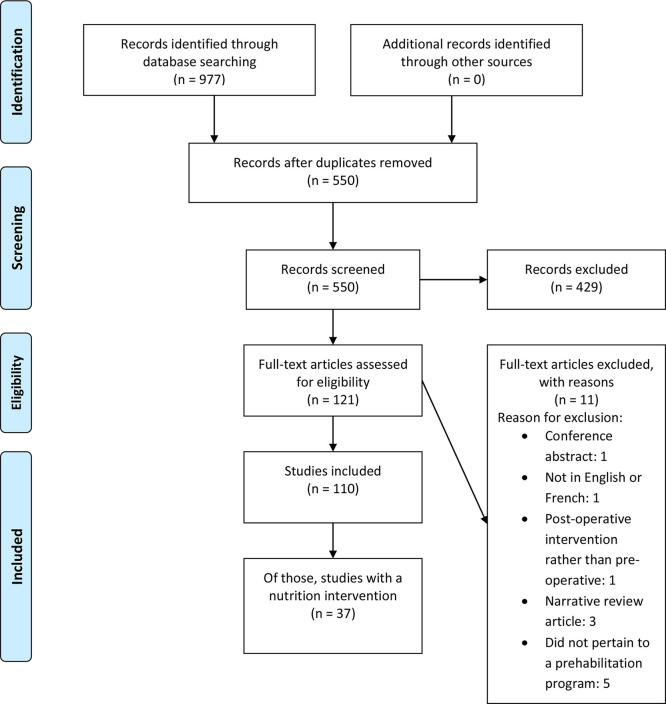
Prehabilitation aims to improve functional capacity prior to cancer treatment to achieve better psychosocial and clinical outcomes. Prehabilitation interventions vary considerably in design and delivery. In order to identify gaps in knowledge and facilitate the design of future studies, we undertook a scoping review of prehabilitation studies to map the range of work on prehabilitation being carried out in any cancer type and with a particular focus on diet or nutrition interventions. Firstly, to describe the type of prehabilitation programs currently being conducted. Secondly, to describe the extent to which prehabilitation studies involved aspects of nutrition, including assessment, interventions, implementation, and outcomes. Any study of quantitative or qualitative design that employed a formal prehabilitation program before cancer treatment ("prehabilitation" listed in keywords, title, or abstract). Search was conducted in July 2020 using MEDLINE, PubMed, EMBASE, EMCARE, CINAHL, and AMED. Quantitative data were reported as frequencies. Qualitative nutrition data were charted using a framework analysis that reflects the Nutrition Care Process Model: assessment, intervention, and monitoring/evaluation of the nutrition intervention. Five hundred fifty unique articles were identified: 110 studies met inclusion criteria of a formal prehabilitation study in oncology. prehabilitation studies were mostly cohort studies (41%) or randomized-controlled trials (38%) of multimodal (49%), or exercise-only (44%) interventions that were applied before surgery (94%). Nutrition assessment was inconsistently applied across these studies, and often conducted without validated tools (46%). Of the 110 studies, 37 (34%) included a nutrition treatment component. Half of these studies provided the goal for the nutrition component of their prehabilitation program; of these goals, less than half referenced accepted nutrition guidelines in surgery or oncology. Nutrition interventions largely consisted of counseling with dietary supplementation. The nutrition intervention was indiscernible in 24% of studies. Two-thirds of studies did not monitor the nutrition intervention nor evaluate nutrition outcomes. Prehabilitation literature lacks standardized and validated nutritional assessment, is frequently conducted without evidence-based nutrition interventions, and is typically implemented without monitoring the nutrition intervention or evaluating the intervention's contribution to outcomes. We suggest that the development of a core outcome set could improve the quality of the studies, enable pooling of evidence, and address some of the research gaps identified.
术前康复旨在提高癌症治疗前的功能能力,以实现更好的心理社会和临床结果。术前康复干预在设计和实施方面差异很大。为了找出知识空白并促进未来研究的设计,我们对术前康复研究进行了一项范围综述,以梳理针对任何癌症类型开展的术前康复工作范围,并特别关注饮食或营养干预措施。首先,描述当前正在开展的术前康复计划类型。其次,描述术前康复研究涉及营养方面的程度,包括评估、干预措施、实施情况和结果。任何在癌症治疗前采用正式术前康复计划的定量或定性设计研究(关键词、标题或摘要中列出“术前康复”)。检索于2020年7月使用MEDLINE、PubMed、EMBASE、EMCARE、CINAHL和AMED进行。定量数据以频率形式报告。定性营养数据使用反映营养护理过程模型的框架分析进行梳理:营养干预的评估、干预措施以及监测/评估。共识别出550篇独特文章:110项研究符合肿瘤学中正式术前康复研究的纳入标准。术前康复研究大多为队列研究(41%)或随机对照试验(38%),涉及多模式(49%)或仅运动(44%)干预措施,这些干预措施在手术前应用(94%)。这些研究中营养评估的应用不一致,且常常在没有经过验证的工具的情况下进行(46%)。在110项研究中,37项(34%)包括营养治疗部分。其中一半的研究为其术前康复计划的营养部分设定了目标;在这些目标中,不到一半参考了手术或肿瘤学方面公认的营养指南。营养干预措施主要包括饮食补充咨询。24%的研究中营养干预不明显。三分之二的研究未监测营养干预措施,也未评估营养结果。术前康复文献缺乏标准化和经过验证的营养评估,经常在没有循证营养干预措施的情况下开展,并且通常在没有监测营养干预措施或评估该干预措施对结果的贡献的情况下实施。我们建议制定一套核心结局指标可以提高研究质量,实现证据汇总,并解决所发现的一些研究空白。