Department of Internal Medicine, VieCuri Medical Centre, Tegelseweg 210, 5912 BL, Venlo, The Netherlands.
Department of Clinical Epidemiology, VieCuri Medical Centre, Venlo, The Netherlands.
Support Care Cancer. 2024 Oct 8;32(10):710. doi: 10.1007/s00520-024-08915-3.
The preoperative period provides a window of opportunity to improve modifiable risk factors for treatment complications such as malnutrition, the so-called prehabilitation. Identifying factors related to adherence to nutritional interventions is essential for optimizing prehabilitation programs. The aim of this study is to evaluate a nutritional support module as part of a teleprehabilitation program in high-risk patients with colorectal cancer (CRC).
A secondary analysis with a mixed method design of the nutritional support module of a pre-post teleprehabilitation pilot study was performed. Change in weight, complaints with intake, motivation, and subjective and objective adherence were evaluated.
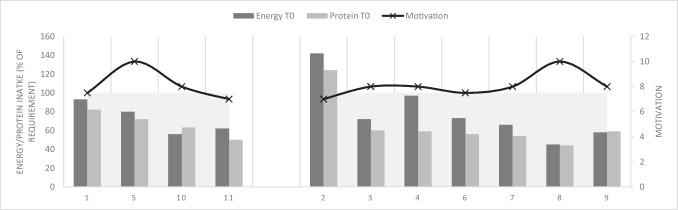
Eleven patients were included. Subjectively, six patients (55%) were able to adhere to the nutritional advice. Despite that, nine of eleven (82%) patients experienced difficulties with the amount of food that was advised by the dietician. Six of eleven (55%) patients gained weight during the prehabilitation program. After prehabilitation, nine of eleven (82%) were able to reach 100% of their energy requirement and six of eleven (55%) were able to reach 100% of their protein requirement. Differences between patients in motivation and/or having complaints did not seem to be associated with protein and energy intake.
This secondary analysis of a pilot study provides insights into understanding patients' experiences with a nutritional support module as part of a teleprehabilitation program. With 82% of patients who were able to reach 100% of their energy requirement, teleprehabilitation seems to be feasible, while there is still room for improvement with respect to protein intake as only 55% of patients reached a sufficient intake.
术前阶段为改善营养不良等治疗并发症的可改变风险因素(所谓的预康复)提供了机会窗口。确定与营养干预措施依从性相关的因素对于优化预康复计划至关重要。本研究旨在评估一种营养支持模块,作为结直肠癌(CRC)高危患者远程康复计划的一部分。
对预前后远程康复试点研究中营养支持模块的二次分析采用混合方法设计。评估体重变化、摄入抱怨、动机以及主观和客观依从性。
纳入了 11 名患者。主观上,6 名患者(55%)能够坚持营养建议。尽管如此,11 名患者中有 9 名(82%)患者在营养师建议的食物量方面遇到了困难。11 名患者中有 6 名(55%)在预康复计划期间体重增加。预康复后,11 名患者中有 9 名(82%)能够达到能量需求的 100%,11 名患者中有 6 名(55%)能够达到蛋白质需求的 100%。在动机和/或有抱怨的患者之间似乎没有差异与蛋白质和能量摄入相关。
这项对试点研究的二次分析提供了对理解患者在远程康复计划中接受营养支持模块的体验的见解。82%的患者能够达到能量需求的 100%,远程康复似乎是可行的,而蛋白质摄入方面仍有改进的空间,只有 55%的患者达到了足够的摄入量。