González-Fernández Doris, Nemeth Elizabeta, Pons Emérita Del Carmen, Rueda Delfina, Sinisterra Odalis Teresa, Murillo Enrique, Sangkhae Veena, Starr Lisa M, Scott Marilyn E, Koski Kristine G
School of Human Nutrition, McGill University (Macdonald Campus), Ste-Anne-de-Bellevue, Quebec, Canada.
Center for Iron Disorders, David Geffen School of Medicine, University of California, Los Angeles, CA, USA.
Curr Dev Nutr. 2021 Apr 12;5(4):nzab012. doi: 10.1093/cdn/nzab012. eCollection 2021 Apr.
In the absence of ultrasound, symphysis-fundal height (SFH) can assess maternal-fetal well-being as it is associated with gestational age, fetal weight, and amniotic fluid volume. However, other modifiers of SFH, including maternal infections, nutrient deficiencies, and inflammation (MINDI), have not been widely explored.
Our objectives were 2-fold: ) to assess prevalence of low SFH in indigenous Panamanian women using both Pan-American Health Organization (PAHO) and INTERGROWTH-21 standards and ) to explore associations of SFH with maternal health indicators: infections (oral, skin, urogenital, nematode infections), nutrient deficiencies [protein and iron indicators (ferritin, serum iron, serum transferrin receptor, hepcidin), folate, and vitamins A, D, and B-12], and inflammation [leukocytes, C-reactive protein (CRP), cytokines].
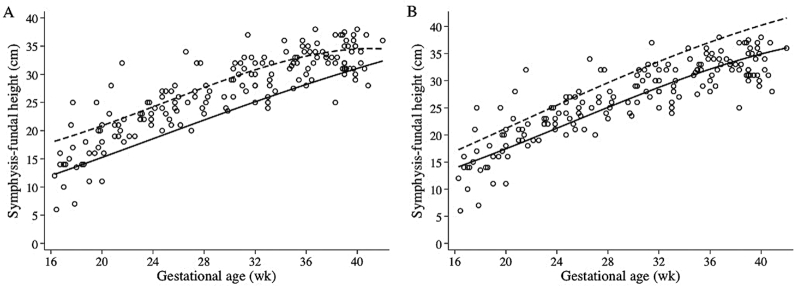
For this cross-sectional study, low-SFH-for-gestational-age was assessed using PAHO and INTERGROWTH <10th centile in 174 women at ≥16 weeks of gestation. Bootstrapping selected MINDI variables for inclusion in multivariable fractional polynomial (MFP) logistic regressions for low SFH. Associations of MINDI variables with hepcidin were also investigated.
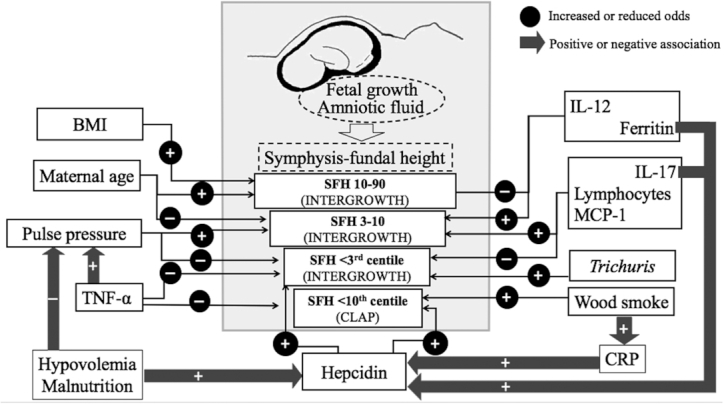
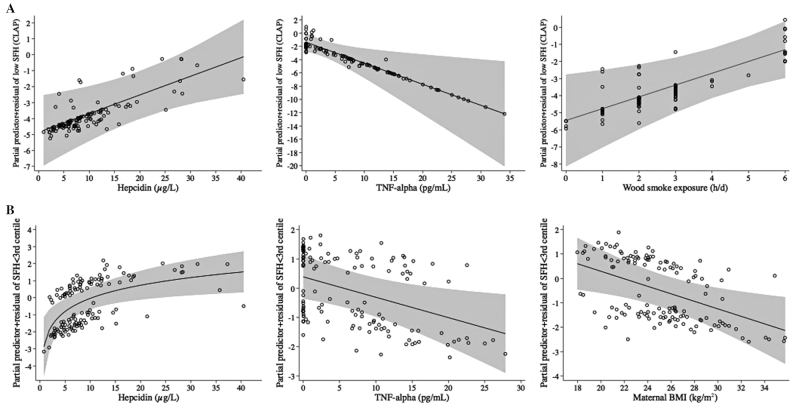
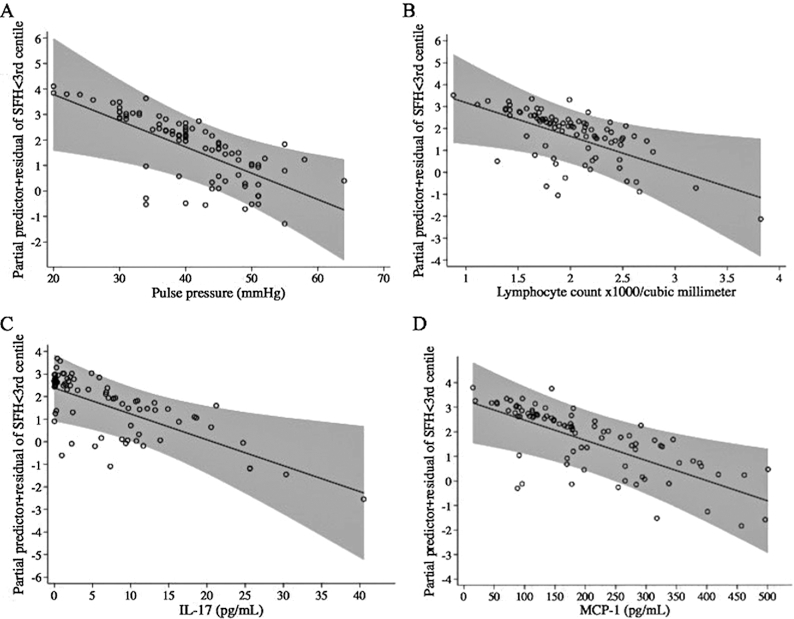
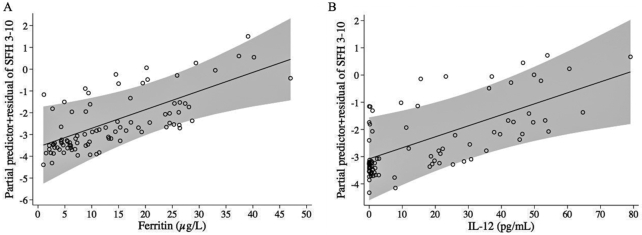
Prevalence of low SFH was 8% using PAHO, but using INTERGROWTH, 50.6% had SFH <10th centile, including 37.9% <3rd centile. Both PAHO-SFH <10th centile and INTERGROWTH-SFH <3rd centile were associated with higher hepcidin (OR = 1.12, = 0.008, and OR = 3.04, = 0.001, respectively) and with lower TNF-α (OR = 0.73, = 0.012, and OR = 0.93, = 0.015, respectively). Wood-smoke exposure increased the odds of PAHO-SFH <10th centile (OR = 1.19, = 0.009), whereas higher BMI decreased the odds of INTERGROWTH-SFH <3rd centile (OR = 0.87, = 0.012). Lower pulse pressure (OR = 0.90, = 0.009) and lower inflammatory responses [lower lymphocytes (OR = 0.21, = 0.026), IL-17 (OR = 0.89, = 0.011)] distinguished SFH <3rd centile from SFH ≥3rd to <10th centiles using INTERGROWTH-21 standards. The MFP regression for hepcidin controlling for SFH (adjusted = 0.40, = 0.001) revealed associations with indicators of inflammation (CRP, < 0.0001; IL-17, = 0.012), acidic urinary pH (= 0.008), and higher intake of supplements (= 0.035).
Associations of low SFH with MINDI variables, including hepcidin, highlight its potential for early detection of multicausal in utero growth faltering.
在没有超声检查的情况下,耻骨联合上缘高度(SFH)可用于评估母婴健康状况,因为它与孕周、胎儿体重和羊水量相关。然而,耻骨联合上缘高度的其他影响因素,包括母亲感染、营养缺乏和炎症(MINDI),尚未得到广泛研究。
我们的目标有两个:)使用泛美卫生组织(PAHO)和INTERGROWTH-21标准评估巴拿马土著妇女中低SFH的患病率;)探讨SFH与母亲健康指标之间的关联:感染(口腔、皮肤、泌尿生殖系统、线虫感染)、营养缺乏[蛋白质和铁指标(铁蛋白、血清铁、血清转铁蛋白受体、铁调素)、叶酸以及维生素A、D和B-12]和炎症[白细胞、C反应蛋白(CRP)、细胞因子]。
在这项横断面研究中,对于174名孕周≥16周的妇女,使用PAHO和INTERGROWTH标准评估低于第10百分位数的低孕周SFH。通过自抽样选择MINDI变量纳入低SFH的多变量分数多项式(MFP)逻辑回归分析。还研究了MINDI变量与铁调素之间的关联。
使用PAHO标准,低SFH的患病率为8%,但使用INTERGROWTH标准时,50.6%的妇女SFH低于第10百分位数,其中37.9%低于第3百分位数。PAHO-SFH低于第10百分位数和INTERGROWTH-SFH低于第3百分位数均与较高的铁调素水平相关(OR分别为1.12,P = 0.008和OR为3.04,P = 0.001),且与较低的肿瘤坏死因子-α水平相关(OR分别为0.73,P = 0.012和OR为0.93,P = 0.015)。接触木烟会增加PAHO-SFH低于第10百分位数的几率(OR = 1.19,P = 0.009),而较高的体重指数会降低INTERGROWTH-SFH低于第3百分位数的几率(OR = 0.87,P = 0.012)。较低的脉压(OR = 0.90,P = 那么0.009)和较低的炎症反应[较低的淋巴细胞(OR = 0.21,P = 0.026)、白细胞介素-17(OR = 0.89,P = 0.011)]使用INTERGROWTH-21标准将低于第第三百分位数的SFH与第3至低于第10百分位数的SFH区分开来。控制SFH的铁调素MFP回归分析(调整后β = 0.40,P = 0.001)显示与炎症指标(CRP,P < 0.0001;白细胞介素-17,P = 0.012)、酸性尿pH值(P = 0.008)以及较高的补充剂摄入量(P = 0.035)相关。
低SFH与包括铁调素在内的MINDI变量之间的关联,突出了其在早期检测多因素宫内生长迟缓方面的潜力。