NHC Key Laboratory of Medical Virology and Viral Diseases, National Institute for Viral Disease Control and Prevention, Chinese Center for Disease Control and Prevention, Beijing, People's Republic of China.
Chinese Center for Disease Control and Prevention -Wuhan Institute of Virology, Chinese Academy of Sciences Joint Research Center for Emerging Infectious Diseases and Biosafety, Center for Biosafety Mega-Science, Chinese Academy of Sciences, Wuhan, People's Republic of China.
PLoS Negl Trop Dis. 2021 Apr 26;15(4):e0009381. doi: 10.1371/journal.pntd.0009381. eCollection 2021 Apr.
Mosquitoes host and transmit numerous arthropod-borne viruses (arboviruses) that cause disease in both humans and animals. Effective surveillance of virome profiles in mosquitoes is vital to the prevention and control of mosquito-borne diseases in northwestern China, where epidemics occur frequently.
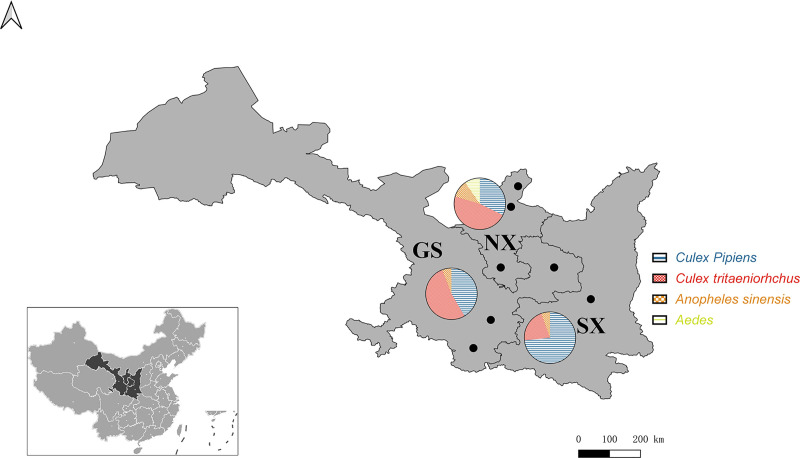
Mosquitoes were collected in the Shaanxi-Gansu-Ningxia region (Shaanxi Province, Gansu Province, and Ningxia Hui Autonomous Region) of China from June to August 2019. Morphological methods were used for taxonomic identification of mosquito species. High-throughput sequencing and metagenomic analysis were used to characterize mosquito viromes.
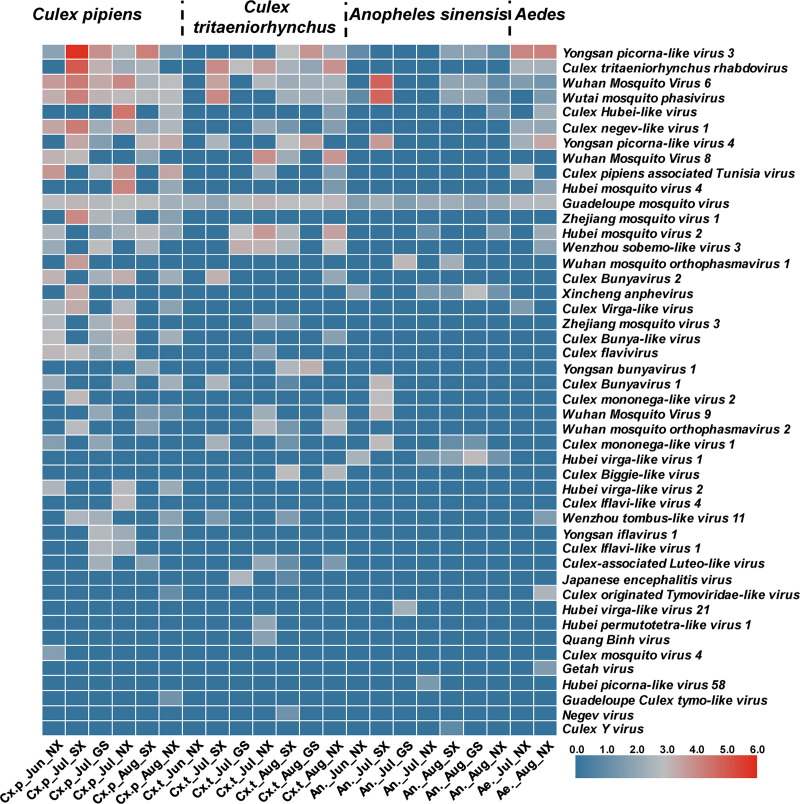
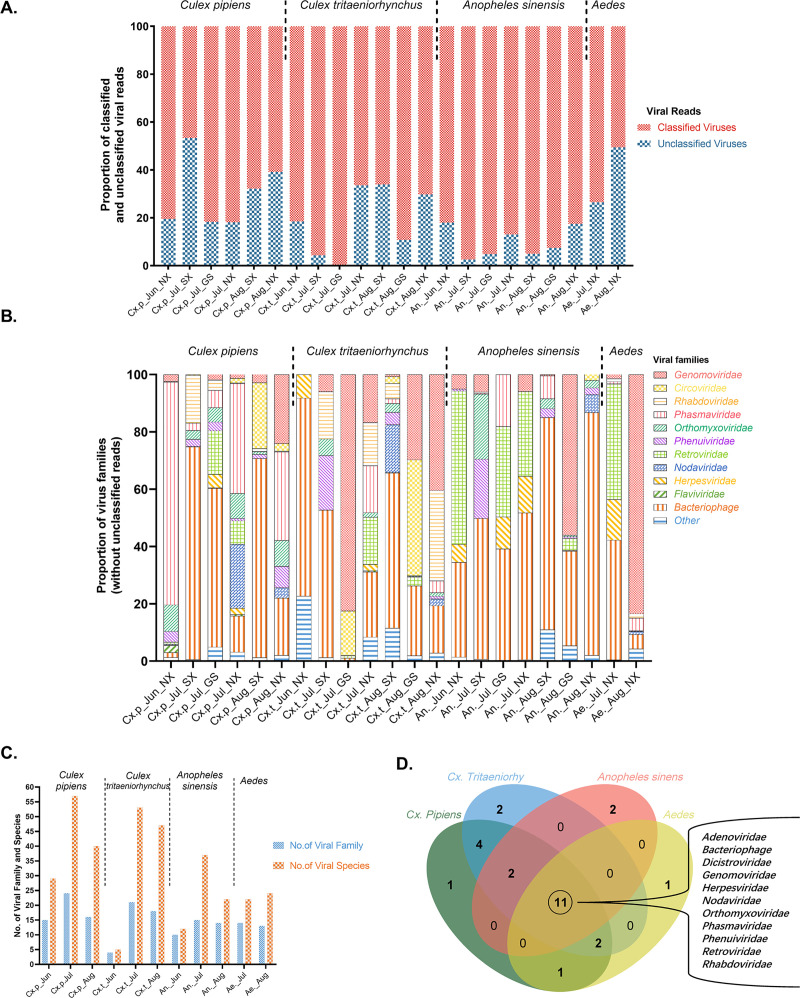
A total of 22,959 mosquitoes were collected, including Culex pipiens (45.7%), Culex tritaeniorhynchus (40.6%), Anopheles sinensis (8.4%), Aedes (5.2%), and Armigeres subalbatus (0.1%). In total, 3,014,183 (0.95% of clean reads) viral sequences were identified and assigned to 116 viral species (including pathogens such as Japanese encephalitis virus and Getah virus) in 31 viral families, including Flaviviridae, Togaviridae, Phasmaviridae, Phenuiviridae, and some unclassified viruses. Mosquitoes collected in July (86 species in 26 families) showed greater viral diversity than those from June and August. Culex pipiens (69 species in 25 families) and Culex tritaeniorhynchus (73 species in 24 families) carried more viral species than Anopheles sinensis (50 species in 19 families) or Aedes (38 species in 20 families) mosquitoes.
Viral diversity and abundance were affected by mosquito species and collection time. The present study elucidates the virome compositions of various mosquito species in northwestern China, improving the understanding of virus transmission dynamics for comparison with those of disease outbreaks.
蚊子是许多节肢动物传播病毒(arboviruses)的宿主和传播媒介,这些病毒会导致人类和动物患病。有效监测西北地区蚊子的病毒组谱对于预防和控制蚊媒疾病至关重要,因为该地区经常发生疫情。
2019 年 6 月至 8 月,我们在中国陕甘宁地区(陕西省、甘肃省和宁夏回族自治区)采集了蚊子。采用形态学方法对蚊子进行分类鉴定。高通量测序和宏基因组分析用于描述蚊子病毒组。
共采集到 22959 只蚊子,包括库蚊(45.7%)、三带喙库蚊(40.6%)、中华按蚊(8.4%)、伊蚊(5.2%)和阿蚊(0.1%)。共鉴定出 3014183 个(占清洁读数的 0.95%)病毒序列,它们被分配到 31 个病毒科中的 116 种病毒(包括日本脑炎病毒和基特病毒等病原体)。蚊子采集时间和蚊种会影响病毒的多样性。7 月采集的蚊子(26 科 86 种)比 6 月和 8 月采集的蚊子具有更高的病毒多样性。库蚊(25 科 69 种)和三带喙库蚊(24 科 73 种)携带的病毒种类多于中华按蚊(19 科 50 种)或伊蚊(20 科 38 种)。
本研究阐明了中国西北地区不同蚊种的病毒组组成,提高了对病毒传播动态的认识,有助于与疾病暴发进行比较。