Guerrant Richard L, Bolick David T, Swann Jonathan R
Center for Global Health Equity, Division of Infectious Diseases and International Health, University of Virginia School of Medicine, Charlottesville, Virginia 22908, United States.
School of Human Development and Health, Faculty of Medicine, University of Southampton, Southampton SO16 6YD, United Kingdom.
ACS Infect Dis. 2021 May 14;7(5):1020-1031. doi: 10.1021/acsinfecdis.0c00831. Epub 2021 Apr 26.
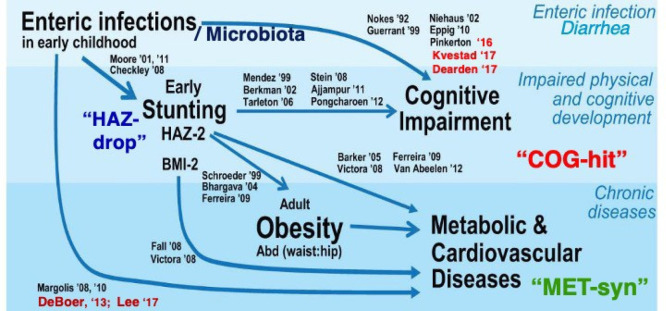
Developing effective therapeutics or preventive interventions for important health threats is greatly enhanced whenever accessible models can enable the assessment of clinically important outcomes. While no non-human model is ever perfect, inexpensive small animal models in such as mice are often of great help in assessing the relevant efficacy of potential interventions. In addition to acute diarrhea, the long-term growth and developmental effects of enteric infections, with or without overt diarrhea, are increasingly recognized. To address these diverse effects, inexpensive animal models are proving to be very helpful. Herein, we review the major clinical concerns with enteric parasitic and bacterial infections that are extremely common worldwide, especially in vulnerable young children living in impoverished areas, and the recently published murine models of these infections and their outcomes. We find that common dietary deficiencies seen in children in developing areas have striking effects on diarrhea and enteropathy outcomes in mice. However, these effects differ with different pathogens. Specifically, the effects of protein or zinc deficiency differ considerably with different major protozoal and bacterial pathogens, suggesting different pathogenetic pathways and intervention effects. The pathogens reviewed are the seven top parasitic and bacterial pathogens seen in children, namely, , , , , enterotoxigenic (ETEC), enteroaggregative (EAEC), and enteropathogenic (EPEC).
只要可利用的模型能够对临床重要结果进行评估,那么针对重大健康威胁研发有效的治疗方法或预防干预措施就能得到极大加强。虽然没有任何非人类模型是完美的,但诸如小鼠等廉价的小动物模型在评估潜在干预措施的相关疗效方面往往有很大帮助。除了急性腹泻外,肠道感染对长期生长发育的影响,无论有无明显腹泻,都越来越受到认可。为解决这些多样的影响,事实证明廉价的动物模型非常有用。在此,我们综述了全球极为常见的肠道寄生虫和细菌感染的主要临床问题,特别是在生活在贫困地区的脆弱幼儿中,以及最近发表的这些感染的小鼠模型及其结果。我们发现,发展中地区儿童常见的饮食缺乏对小鼠腹泻和肠病结果有显著影响。然而,这些影响因不同病原体而异。具体而言,蛋白质或锌缺乏的影响因不同的主要原生动物和细菌病原体而有很大差异,这表明存在不同的致病途径和干预效果。所综述的病原体是儿童中最常见的七种寄生虫和细菌病原体,即[此处原文缺失具体病原体名称]、产肠毒素大肠杆菌(ETEC)、聚集性大肠杆菌(EAEC)和致病性大肠杆菌(EPEC)。