Department of Infectious Diseases, Graduate School of Medical Science, Kyoto Prefectural University of Medicine, Kyoto, Japan; Department of Molecular Gastroenterology and Hepatology, Graduate School of Medical Science, Kyoto Prefectural University of Medicine, Kyoto, Japan.
Department of Infectious Diseases, Graduate School of Medical Science, Kyoto Prefectural University of Medicine, Kyoto, Japan; Department of Forensics Medicine, Graduate School of Medical Science, Kyoto Prefectural University of Medicine, Kyoto, Japan.
Clin Microbiol Infect. 2021 Jul;27(7):1042.e1-1042.e4. doi: 10.1016/j.cmi.2021.04.009. Epub 2021 Apr 24.
Disinfection effectiveness against severe acute respiratory syndrome coronavirus 2 (SARS-CoV-2) on human skin remains unclear because of the hazards of viral exposure. An evaluation model, which has been previously generated using human skin obtained from forensic autopsy samples, accurately mimics in vivo skin conditions for evaluating the effectiveness of disinfection against the virus. Using this model, we evaluated disinfection effectiveness against viruses on human skin.
Ethanol (EA), isopropanol (IPA), chlorhexidine gluconate (CHG) and benzalkonium chloride (BAC) were used as target disinfectants. First, disinfectant effectiveness against SARS-CoV-2 and influenza A virus (IAV) was evaluated in vitro. Disinfectant effectiveness against SARS-CoV-2 and IAV on human skin was then evaluated by titrating viruses present on the skin after applying each disinfectant on the skin for 5-60 seconds.
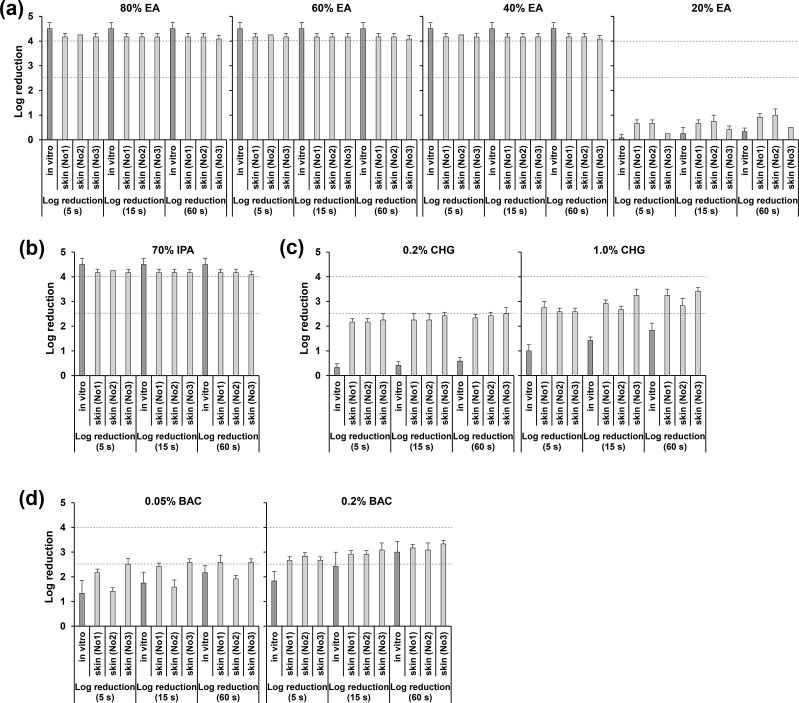
Both, SARS-CoV-2 and IAV on human skin were completely inactivated within 5 seconds by 40%-80% EA and 70% IPA (log reduction values (LRVs) were >4). However, SARS-CoV-2 and IAV were barely inactivated by 20% EA (LRVs were <1). In vitro evaluation showed that, compared with EA and IPA, CHG and BAC were significantly inferior in terms of disinfection effectiveness. Conversely, the disinfection effectiveness of CHG and BAC against SARS-CoV-2 was higher on human skin than in vitro, and increased with increases in their concentration and reaction time (LRVs of 0.2% CHG/0.05% BAC were >2, and LRVs of 1.0% CHG/0.2% BAC were >2.5).
Proper hand hygiene practices using alcohol-based disinfectants such as EA/IPA effectively inactivate SARS-CoV-2 and IAV on human skin.
由于接触病毒的危害,人类皮肤对严重急性呼吸综合征冠状病毒 2(SARS-CoV-2)的消毒效果仍不清楚。我们之前使用法医解剖样本获得的人体皮肤生成了一种评估模型,该模型能够准确模拟体内皮肤条件,用于评估针对病毒的消毒效果。使用该模型,我们评估了针对人类皮肤上病毒的消毒效果。
乙醇(EA)、异丙醇(IPA)、葡萄糖酸氯己定(CHG)和苯扎氯铵(BAC)被用作目标消毒剂。首先,在体外评估了消毒剂对 SARS-CoV-2 和甲型流感病毒(IAV)的消毒效果。然后,通过在皮肤上涂抹每种消毒剂 5-60 秒后检测皮肤上残留的病毒滴度,评估消毒剂对 SARS-CoV-2 和 IAV 对人体皮肤的消毒效果。
40%-80%的 EA 和 70%的 IPA 可在 5 秒内使皮肤表面的 SARS-CoV-2 和 IAV 完全失活(对数减少值(LRV)>4)。然而,20%的 EA 对 SARS-CoV-2 和 IAV 的消毒效果几乎没有作用(LRV<1)。体外评估显示,与 EA 和 IPA 相比,CHG 和 BAC 的消毒效果明显较差。相反,CHG 和 BAC 对 SARS-CoV-2 的消毒效果在人体皮肤上优于体外,且随着浓度和反应时间的增加而增强(0.2%CHG/0.05%BAC 的 LRV 为>2,1.0%CHG/0.2%BAC 的 LRV 为>2.5)。
使用 EA/IPA 等醇基消毒剂进行适当的手部卫生操作可有效灭活人体皮肤表面的 SARS-CoV-2 和 IAV。