• 文献检索
  • 文档翻译
  • 深度研究
  • 学术资讯
  • Suppr Zotero 插件Zotero 插件
  • 邀请有礼
  • 套餐&价格
  • 历史记录
应用&插件
Suppr Zotero 插件Zotero 插件浏览器插件Mac 客户端Windows 客户端微信小程序
定价
高级版会员购买积分包购买API积分包
服务
文献检索文档翻译深度研究API 文档MCP 服务
关于我们
关于 Suppr公司介绍联系我们用户协议隐私条款
关注我们

Suppr 超能文献

核心技术专利:CN118964589B侵权必究
粤ICP备2023148730 号-1Suppr @ 2026

文献检索

告别复杂PubMed语法,用中文像聊天一样搜索,搜遍4000万医学文献。AI智能推荐,让科研检索更轻松。

立即免费搜索

文件翻译

保留排版,准确专业,支持PDF/Word/PPT等文件格式,支持 12+语言互译。

免费翻译文档

深度研究

AI帮你快速写综述,25分钟生成高质量综述,智能提取关键信息,辅助科研写作。

立即免费体验

采用 MRI 和放射组学特征对全肿瘤进行评估,预测术后胰腺癌患者 S-1 辅助化疗疗效的初步研究。

Whole-tumour evaluation with MRI and radiomics features to predict the efficacy of S-1 for adjuvant chemotherapy in postoperative pancreatic cancer patients: a pilot study.

机构信息

Department of Radiology, Zhongshan Hospital, Fudan University, and Shanghai Institute of Medical Imaging, No. 180 Fenglin Road, Xuhui District, Shanghai, 200032, China.

Department of Medical Oncology, Zhongshan Hospital, Fudan University, No. 180 Fenglin Road, Xuhui District, Shanghai, 200032, China.

出版信息

BMC Med Imaging. 2021 Apr 26;21(1):75. doi: 10.1186/s12880-021-00605-4.

DOI:10.1186/s12880-021-00605-4
PMID:33902469
原文链接:https://pmc.ncbi.nlm.nih.gov/articles/PMC8077911/
Abstract

BACKGROUND

Multiple guidelines for pancreatic ductal adenocarcinoma (PDAC) suggest that all stages of patients need to receive postoperative adjuvant chemotherapy. S-1 is a recently emerged oral antitumour agent recommended by the guidelines. However, which population would benefit from S-1 needs to be determined, and predictors of chemotherapy response are needed for personalized precision medicine. This pilot study aimed to initially identify whether whole-tumour evaluation with MRI and radiomics features could be used for predicting the efficacy of S-1 and to find potential predictors of the efficacy of S-1 as evidence to assist personalized precision treatment.

METHODS

Forty-six patients with PDAC (31 in the primary cohort and 15 in the validation cohort) who underwent curative resection and subsequently adjuvant chemotherapy with S-1 were included. Pre-operative abdominal contrast-enhanced MRI was performed, and radiomics features of the whole PDAC were extracted from the primary cohort. After univariable analysis and radiomics features selection, a multivariable Cox regression model for survival analysis was subsequently used to select statistically significant factors associated with postoperative disease-free survival (DFS). Predictive capacities of the factors were tested on the validation cohort by using Kaplan-Meier method.

RESULTS

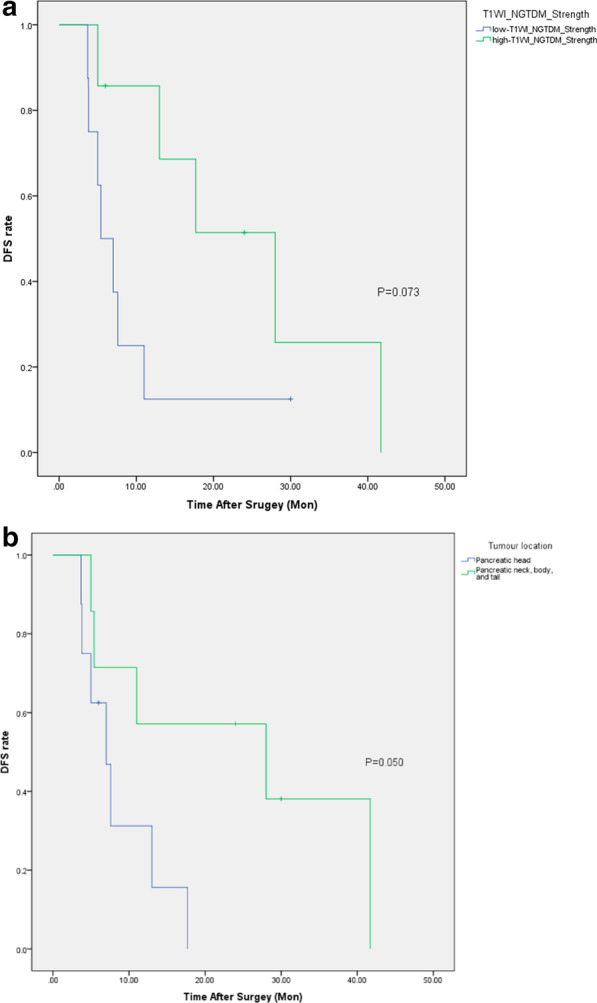
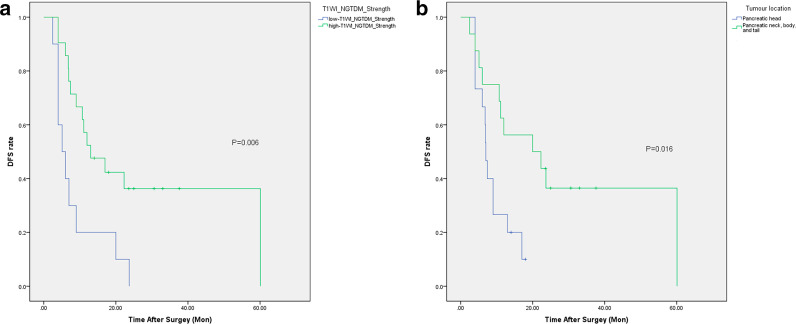
Multivariable Cox regression analysis identified the probability of TWI_NGTDM_Strength and tumour location as independent predictors of the efficacy of S-1 for adjuvant chemotherapy of PDAC (p = 0.005 and 0.013) in the primary cohort, with hazard ratios (HRs) of 0.289 and 0.293, respectively. Further survival analysis showed that patients in the low-TWI_NGTDM_Strength group had shorter DFS (median = 5.1 m) than those in the high-TWI_NGTDM_Strength group (median = 13.0 m) (p = 0.006), and patients with PDAC on the pancreatic head exhibited shorter DFS (median = 7.0 m) than patients with tumours in other locations (median = 20.0 m) (p = 0.016). In the validation cohort, the difference in DFS between patients with low-TWI_NGTDM_Strength and high-TWI_NGTDM_Strength and the difference between patients with PDAC on the pancreatic head and that in other locations were approved, with marginally significant (p = 0.073 and 0.050), respectively.

CONCLUSIONS

Whole-tumour radiomics feature of TWI_NGTDM_Strength and tumour location were potential predictors of the efficacy of S-1 and for the precision selection of S-1 as adjuvant chemotherapy regimen for PDAC.

摘要

背景

多项胰腺导管腺癌(PDAC)指南建议所有阶段的患者均需接受术后辅助化疗。S-1 是一种新出现的口服抗肿瘤药物,被指南推荐。然而,需要确定哪些人群将从 S-1 中受益,并且需要预测化疗反应的生物标志物,以便为个性化精准医学提供依据。本研究旨在初步探讨全肿瘤 MRI 评估和放射组学特征是否可用于预测 S-1 的疗效,并寻找 S-1 疗效的潜在预测标志物,为辅助个性化精准治疗提供依据。

方法

纳入 46 例接受根治性切除术且随后接受 S-1 辅助化疗的 PDAC 患者(原发性队列 31 例,验证性队列 15 例)。所有患者均接受腹部增强 MRI 检查,并从原发性队列中提取 PDAC 的全肿瘤放射组学特征。在单变量分析和放射组学特征选择后,使用多变量 Cox 回归模型进行生存分析,以选择与术后无病生存(DFS)相关的统计学显著因素。然后,使用 Kaplan-Meier 方法在验证性队列中测试这些因素的预测能力。

结果

多变量 Cox 回归分析确定 TWI_NGTDM_Strength 概率和肿瘤位置是 PDAC 患者 S-1 辅助化疗疗效的独立预测因素(p=0.005 和 0.013),风险比(HR)分别为 0.289 和 0.293。进一步的生存分析显示,低 TWI_NGTDM_Strength 组患者的 DFS 更短(中位=5.1 个月),而高 TWI_NGTDM_Strength 组患者的 DFS 更长(中位=13.0 个月)(p=0.006),胰腺头部的 PDAC 患者的 DFS 更短(中位=7.0 个月),而其他部位的 PDAC 患者的 DFS 更长(中位=20.0 个月)(p=0.016)。在验证性队列中,低 TWI_NGTDM_Strength 组和高 TWI_NGTDM_Strength 组之间的 DFS 差异以及胰腺头部 PDAC 患者和其他部位 PDAC 患者之间的 DFS 差异得到了证实,分别为 marginally significant(p=0.073 和 0.050)。

结论

全肿瘤 TWI_NGTDM_Strength 和肿瘤位置的放射组学特征是 S-1 疗效的潜在预测因素,可用于 PDAC 患者 S-1 辅助化疗方案的精准选择。
https://cdn.ncbi.nlm.nih.gov/pmc/blobs/a28d/8077911/6aa6fcc50fb6/12880_2021_605_Fig3_HTML.jpg
https://cdn.ncbi.nlm.nih.gov/pmc/blobs/a28d/8077911/4a034971724f/12880_2021_605_Fig1_HTML.jpg
https://cdn.ncbi.nlm.nih.gov/pmc/blobs/a28d/8077911/edfedfb593fb/12880_2021_605_Fig2_HTML.jpg
https://cdn.ncbi.nlm.nih.gov/pmc/blobs/a28d/8077911/6aa6fcc50fb6/12880_2021_605_Fig3_HTML.jpg
https://cdn.ncbi.nlm.nih.gov/pmc/blobs/a28d/8077911/4a034971724f/12880_2021_605_Fig1_HTML.jpg
https://cdn.ncbi.nlm.nih.gov/pmc/blobs/a28d/8077911/edfedfb593fb/12880_2021_605_Fig2_HTML.jpg
https://cdn.ncbi.nlm.nih.gov/pmc/blobs/a28d/8077911/6aa6fcc50fb6/12880_2021_605_Fig3_HTML.jpg

相似文献

1
Whole-tumour evaluation with MRI and radiomics features to predict the efficacy of S-1 for adjuvant chemotherapy in postoperative pancreatic cancer patients: a pilot study.采用 MRI 和放射组学特征对全肿瘤进行评估,预测术后胰腺癌患者 S-1 辅助化疗疗效的初步研究。
BMC Med Imaging. 2021 Apr 26;21(1):75. doi: 10.1186/s12880-021-00605-4.
2
Evaluation of the significance of adjuvant chemotherapy in patients with stage ⅠA pancreatic ductal adenocarcinoma.评估ⅠA 期胰腺导管腺癌患者辅助化疗的意义。
Pancreatology. 2021 Apr;21(3):581-588. doi: 10.1016/j.pan.2021.01.024. Epub 2021 Feb 5.
3
Clinical application of the biomarkers for the selection of adjuvant chemotherapy in pancreatic ductal adenocarcinoma.生物标志物在胰腺导管腺癌辅助化疗选择中的临床应用。
J Hepatobiliary Pancreat Sci. 2016 Aug;23(8):480-8. doi: 10.1002/jhbp.366. Epub 2016 Jun 23.
4
Correlation between relative dose intensity of adjuvant S-1 chemotherapy and psoas muscle mass volume and survival after resection of pancreatic ductal adenocarcinoma: A retrospective study.辅助 S-1 化疗的相对剂量强度与腹直肌肌肉量体积和胰导管腺癌切除术后生存的相关性:一项回顾性研究。
Medicine (Baltimore). 2024 May 24;103(21):e38292. doi: 10.1097/MD.0000000000038292.
5
Impact of adjuvant gemcitabine plus S-1 chemotherapy after surgical resection for adenocarcinoma of the body or tail of the pancreas.胰腺癌体尾部手术切除后辅助吉西他滨联合S-1化疗的疗效
J Gastrointest Surg. 2009 Jan;13(1):85-92. doi: 10.1007/s11605-008-0650-4. Epub 2008 Aug 13.
6
Impact of S-1 adjuvant chemotherapy longer than 6 months on survival in patients with resected pancreatic cancer: a nationwide survey by the Japan Pancreas Society based on real-world data.S-1辅助化疗超过6个月对可切除胰腺癌患者生存的影响:日本胰腺学会基于真实世界数据的全国性调查
Cancer. 2023 Mar 1;129(5):728-739. doi: 10.1002/cncr.34580. Epub 2022 Dec 12.
7
The high stromal SPARC expression is independently associated with poor survival of patients with resected pancreatic ductal adenocarcinoma treated with adjuvant gemcitabine in combination with S-1 or adjuvant gemcitabine alone.高基质 SPARC 表达与接受吉西他滨联合 S-1 辅助治疗或单独接受吉西他滨辅助治疗的可切除胰腺导管腺癌患者的不良生存独立相关。
Pancreatology. 2018 Mar;18(2):191-197. doi: 10.1016/j.pan.2017.12.014. Epub 2017 Dec 26.
8
Overall survival of patients with recurrent pancreatic cancer treated with systemic therapy: a retrospective study.接受系统治疗的复发性胰腺癌患者的总生存:一项回顾性研究。
BMC Cancer. 2019 May 17;19(1):468. doi: 10.1186/s12885-019-5630-4.
9
Preoperative prediction of disease-free survival in pancreatic ductal adenocarcinoma patients after R0 resection using contrast-enhanced CT and CA19-9.应用增强 CT 和 CA19-9 对 R0 切除术后胰腺导管腺癌患者无病生存的术前预测。
Eur Radiol. 2024 Jan;34(1):509-524. doi: 10.1007/s00330-023-09980-8. Epub 2023 Jul 28.
10
Comparison of 4- and 4 plus-courses S-1 administration as adjuvant chemotherapy for pancreatic ductal adenocarcinoma.4 个疗程和 4 个疗程加 S-1 给药作为胰腺导管腺癌辅助化疗的比较。
BMC Cancer. 2021 May 26;21(1):612. doi: 10.1186/s12885-021-08380-9.

引用本文的文献

1
Topological regularization of networks in temporal lobe epilepsy: a structural MRI study.颞叶癫痫中网络的拓扑正则化:一项结构磁共振成像研究
Front Neurosci. 2024 Jul 4;18:1423389. doi: 10.3389/fnins.2024.1423389. eCollection 2024.
2
A more objective PD diagnostic model: integrating texture feature markers of cerebellar gray matter and white matter through machine learning.一种更客观的帕金森病诊断模型:通过机器学习整合小脑灰质和白质的纹理特征标记物。
Front Aging Neurosci. 2024 Jun 7;16:1393841. doi: 10.3389/fnagi.2024.1393841. eCollection 2024.
3
A nomogram based on CT texture features to predict the response of patients with advanced pancreatic cancer treated with chemotherapy.

本文引用的文献

1
Validation of Prognostic Radiomic Features From Resectable Pancreatic Ductal Adenocarcinoma in Patients With Advanced Disease Undergoing Chemotherapy.接受化疗的晚期可切除胰腺导管腺癌患者预后放射组学特征的验证
Can Assoc Radiol J. 2021 Nov;72(4):605-613. doi: 10.1177/0846537120968782. Epub 2020 Nov 5.
2
CT and MRI of pancreatic tumors: an update in the era of radiomics.胰腺肿瘤的 CT 和 MRI:放射组学时代的新进展。
Jpn J Radiol. 2020 Dec;38(12):1111-1124. doi: 10.1007/s11604-020-01057-6. Epub 2020 Oct 21.
3
Prognostic value of FDG-PET radiomics with machine learning in pancreatic cancer.
基于 CT 纹理特征的列线图预测接受化疗的晚期胰腺癌患者的反应。
BMC Gastroenterol. 2023 Aug 10;23(1):274. doi: 10.1186/s12876-023-02902-4.
4
Artificial Intelligence in the Diagnosis and Treatment of Pancreatic Cystic Lesions and Adenocarcinoma.人工智能在胰腺囊性病变和腺癌诊断与治疗中的应用
Cancers (Basel). 2023 Apr 22;15(9):2410. doi: 10.3390/cancers15092410.
5
Pancreatic Mass Characterization Using IVIM-DKI MRI and Machine Learning-Based Multi-Parametric Texture Analysis.使用体素内不相干运动扩散峰度成像磁共振成像(IVIM-DKI MRI)和基于机器学习的多参数纹理分析对胰腺肿块进行特征描述
Bioengineering (Basel). 2023 Jan 8;10(1):83. doi: 10.3390/bioengineering10010083.
6
Application of Artificial Intelligence in the Management of Pancreatic Cystic Lesions.人工智能在胰腺囊性病变管理中的应用。
Biomimetics (Basel). 2022 Jun 14;7(2):79. doi: 10.3390/biomimetics7020079.
7
A novel preoperative MRI-based radiomics nomogram outperforms traditional models for prognostic prediction in pancreatic ductal adenocarcinoma.一种基于术前MRI的新型影像组学列线图在预测胰腺导管腺癌预后方面优于传统模型。
Am J Cancer Res. 2022 May 15;12(5):2032-2049. eCollection 2022.
8
Using Quantitative Imaging for Personalized Medicine in Pancreatic Cancer: A Review of Radiomics and Deep Learning Applications.利用定量成像技术实现胰腺癌的个性化医疗:放射组学与深度学习应用综述
Cancers (Basel). 2022 Mar 24;14(7):1654. doi: 10.3390/cancers14071654.
基于 FDG-PET 影像组学和机器学习的胰腺癌预后预测价值。
Sci Rep. 2020 Oct 12;10(1):17024. doi: 10.1038/s41598-020-73237-3.
4
The application of texture quantification in hepatocellular carcinoma using CT and MRI: a review of perspectives and challenges.CT 和 MRI 中纹理量化在肝细胞癌中的应用:观点和挑战综述。
Cancer Imaging. 2020 Sep 22;20(1):67. doi: 10.1186/s40644-020-00341-y.
5
S100A4 overexpression in pancreatic ductal adenocarcinoma: imaging biomarkers from whole-tumor evaluation with MRI and texture analysis.S100A4 在胰腺导管腺癌中的过表达:MRI 全瘤评估及纹理分析的成像生物标志物。
Abdom Radiol (NY). 2021 Feb;46(2):623-635. doi: 10.1007/s00261-020-02676-3. Epub 2020 Aug 1.
6
Clinical Practice Guidelines for Pancreatic Cancer 2019 From the Japan Pancreas Society: A Synopsis.《2019 年日本胰腺学会胰腺癌临床实践指南概要》。
Pancreas. 2020 Mar;49(3):326-335. doi: 10.1097/MPA.0000000000001513.
7
Pancreatic Ductal Adenocarcinoma: Machine Learning-Based Quantitative Computed Tomography Texture Analysis For Prediction Of Histopathological Grade.胰腺导管腺癌:基于机器学习的定量计算机断层扫描纹理分析用于预测组织病理学分级
Cancer Manag Res. 2019 Oct 30;11:9253-9264. doi: 10.2147/CMAR.S218414. eCollection 2019.
8
A machine learning algorithm predicts molecular subtypes in pancreatic ductal adenocarcinoma with differential response to gemcitabine-based versus FOLFIRINOX chemotherapy.机器学习算法预测胰腺导管腺癌的分子亚型,这些亚型对基于吉西他滨与 FOLFIRINOX 化疗的反应存在差异。
PLoS One. 2019 Oct 2;14(10):e0218642. doi: 10.1371/journal.pone.0218642. eCollection 2019.
9
Chemotherapy for pancreatic cancer.胰腺癌的化疗
Presse Med. 2019 Mar;48(3 Pt 2):e159-e174. doi: 10.1016/j.lpm.2019.02.025. Epub 2019 Mar 15.
10
Global cancer statistics 2018: GLOBOCAN estimates of incidence and mortality worldwide for 36 cancers in 185 countries.全球癌症统计数据 2018:GLOBOCAN 对全球 185 个国家/地区 36 种癌症的发病率和死亡率的估计。
CA Cancer J Clin. 2018 Nov;68(6):394-424. doi: 10.3322/caac.21492. Epub 2018 Sep 12.