Alvarez-Guzman Carlos, Bustamante-Arias Andres, Colorado-Zavala Maria F, Rodriguez-Garcia Alejandro
Tecnologico de Monterrey, School of Medicine and Health Sciences, Institute of Ophthalmology and Visual Sciences, Ocular Immunology & Uveitis Service, Monterrey, Mexico.
Hospital Zambrano Hellion, TecSalud, Av. Batallon de San Patricio No. 112. Col. Real de San Agustin, San Pedro Garza Garcia, N.L., C.P. 66278, Mexico.
Int J Retina Vitreous. 2021 Apr 27;7(1):36. doi: 10.1186/s40942-021-00306-8.
To analyze the relationship between the central foveal thickness (CFT) and the integrity of the ellipsoid portion of inner segments (EPIS) and interdigitating zone (IZ) retinal layers in the visual outcome of uveitic macular edema (UME).
Prospective, observational, and cross-sectional study of eyes with UME. Spectral-domain optical coherence tomography (SD-OCT) macular morphological pattern, CFT, and integrity of the outer retinal layers were analyzed. We arranged the data by EPIS or IZ integrity and contrasted it with student t-test (quantitative variables) and Fisher exact test or χ² distribution (categorical variables) to evaluate visual impairment and retinal measures. Receiver operator curve (ROC) estimation and logistic regression (probit) assessed if the sample´s variance could be associated with IZ or EPIS integrity.
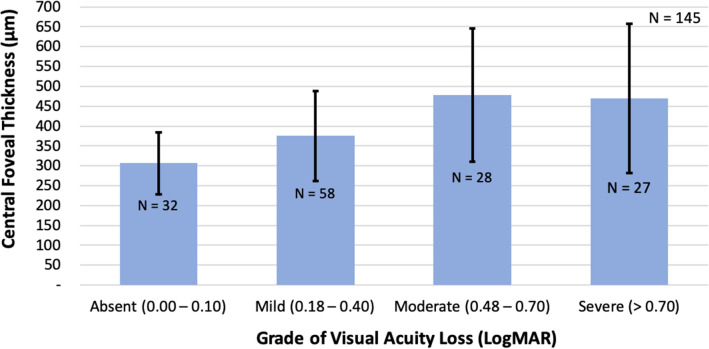
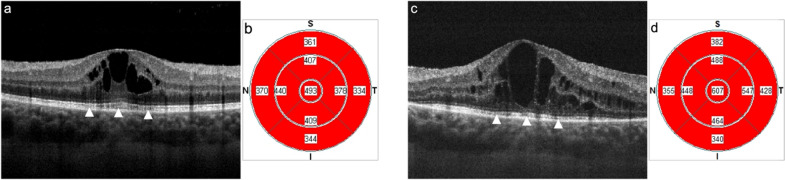
We included 145 SD-OCT macular scans from 45 patients at different stages of UME. Cystoid macular edema (CME) increased the risk of severe (P ≤ 0.0162) and moderate visual loss (P ≤ 0.0032). The highest CFT values occurred in patients with moderate (478.11 ± 167.62 μm) and severe (449.4 ± 224.86 μm) visual loss. Of all morphological patterns of macular edema, only CME showed a statistically significant relationship with severe visual impairment (44.92%, p = 0.0035, OR 4.29 [1.62-11.4]). Likewise, an increased probability of severe visual loss correlated negatively with both, IZ (37.93%, P ≤ 0.001, OR 10.02) and EPIS (38.98%, P ≤ 0.001, OR 13.1) disruption. A CFT > 337 μm showed a higher probability of IZ (AUROC = 0.7341, SEN 77.59%, ESP 65.52) and EPIS (AUROC = 0.7489, SEN 76.37%, ESP 65.12%) loss of integrity. Moreover, when BCVA reached 0.44 LogMAR (≤ 20/50 Snellen eq.), it was more likely to have IZ (AUROC = 0.8706, ESP 88.51%, SEN 77.59%) and EPIS (AUROC = 0.8898, ESP 88.3%, SEN 76.27) disruption.
Significantly increased CFT has a higher probability for EPIS and IZ disruption, which significantly increases the risk for irreversible visual loss in eyes with UME. Evaluating these layers' integrity by optical coherence tomography helps predict the visual outcome and make the right therapeutic decisions. Trial registration The study was registered on April 13, 2020, at the Instituto Tecnologico y de Estudios Superiores de Monterrey Research Committee (License No. COFEPRIS 20 CI 19 039 002), project registration No. P000338-CAVICaREMU-CI-CR002, and the Ethics Committee (License No. CONBIOETICA 19 CEI 011-2016-10-17), project registration No. P000338-CAVICaREMU-CEIC-CR002.
分析葡萄膜炎性黄斑水肿(UME)患者的中心凹厚度(CFT)与视网膜内层椭圆体带(EPIS)和指状交叉区(IZ)视网膜层完整性之间的关系,及其对视觉预后的影响。
对UME患者进行前瞻性、观察性横断面研究。分析黄斑部形态学模式、CFT及外层视网膜层的完整性。根据EPIS或IZ的完整性对数据进行整理,并采用学生t检验(定量变量)、Fisher精确检验或χ²分布(分类变量)进行对比,以评估视力损害和视网膜测量结果。采用受试者工作特征曲线(ROC)估计和逻辑回归(概率单位)分析样本方差是否与IZ或EPIS完整性相关。
纳入45例不同阶段UME患者的145幅黄斑部SD-OCT扫描图像。黄斑囊样水肿(CME)增加了严重视力丧失(P≤0.0162)和中度视力丧失(P≤0.0032)的风险。中度视力丧失(478.11±167.62μm)和严重视力丧失(449.4±224.86μm)患者的CFT值最高。在所有黄斑水肿形态中,只有CME与严重视力损害存在统计学显著相关性(44.92%,p = 0.0035,OR 4.29 [1.62 - 11.4])。同样,严重视力丧失的可能性增加与IZ(37.93%,P≤0.001,OR 10.02)和EPIS(38.98%,P≤0.001,OR 13.1)破坏均呈负相关。CFT>337μm时,IZ(曲线下面积=0.7341,敏感度77.59%,特异度65.52%)和EPIS(曲线下面积=0.7489,敏感度76.37%,特异度65.12%)完整性丧失的可能性更高。此外,当最佳矫正视力(BCVA)达到0.44 LogMAR(≤20/50 Snellen视力表等效值)时,IZ(曲线下面积=0.8706,特异度88.51%,敏感度77.59%)和EPIS(曲线下面积=0.8898,特异度88.3%,敏感度76.27%)破坏的可能性更大。
CFT显著增加时,EPIS和IZ破坏的可能性更高,这显著增加了UME患者不可逆视力丧失的风险。通过光学相干断层扫描评估这些层的完整性有助于预测视觉预后并做出正确的治疗决策。试验注册 本研究于2020年4月13日在蒙特雷理工学院研究委员会注册(许可证编号:COFEPRIS 20 CI 19 039 002),项目注册号:P000338 - CAVICaREMU - CI - CR002,以及伦理委员会(许可证编号:CONBIOETICA 19 CEI 011 - 2016 - 10 - 17),项目注册号:P000338 - CAVICaREMU - CEIC - CR002。