Health Service & Population Research Department, King's College London Institute of Psychiatry Psychology and Neuroscience, London, UK
Global Health and Social Medicine, King's College London, London, UK.
BMJ Glob Health. 2021 Apr;6(4). doi: 10.1136/bmjgh-2020-004661.
Although cash transfer programmes are not explicitly designed to improve mental health, by reducing poverty and improving the life chances of children and young people, they may also improve their mental health. This systematic review and meta-analysis assessed the evidence on the effectiveness of cash transfers to improve the mental health of children and young people in low-income and middle-income countries.
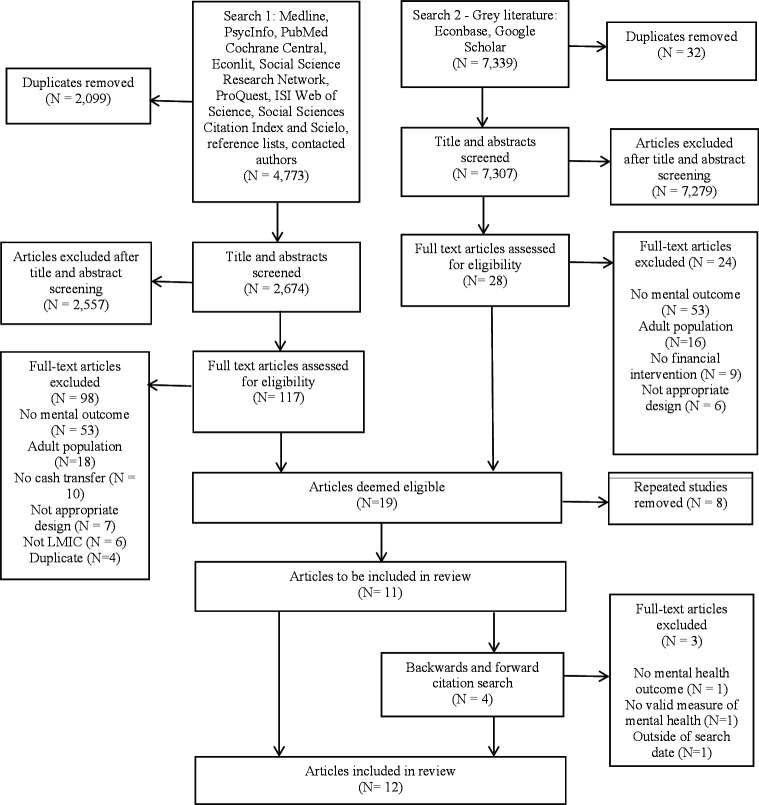
We searched Pubmed, EBSCOhost, Scientific Electronic Library Online, ISI Web of Science and Social Sciences Citation Index and grey literature (from January 2000 to July 2020) for studies which quantitatively assessed the impact of cash transfers on mental health in young people (aged 0-24 years), using a design that incorporated a control group. We extracted Cohen's d effects size and used a random-effects model for the meta-analysis on studies that measured depressive symptoms, I statistic and assessment of study quality.
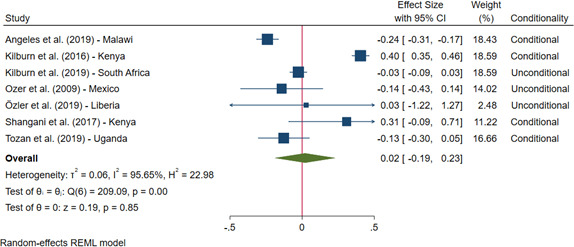
We identified 12 116 articles for screening, of which 12 were included in the systematic review (covering 13 interventions) and seven in the meta-analysis assessing impact on depressive symptoms specifically. There was high heterogeneity (I=95.2) and a high risk of bias (0.38, 95% CIs: -5.08 to 5.85; p=0.86) across studies. Eleven interventions (85%) showed a significant positive impact of cash transfers on at least one mental health outcome in children and young people. However, no study found a positive effect on all mental health outcomes examined, and the meta-analysis showed no impact of cash transfers on depressive symptoms (0.02, 95% CIs: -0.19 to 0.23; p=0.85).
Cash transfers may have positive effects on some mental health outcomes for young people, with no negative effects identified. However, there is high heterogeneity across studies, with some interventions showing no effects. Our review highlights how the effect of cash transfers may vary by social and economic context, culture, design, conditionality and mental health outcome.
尽管现金转移计划并非专门设计用于改善心理健康,但通过减少贫困和提高儿童和年轻人的生活机会,它们也可能改善他们的心理健康。本系统评价和荟萃分析评估了现金转移对中低收入国家儿童和年轻人心理健康的有效性的证据。
我们在 Pubmed、EBSCOhost、Scientific Electronic Library Online、ISI Web of Science 和社会科学引文索引以及灰色文献(2000 年 1 月至 2020 年 7 月)中搜索了定量评估现金转移对年轻人(0-24 岁)心理健康影响的研究,使用了包含对照组的设计。我们提取了 Cohen 的 d 效应大小,并对专门评估抑郁症状的研究进行了随机效应模型荟萃分析,评估了 I 统计量和研究质量。
我们筛选出了 12116 篇文章,其中 12 篇被纳入系统评价(涵盖 13 项干预措施),7 篇被纳入专门评估对抑郁症状影响的荟萃分析。研究之间存在高度异质性(I=95.2)和高偏倚风险(0.38,95%置信区间:-5.08 至 5.85;p=0.86)。11 项干预措施(85%)显示现金转移对儿童和年轻人的至少一项心理健康结果有显著的积极影响。然而,没有一项研究发现对所有评估的心理健康结果都有积极影响,荟萃分析显示现金转移对抑郁症状没有影响(0.02,95%置信区间:-0.19 至 0.23;p=0.85)。
现金转移可能对年轻人的一些心理健康结果产生积极影响,没有发现负面影响。然而,研究之间存在高度异质性,一些干预措施没有效果。我们的综述强调了现金转移的效果可能因社会和经济背景、文化、设计、条件和心理健康结果而有所不同。