Bioinformatics Graduate Program, Boston University, Boston, MA, USA.
Department of Medicine (Biomedical Genetics), Boston University School of Medicine, Boston, MA, USA.
Transl Psychiatry. 2021 Apr 27;11(1):250. doi: 10.1038/s41398-021-01373-z.
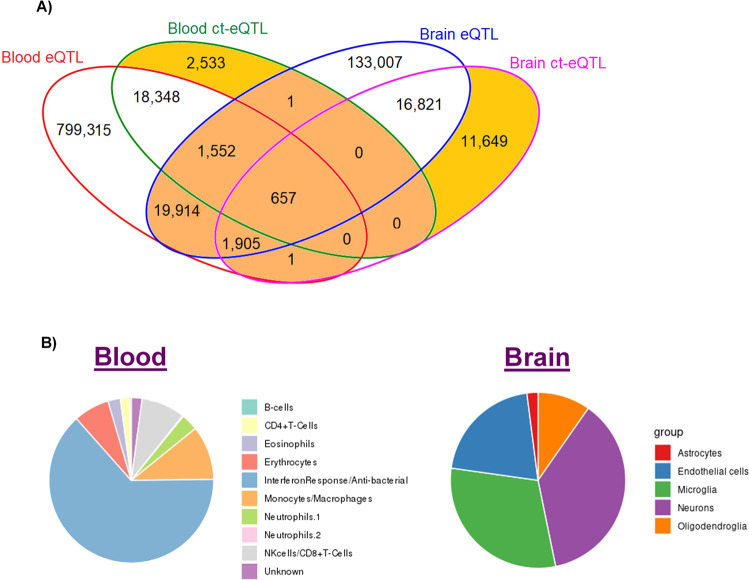
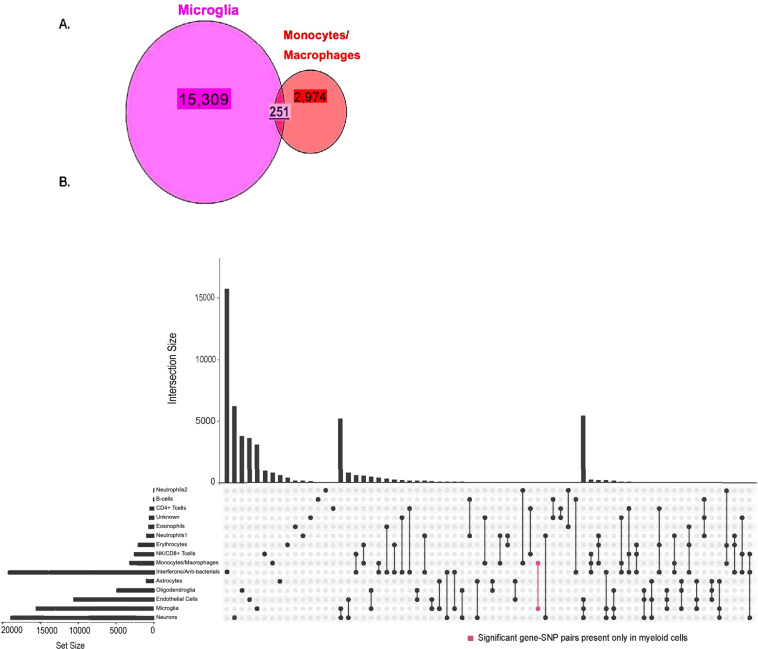
Because regulation of gene expression is heritable and context-dependent, we investigated AD-related gene expression patterns in cell types in blood and brain. Cis-expression quantitative trait locus (eQTL) mapping was performed genome-wide in blood from 5257 Framingham Heart Study (FHS) participants and in brain donated by 475 Religious Orders Study/Memory & Aging Project (ROSMAP) participants. The association of gene expression with genotypes for all cis SNPs within 1 Mb of genes was evaluated using linear regression models for unrelated subjects and linear-mixed models for related subjects. Cell-type-specific eQTL (ct-eQTL) models included an interaction term for the expression of "proxy" genes that discriminate particular cell type. Ct-eQTL analysis identified 11,649 and 2533 additional significant gene-SNP eQTL pairs in brain and blood, respectively, that were not detected in generic eQTL analysis. Of note, 386 unique target eGenes of significant eQTLs shared between blood and brain were enriched in apoptosis and Wnt signaling pathways. Five of these shared genes are established AD loci. The potential importance and relevance to AD of significant results in myeloid cell types is supported by the observation that a large portion of GWS ct-eQTLs map within 1 Mb of established AD loci and 58% (23/40) of the most significant eGenes in these eQTLs have previously been implicated in AD. This study identified cell-type-specific expression patterns for established and potentially novel AD genes, found additional evidence for the role of myeloid cells in AD risk, and discovered potential novel blood and brain AD biomarkers that highlight the importance of cell-type-specific analysis.
由于基因表达的调控具有遗传性和上下文依赖性,我们研究了血液和大脑细胞类型中与 AD 相关的基因表达模式。在 5257 名弗雷明汉心脏研究(FHS)参与者的血液和 475 名宗教秩序研究/记忆与衰老项目(ROSMAP)参与者捐赠的大脑中进行了全基因组范围内的顺式表达数量性状基因座(eQTL)图谱绘制。使用无关联个体的线性回归模型和相关个体的线性混合模型,评估了基因表达与基因 1Mb 内所有顺式 SNP 基因型的关联。细胞类型特异性 eQTL(ct-eQTL)模型包括用于区分特定细胞类型的“代理”基因表达的交互项。ct-eQTL 分析分别在大脑和血液中鉴定出 11649 和 2533 个额外的显著基因-SNP eQTL 对,这些对在通用 eQTL 分析中未被检测到。值得注意的是,在血液和大脑之间共享的显著 eQTL 的 386 个独特靶基因 eGenes 富集在凋亡和 Wnt 信号通路中。这些共享基因中有 5 个是已确立的 AD 基因座。在髓样细胞类型中,大量的 GWS ct-eQTL 映射到已建立的 AD 基因座的 1Mb 内,并且这些 eQTL 中 58%(23/40)的最显著 eGenes 之前与 AD 有关,这支持了这些显著结果对 AD 的重要性和相关性。本研究确定了已建立和潜在新型 AD 基因的细胞类型特异性表达模式,为髓样细胞在 AD 风险中的作用提供了更多证据,并发现了潜在的新型血液和大脑 AD 生物标志物,突出了细胞类型特异性分析的重要性。