Huang Shigao, Yang Jie, Fong Simon, Zhao Qi
Cancer Centre, Institute of Translational Medicine, Faculty of Health Sciences, University of Macau 999078, Macau SAR, China.
Department of Computer and Information Science, University of Macau 999078, Macau SAR, China.
Int J Biol Sci. 2021 Apr 10;17(6):1581-1587. doi: 10.7150/ijbs.58855. eCollection 2021.
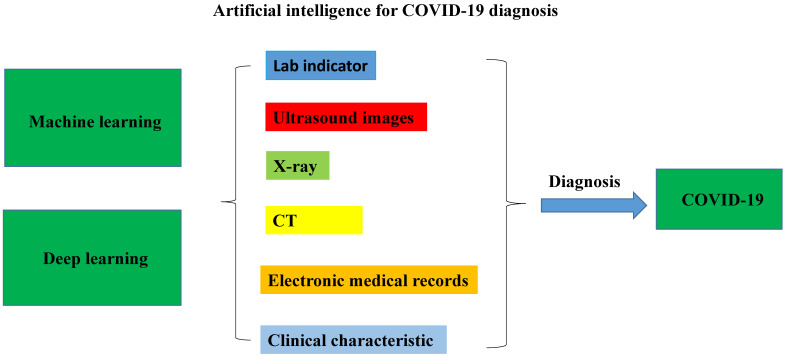
Artificial intelligence (AI) is being used to aid in various aspects of the COVID-19 crisis, including epidemiology, molecular research and drug development, medical diagnosis and treatment, and socioeconomics. The association of AI and COVID-19 can accelerate to rapidly diagnose positive patients. To learn the dynamics of a pandemic with relevance to AI, we search the literature using the different academic databases (PubMed, PubMed Central, Scopus, Google Scholar) and preprint servers (bioRxiv, medRxiv, arXiv). In the present review, we address the clinical applications of machine learning and deep learning, including clinical characteristics, electronic medical records, medical images (CT, X-ray, ultrasound images, etc.) in the COVID-19 diagnosis. The current challenges and future perspectives provided in this review can be used to direct an ideal deployment of AI technology in a pandemic.
人工智能(AI)正被用于协助应对新冠疫情危机的各个方面,包括流行病学、分子研究与药物研发、医学诊断与治疗以及社会经济学。人工智能与新冠疫情的关联能够加速对阳性患者的快速诊断。为了解与人工智能相关的大流行病动态,我们使用不同的学术数据库(PubMed、PubMed Central、Scopus、谷歌学术)和预印本服务器(bioRxiv、medRxiv、arXiv)检索文献。在本综述中,我们探讨机器学习和深度学习在新冠疫情诊断中的临床应用,包括临床特征、电子病历、医学图像(CT、X射线、超声图像等)。本综述中提出的当前挑战和未来展望可用于指导人工智能技术在大流行病中的理想应用。