• 文献检索
  • 文档翻译
  • 深度研究
  • 学术资讯
  • Suppr Zotero 插件Zotero 插件
  • 邀请有礼
  • 套餐&价格
  • 历史记录
应用&插件
Suppr Zotero 插件Zotero 插件浏览器插件Mac 客户端Windows 客户端微信小程序
定价
高级版会员购买积分包购买API积分包
服务
文献检索文档翻译深度研究API 文档MCP 服务
关于我们
关于 Suppr公司介绍联系我们用户协议隐私条款
关注我们

Suppr 超能文献

核心技术专利:CN118964589B侵权必究
粤ICP备2023148730 号-1Suppr @ 2026

文献检索

告别复杂PubMed语法,用中文像聊天一样搜索,搜遍4000万医学文献。AI智能推荐,让科研检索更轻松。

立即免费搜索

文件翻译

保留排版,准确专业,支持PDF/Word/PPT等文件格式,支持 12+语言互译。

免费翻译文档

深度研究

AI帮你快速写综述,25分钟生成高质量综述,智能提取关键信息,辅助科研写作。

立即免费体验

基于多任务深度学习的 COVID-19 肺炎 CT 成像分析:分类与分割。

Multi-task deep learning based CT imaging analysis for COVID-19 pneumonia: Classification and segmentation.

机构信息

General Electric Healthcare, Buc, France; LITIS - EA4108 - Quantif, University of Rouen, Rouen, France.

LITIS - EA4108 - Quantif, University of Rouen, Rouen, France; Nuclear Medicine Department, Henri Becquerel Center, Rouen, France.

出版信息

Comput Biol Med. 2020 Nov;126:104037. doi: 10.1016/j.compbiomed.2020.104037. Epub 2020 Oct 8.

DOI:10.1016/j.compbiomed.2020.104037
PMID:33065387
原文链接:https://pmc.ncbi.nlm.nih.gov/articles/PMC7543793/
Abstract

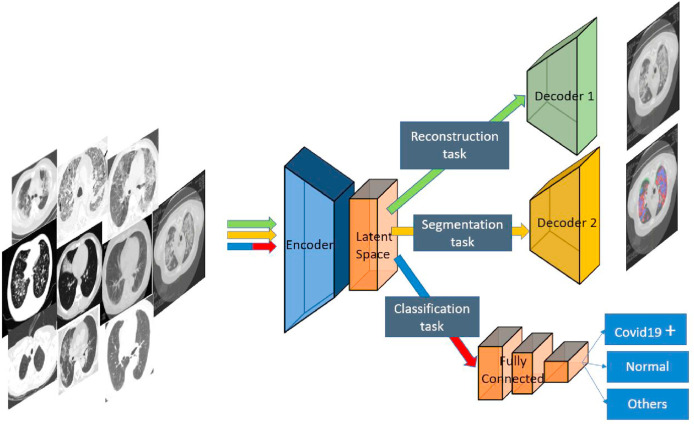
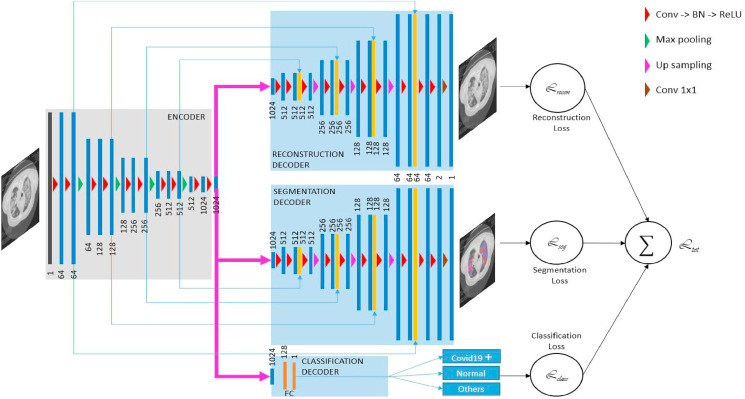
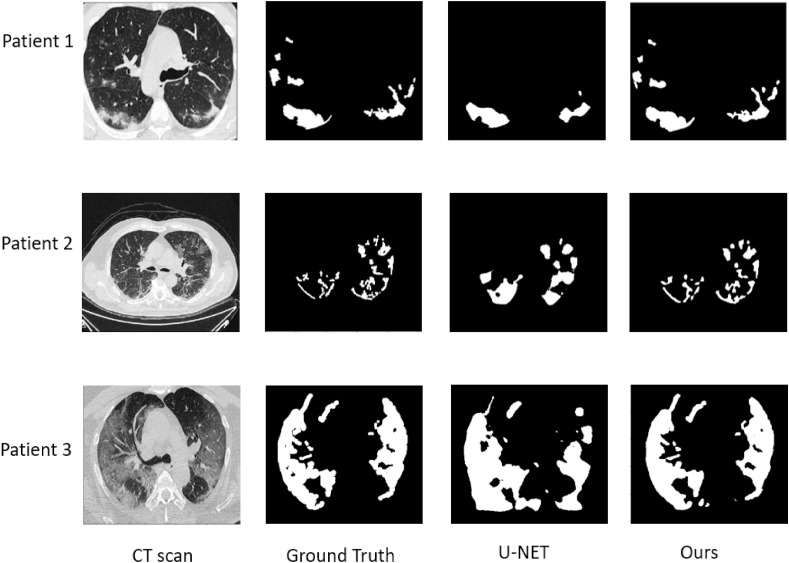
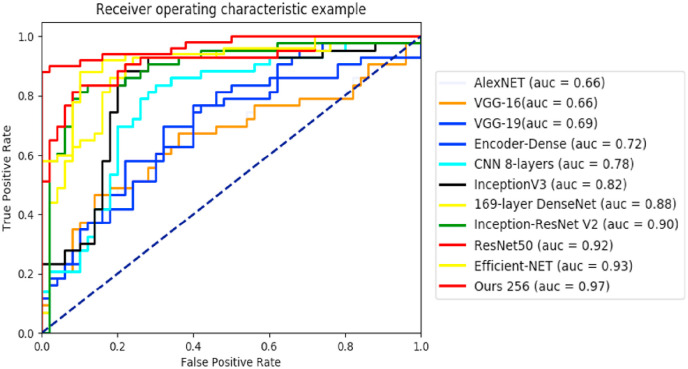
This paper presents an automatic classification segmentation tool for helping screening COVID-19 pneumonia using chest CT imaging. The segmented lesions can help to assess the severity of pneumonia and follow-up the patients. In this work, we propose a new multitask deep learning model to jointly identify COVID-19 patient and segment COVID-19 lesion from chest CT images. Three learning tasks: segmentation, classification and reconstruction are jointly performed with different datasets. Our motivation is on the one hand to leverage useful information contained in multiple related tasks to improve both segmentation and classification performances, and on the other hand to deal with the problems of small data because each task can have a relatively small dataset. Our architecture is composed of a common encoder for disentangled feature representation with three tasks, and two decoders and a multi-layer perceptron for reconstruction, segmentation and classification respectively. The proposed model is evaluated and compared with other image segmentation techniques using a dataset of 1369 patients including 449 patients with COVID-19, 425 normal ones, 98 with lung cancer and 397 of different kinds of pathology. The obtained results show very encouraging performance of our method with a dice coefficient higher than 0.88 for the segmentation and an area under the ROC curve higher than 97% for the classification.

摘要

本文提出了一种自动分类分割工具,用于帮助使用胸部 CT 成像筛查 COVID-19 肺炎。分割的病变可以帮助评估肺炎的严重程度并对患者进行随访。在这项工作中,我们提出了一种新的多任务深度学习模型,用于联合识别 COVID-19 患者并从胸部 CT 图像中分割 COVID-19 病变。三个学习任务:分割、分类和重建,使用不同的数据集共同执行。我们的动机一方面是利用多个相关任务中包含的有用信息来提高分割和分类性能,另一方面是处理小数据集的问题,因为每个任务都可以有相对较小的数据集。我们的架构由一个用于解耦特征表示的公共编码器组成,该编码器有三个任务,两个解码器和一个多层感知机,分别用于重建、分割和分类。使用包含 1369 名患者的数据集评估并比较了我们的模型与其他图像分割技术,其中包括 449 名 COVID-19 患者、425 名正常患者、98 名肺癌患者和 397 名不同病理患者。获得的结果表明,我们的方法表现非常出色,分割的骰子系数高于 0.88,分类的 ROC 曲线下面积高于 97%。
https://cdn.ncbi.nlm.nih.gov/pmc/blobs/f8bc/7543793/0cbdd185b540/gr10_lrg.jpg
https://cdn.ncbi.nlm.nih.gov/pmc/blobs/f8bc/7543793/064bb5e9a604/gr1_lrg.jpg
https://cdn.ncbi.nlm.nih.gov/pmc/blobs/f8bc/7543793/3c492a5bcac6/gr2_lrg.jpg
https://cdn.ncbi.nlm.nih.gov/pmc/blobs/f8bc/7543793/bf8f92e55cdd/gr3_lrg.jpg
https://cdn.ncbi.nlm.nih.gov/pmc/blobs/f8bc/7543793/8dd3f4980068/gr4_lrg.jpg
https://cdn.ncbi.nlm.nih.gov/pmc/blobs/f8bc/7543793/c9c8ae2cbe71/gr5_lrg.jpg
https://cdn.ncbi.nlm.nih.gov/pmc/blobs/f8bc/7543793/f0324f3d2ed1/gr6_lrg.jpg
https://cdn.ncbi.nlm.nih.gov/pmc/blobs/f8bc/7543793/9b300d2f56d8/gr7_lrg.jpg
https://cdn.ncbi.nlm.nih.gov/pmc/blobs/f8bc/7543793/0a047cf954e2/gr8_lrg.jpg
https://cdn.ncbi.nlm.nih.gov/pmc/blobs/f8bc/7543793/de0b52d5d7a7/gr9_lrg.jpg
https://cdn.ncbi.nlm.nih.gov/pmc/blobs/f8bc/7543793/0cbdd185b540/gr10_lrg.jpg
https://cdn.ncbi.nlm.nih.gov/pmc/blobs/f8bc/7543793/064bb5e9a604/gr1_lrg.jpg
https://cdn.ncbi.nlm.nih.gov/pmc/blobs/f8bc/7543793/3c492a5bcac6/gr2_lrg.jpg
https://cdn.ncbi.nlm.nih.gov/pmc/blobs/f8bc/7543793/bf8f92e55cdd/gr3_lrg.jpg
https://cdn.ncbi.nlm.nih.gov/pmc/blobs/f8bc/7543793/8dd3f4980068/gr4_lrg.jpg
https://cdn.ncbi.nlm.nih.gov/pmc/blobs/f8bc/7543793/c9c8ae2cbe71/gr5_lrg.jpg
https://cdn.ncbi.nlm.nih.gov/pmc/blobs/f8bc/7543793/f0324f3d2ed1/gr6_lrg.jpg
https://cdn.ncbi.nlm.nih.gov/pmc/blobs/f8bc/7543793/9b300d2f56d8/gr7_lrg.jpg
https://cdn.ncbi.nlm.nih.gov/pmc/blobs/f8bc/7543793/0a047cf954e2/gr8_lrg.jpg
https://cdn.ncbi.nlm.nih.gov/pmc/blobs/f8bc/7543793/de0b52d5d7a7/gr9_lrg.jpg
https://cdn.ncbi.nlm.nih.gov/pmc/blobs/f8bc/7543793/0cbdd185b540/gr10_lrg.jpg

相似文献

1
Multi-task deep learning based CT imaging analysis for COVID-19 pneumonia: Classification and segmentation.基于多任务深度学习的 COVID-19 肺炎 CT 成像分析:分类与分割。
Comput Biol Med. 2020 Nov;126:104037. doi: 10.1016/j.compbiomed.2020.104037. Epub 2020 Oct 8.
2
A Noise-Robust Framework for Automatic Segmentation of COVID-19 Pneumonia Lesions From CT Images.一种用于从 CT 图像中自动分割 COVID-19 肺炎病变的抗噪框架。
IEEE Trans Med Imaging. 2020 Aug;39(8):2653-2663. doi: 10.1109/TMI.2020.3000314.
3
From community-acquired pneumonia to COVID-19: a deep learning-based method for quantitative analysis of COVID-19 on thick-section CT scans.从社区获得性肺炎到 COVID-19:一种基于深度学习的 CT 厚层扫描 COVID-19 定量分析方法。
Eur Radiol. 2020 Dec;30(12):6828-6837. doi: 10.1007/s00330-020-07042-x. Epub 2020 Jul 18.
4
Development of a quantitative segmentation model to assess the effect of comorbidity on patients with COVID-19.开发一种定量分割模型,以评估合并症对 COVID-19 患者的影响。
Eur J Med Res. 2020 Oct 12;25(1):49. doi: 10.1186/s40001-020-00450-1.
5
COVID-19 identification in chest X-ray images on flat and hierarchical classification scenarios.基于平面和分层分类场景的胸部 X 射线图像中的 COVID-19 识别。
Comput Methods Programs Biomed. 2020 Oct;194:105532. doi: 10.1016/j.cmpb.2020.105532. Epub 2020 May 8.
6
A deep learning approach to characterize 2019 coronavirus disease (COVID-19) pneumonia in chest CT images.深度学习在胸部 CT 图像中对 2019 冠状病毒病(COVID-19)肺炎的特征描述
Eur Radiol. 2020 Dec;30(12):6517-6527. doi: 10.1007/s00330-020-07044-9. Epub 2020 Jul 2.
7
Deep learning-based multi-view fusion model for screening 2019 novel coronavirus pneumonia: A multicentre study.基于深度学习的多视图融合模型用于筛查 2019 年新型冠状病毒肺炎:一项多中心研究。
Eur J Radiol. 2020 Jul;128:109041. doi: 10.1016/j.ejrad.2020.109041. Epub 2020 May 5.
8
Adaptive Feature Selection Guided Deep Forest for COVID-19 Classification With Chest CT.基于胸部 CT 的 COVID-19 分类的自适应特征选择引导深度森林
IEEE J Biomed Health Inform. 2020 Oct;24(10):2798-2805. doi: 10.1109/JBHI.2020.3019505. Epub 2020 Aug 26.
9
COVID-19 Pneumonia Diagnosis Using a Simple 2D Deep Learning Framework With a Single Chest CT Image: Model Development and Validation.使用具有单张胸部CT图像的简单二维深度学习框架诊断COVID-19肺炎:模型开发与验证
J Med Internet Res. 2020 Jun 29;22(6):e19569. doi: 10.2196/19569.
10
A Weakly-Supervised Framework for COVID-19 Classification and Lesion Localization From Chest CT.一种基于弱监督的 COVID-19 分类和胸部 CT 病变定位框架。
IEEE Trans Med Imaging. 2020 Aug;39(8):2615-2625. doi: 10.1109/TMI.2020.2995965.

引用本文的文献

1
LGD_Net: Capsule network with extreme learning machine for classification of lung diseases using CT scans.LGD_Net:用于使用CT扫描对肺部疾病进行分类的带极限学习机的胶囊网络。
PLoS One. 2025 Aug 8;20(8):e0327419. doi: 10.1371/journal.pone.0327419. eCollection 2025.
2
WSDC-ViT: a novel transformer network for pneumonia image classification based on windows scalable attention and dynamic rectified linear unit convolutional modules.WSDC-ViT:一种基于窗口可扩展注意力和动态整流线性单元卷积模块的新型肺炎图像分类变压器网络。
Sci Rep. 2025 Jul 30;15(1):27868. doi: 10.1038/s41598-025-12117-0.
3
Deep Learning Network Selection and Optimized Information Fusion for Enhanced COVID-19 Detection: A Literature Review.

本文引用的文献

1
RETRACTED ARTICLE: Deep learning system to screen coronavirus disease 2019 pneumonia.撤稿文章:用于筛查2019冠状病毒病肺炎的深度学习系统。
Appl Intell (Dordr). 2023;53(4):4874. doi: 10.1007/s10489-020-01714-3. Epub 2020 Apr 22.
2
Automatic detection of coronavirus disease (COVID-19) using X-ray images and deep convolutional neural networks.使用X射线图像和深度卷积神经网络自动检测冠状病毒病(COVID-19)。
Pattern Anal Appl. 2021;24(3):1207-1220. doi: 10.1007/s10044-021-00984-y. Epub 2021 May 9.
3
Deep Learning Enables Accurate Diagnosis of Novel Coronavirus (COVID-19) With CT Images.
用于增强COVID-19检测的深度学习网络选择与优化信息融合:文献综述
Diagnostics (Basel). 2025 Jul 21;15(14):1830. doi: 10.3390/diagnostics15141830.
4
GLAPAL-H: Global, Local, And Parts Aware Learner for Hydrocephalus Infection Diagnosis in Low-Field MRI.GLAPAL-H:用于低场磁共振成像中脑积水感染诊断的全局、局部和部分感知学习器
IEEE Trans Biomed Eng. 2025 Jun 9;PP. doi: 10.1109/TBME.2025.3578541.
5
Using fused Contourlet transform and neural features to spot COVID19 infections in CT scan images.利用融合轮廓波变换和神经特征在CT扫描图像中发现新冠病毒感染情况。
Intell Syst Appl. 2023 Feb;17:200182. doi: 10.1016/j.iswa.2023.200182. Epub 2023 Jan 13.
6
GLAPAL-H: Global, Local, And Parts Aware Learner for Hydrocephalus Infection Diagnosis in Low-Field MRI.GLAPAL-H:用于低场MRI中脑积水感染诊断的全局、局部和部分感知学习器
medRxiv. 2025 Jun 6:2025.05.14.25327461. doi: 10.1101/2025.05.14.25327461.
7
Enhanced effective convolutional attention network with squeeze-and-excitation inception module for multi-label clinical document classification.基于挤压激励 inception 模块的增强型有效卷积注意力网络用于多标签临床文档分类
Sci Rep. 2025 May 16;15(1):16988. doi: 10.1038/s41598-025-98719-0.
8
Baseline [F]FP-CIT PET-based deep learning prediction of levodopa-induced dyskinesia in Parkinson's disease.基于基线[F]氟代脱氧苯丙氨酸正电子发射断层扫描([F]FP-CIT PET)的帕金森病左旋多巴诱导性异动症深度学习预测
NPJ Parkinsons Dis. 2025 May 12;11(1):125. doi: 10.1038/s41531-025-00982-5.
9
Challenges issues and future recommendations of deep learning techniques for SARS-CoV-2 detection utilising X-ray and CT images: a comprehensive review.利用X射线和CT图像进行SARS-CoV-2检测的深度学习技术面临的挑战、问题及未来建议:全面综述
PeerJ Comput Sci. 2024 Dec 24;10:e2517. doi: 10.7717/peerj-cs.2517. eCollection 2024.
10
Hybrid transformer-CNN and LSTM model for lung disease segmentation and classification.用于肺病分割与分类的混合变压器-CNN和LSTM模型
PeerJ Comput Sci. 2024 Dec 13;10:e2444. doi: 10.7717/peerj-cs.2444. eCollection 2024.
深度学习利用 CT 图像准确诊断新型冠状病毒(COVID-19)。
IEEE/ACM Trans Comput Biol Bioinform. 2021 Nov-Dec;18(6):2775-2780. doi: 10.1109/TCBB.2021.3065361. Epub 2021 Dec 8.
4
A deep learning algorithm using CT images to screen for Corona virus disease (COVID-19).利用 CT 图像进行冠状病毒病(COVID-19)筛查的深度学习算法。
Eur Radiol. 2021 Aug;31(8):6096-6104. doi: 10.1007/s00330-021-07715-1. Epub 2021 Feb 24.
5
JCS: An Explainable COVID-19 Diagnosis System by Joint Classification and Segmentation.JCS:基于联合分类与分割的 COVID-19 可解释诊断系统。
IEEE Trans Image Process. 2021;30:3113-3126. doi: 10.1109/TIP.2021.3058783. Epub 2021 Feb 24.
6
Automatic COVID-19 CT segmentation using U-Net integrated spatial and channel attention mechanism.使用集成空间和通道注意力机制的U-Net进行新冠肺炎CT图像自动分割
Int J Imaging Syst Technol. 2021 Mar;31(1):16-27. doi: 10.1002/ima.22527. Epub 2020 Nov 24.
7
AI-assisted CT imaging analysis for COVID-19 screening: Building and deploying a medical AI system.用于新冠病毒疾病筛查的人工智能辅助CT影像分析:构建与部署医学人工智能系统
Appl Soft Comput. 2021 Jan;98:106897. doi: 10.1016/j.asoc.2020.106897. Epub 2020 Nov 10.
8
COVID-Net: a tailored deep convolutional neural network design for detection of COVID-19 cases from chest X-ray images.COVID-Net:一种针对胸部 X 光图像中 COVID-19 病例检测的定制化深度卷积神经网络设计。
Sci Rep. 2020 Nov 11;10(1):19549. doi: 10.1038/s41598-020-76550-z.
9
COVID-CAPS: A capsule network-based framework for identification of COVID-19 cases from X-ray images.COVID-CAPS:一种基于胶囊网络的从X射线图像识别新冠肺炎病例的框架。
Pattern Recognit Lett. 2020 Oct;138:638-643. doi: 10.1016/j.patrec.2020.09.010. Epub 2020 Sep 16.
10
A Deep Learning System to Screen Novel Coronavirus Disease 2019 Pneumonia.一种用于筛查2019冠状病毒病肺炎的深度学习系统。
Engineering (Beijing). 2020 Oct;6(10):1122-1129. doi: 10.1016/j.eng.2020.04.010. Epub 2020 Jun 27.