Kheirbek Tareq, Martin Thomas J, Cao Jessica, Hall Benjamin M, Lueckel Stephanie, Adams Charles A
Department of Surgery, Brown University Warren Alpert Medical School, Providence, Rhode Island, USA.
Trauma Surg Acute Care Open. 2021 Apr 13;6(1):e000712. doi: 10.1136/tsaco-2021-000712. eCollection 2021.
The American College of Surgeons Resources for Optimal Care of the Injured Patient recommends using hypotension, defined as systolic blood pressure ≤90 mm Hg, as an indicator of a full team trauma activation. We hypothesized that an elevated shock index (SI) predicts significant traumatic injuries better than hypotension alone.
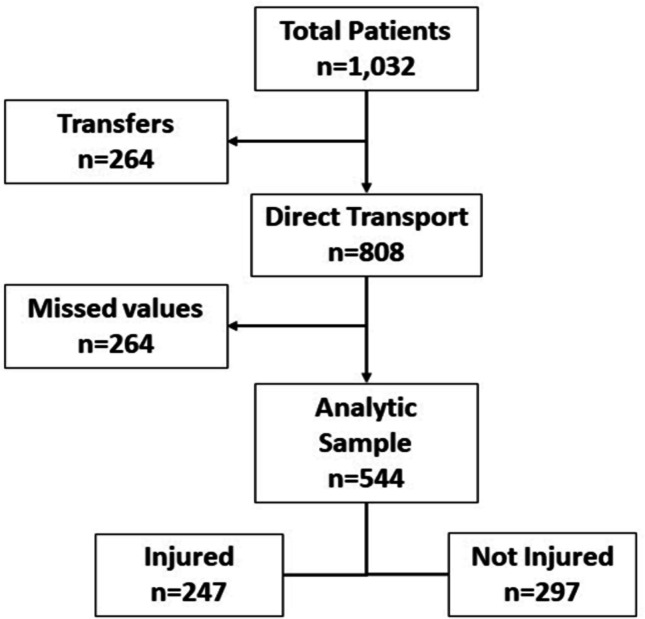
This is a retrospective cohort study analyzing full team trauma activations between February 2018 and January 2020, excluding transfers and those who had missing values for prehospital blood pressure or heart rate. We reviewed patients' demographics, prehospital and emergency department vitals, injury pattern, need for operation, and clinical outcomes. The primary outcome was rate of significant injury defined as identified injured liver, spleen, or kidney, pelvis fracture, long bone fracture, significant extremity soft tissue damage, hemothorax, or pneumothorax.
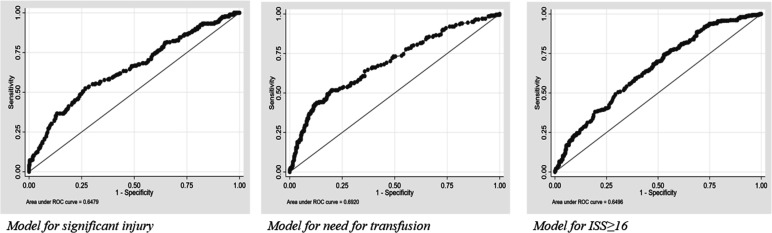
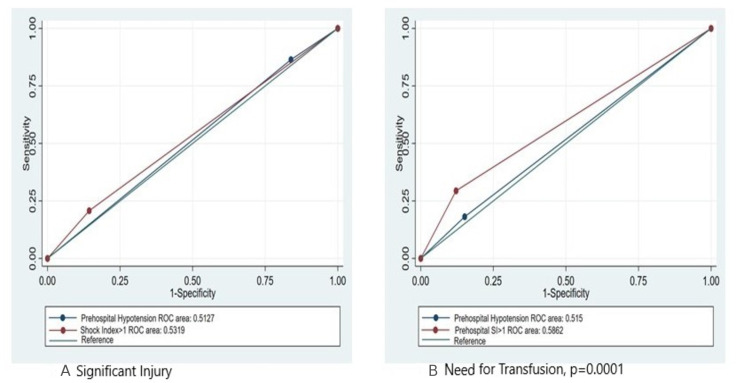
Among 544 patients, 82 (15.1%) had prehospital hypotension and 492 had normal blood pressure. Of the patients with prehospital hypotension, 34 (41.5%) had a significant injury. There was no difference in age, gender, medical history, or injury pattern between the two groups. There was no difference between the two groups in rate of serious injury (41.5% vs. 46.1%, NS), need for emergent operation (31.7% vs. 28.1%, NS) or death (20.7% vs. 18.8%, NS). On the other hand, SI ≥1 was associated with increased rate of serious injury (54.6% vs. 43.4%, p=0.04). On a logistic regression analysis, prehospital hypotension was not associated with significant injury or need for emergent operation (OR 0.83, 95% CI 0.51 to 1.33 and OR 1.32, 95% CI 0.79 to 2.25, respectively). SI ≥1 was associated with both increased odds of significant injury and need for emergent operation (OR 1.57, 95% CI 1.01 to 2.44 and OR 1.64, 95% CI 1.01 to 2.66).
SI was a better indicator and could replace hypotension to better categorize and triage patients in need of higher level of care.
Prognostic and epidemiologic, level III.
美国外科医师学会《受伤患者最佳护理资源》推荐将收缩压≤90 mmHg定义的低血压作为启动创伤团队全面救治的指标。我们假设,升高的休克指数(SI)比单纯低血压能更好地预测严重创伤。
这是一项回顾性队列研究,分析2018年2月至2020年1月期间创伤团队全面救治的情况,排除转院患者以及那些院前血压或心率数据缺失的患者。我们查阅了患者的人口统计学资料、院前和急诊科生命体征、损伤类型、手术需求及临床结局。主要结局是严重损伤发生率,严重损伤定义为确诊的肝、脾或肾损伤、骨盆骨折、长骨骨折、严重肢体软组织损伤、血胸或气胸。
544例患者中,82例(15.1%)院前存在低血压,492例血压正常。院前低血压患者中,34例(41.5%)有严重损伤。两组在年龄、性别、病史或损伤类型方面无差异。两组在严重损伤发生率(41.5%对46.1%,无显著性差异)、急诊手术需求(31.7%对28.1%,无显著性差异)或死亡率(20.7%对18.8%,无显著性差异)方面无差异。另一方面,SI≥1与严重损伤发生率增加相关(54.6%对43.4%,p = 0.04)。在逻辑回归分析中,院前低血压与严重损伤或急诊手术需求无关(比值比分别为0.83,95%置信区间0.51至1.33和1.32,95%置信区间0.79至2.25)。SI≥1与严重损伤几率增加及急诊手术需求均相关(比值比分别为1.57,95%置信区间1.01至2.44和1.64,95%置信区间1.01至2.66)。
SI是一个更好的指标,可以取代低血压,以便更好地对需要更高水平护理的患者进行分类和分诊。
预后和流行病学,三级。